Crosuchan Baillies (Part VI)

William Baillie “Croshucan”

Also in the party of emigrants in May of 1820 was William Baillie styled Crosuchan, and his family.  William and his wife, Christiana Sutherland, lived on Scottarie overlooking Kilbraur.  He was a small tenant of the Sutherland Estate and appears to have had some comparative wealth for the era.  He could read the scriptures indicating that there was some exposure to education.

William and Christiana obtained a 200 acre grant at the top of Church Road.  One can still find the site of the buildings.   He donated a corner of his land for a church and burial ground.  The church never materialized as a more suitable site was later chosen. However the burial ground did come into use around 1824 and is known today as the MacKenzie Cemetery.  Here one can find the graves of William and Christiana as well as many of the Clyne evictees.

Descendants tells the story that William was very devote – so devote that he carried his Bible to the fields each day so he could read passages while resting.

The known issue of this family are:

  1. Marion 1786-1870    unmarried at Earltown
  2. Isabella 1790-1878   married James Sutherland “Buidhe” at East Earltown
  3. Catherine married Peter Gordon, Parish of Dornoch.  This couple had married prior to the emigration era.  Peter was a career soldier.  They remained in Sutherlandshire where descendants can be found to this day.
  4. Christy 1800-1891   married Alexander Douglas of Millbrook, Pictou County.   Alex Douglas was born in Strathbrora in 1800 and had come to Pictou with his parents as a young boy.
  5. Elizabeth 1801-1889  married Alexander Baillie “Buidhe” and was mother to 16 of his 22 children.
  6. George 1805-1830   died unmarried at Earltown
  7. John 1808-after 1871    John never married and inherited the family homestead on the condition that he start treating his sister Marion with more respect.   After John’s death, the farm passed to his niece, Ellen Sutherland MacKay.

William died March 20, 1847 age 87.  Prior to his death, he granted a deed to the MacKenzie Cemetery trustees for 45 shillings.    Christiana died in 1849.

The 22 Baillies (Part V)

Buidhe Baillies

This is the most prolific of the Baillie lines as will become evident in due course.

The earliest named ancestor was Kenneth who lived in Strathbrora, (likely Kilbraur), in the mid 1700’s.  There is no record of his spouse and the only known offspring was a son William, known as William Buidhe or Yellow William.  Buidhe was a descriptor in many families and usually referred to blonde hair.  However these Baillies lived near a small burn named Buidhe on the slopes above Kilbraur.

William would have been born in the 1750’s and was married to Elizabeth MacKay.  He died before the family emigrated in 1820.  They had nine children born in Kilbraur:

  1. Alexander   1782-1866   married 1. Annie Matheson and 2. Elizabeth Baillie.  He was the tireless father of the 22 Baillies.
  2. John Baillie 1784    died in infancy
  3. Christiana 1787-1843  emigrated as a single woman in 1820.  Shortly thereafter she married Alexander MacDonald, a native of Aschoil, who was among the first settlers of The Falls.
  4. John 1788-1866  remained in Scotland in 1820 and married Isabel Sutherland.  They were part of a substantial migration from Sutherlandshire to Earltown in 1832.  This couple settled on Ferguson Road, Balmoral.
  5. Elizabeth 1792-1883 married Alexander Sutherland “Sawyer” in Kilbraur around 1819. Alexander was a veteran of the Peninsular War.  They were the first settlers of The Falls.
  6. Hugh    1795
  7. Janet 1795   These twins did not survive infancy.
  8. Janet 1801-1884  emigrated with her widowed mother and single siblings in 1820.   She married Donald Sutherland “Cairn” of Cnoctorn, Clyne.  They settled on the east facing slope of Spiddle Hill.
  9. Donald 1802  As a lad of 18, he accompanied his mother and sisters to the Earltown district.  After the death of his mother, he left the area and eventually ended up in New Zealand.  It is not known whether he had family.

Widow Elizabeth MacKay, son Donald Baillie and daughters Christiana and Janet are listed as a family among those requesting that the Sutherland Estate extend their lease until the arrival of a ship taking them to America.  Also in this group were her son Alexander and family as well as daughter Elizabeth Sutherland and her husband.  The group sailed from Cromarty in June of 1820 arriving in Pictou a few weeks later.

According to a manuscript penned by Alex Baillie of the Berrichan and Dedham, Ma., Alex “Buidhe” and his family were given a ticket of location in the Blue Mountain area of Pictou County.  Although there were a few families in that area from Sutherland, he decided to forgo that location and settle in the Berrichan next to an Alexander Sutherland.   Sutherland, a native of Dornoch, was on the same ship and the two had become great friends.  Alex Buidhe obtained a grant on the eastern end of the Berrichan near the junction of the Gunshot Road.

Family tradition contains no narrative on where the Widow and her unwed children settled.   The assumption has always been that they would have settled with Alex Buidhe in the Berrichan.  However this appears doubtful as Alex already had a sizable family to maintain with many more on the way.  The most plausible location of settlement would have been The Falls.   Daughter Elizabeth and her husband Alexander had two farms at The Falls.  This was not the norm although war veterans did, on occasion, warrant additional land.  The upper farm, just inside West Earltown, appears to have been the home base of the Sutherlands.  The lower farm later became the home of their second son Gilbert in 1860.  It would seem  the lower farm was inhabited by someone in the family prior to the 1860’s.   The prevailing theory suggests that it was the home of Widow Elizabeth and son Donald.   Although widows with small children sometimes were granted land, this did not appear to be the case for widows with mature children.  On the other hand, Donald was only 18 when they arrived in the area and therefore was too young to qualify.  Alex Sutherland, with his preferred veteran status, may have acquired land for them to occupy.  Other circumstantial evidence is that Christiana married a single man who settled two farms away and Janet married another single settler about a kilometer over the hill. People did not go any further than necessary to locate a mate in those days.

The Baillie’s Part IV

Gilbert’s Hill

Gilbert’s Hill (1) is a landmark on the south shore of Loch Brora and well within the Carroll Estate.  It was also a hamlet containing a number of families who were cleared off the Carroll Estate sometime between 1815 and 1820.  This group appears to have “squatted” temporarily among previous Clyne emigrants in the Caribou area before obtaining land in the Gairloch – Upper Settlement West River area. Among them was the family of George and Catherine Baillie.   They had at least eight children.  Of those, three remained unmarried on the home farm which was located on the edge of the wilderness behind West River Station.  A daughter Annie married Alexander Baillie “Spain” and daughter Isabel married William MacKenzie of Gairloch.

caroll rock 2

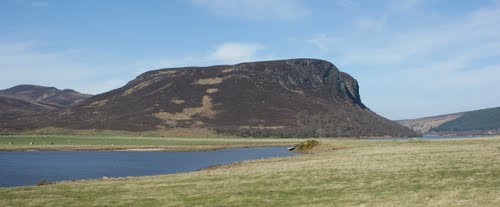
Carroll Rock by Loch Brora.  Gilbert’s Hill is to the back.


(1) Lindsay, N.  Gilbert’s Hill, Carrol, Clyne, Sutherland: A Report on an Archaeological Walk-Over Survey

The Spain Baillies (Part III)

Alexander Baillie “Spain”

The young men of Sutherland were always a valuable asset in time of warfare.  Starting with the tribal warring of local landlords or clans in distant times, there were few generations that didn’t see battle.  For many years the House of Sutherland and its loyal allies, the Murrays, Baillies and others in the south, were at a constant war with the MacKays of the far north and the Sinclairs of Caithness.   When peace came on that front, men were offered up by their landlords to fight for King and country – domestically in the rebellions of 1715 and 1745 as well as in Northern Ireland.  In the period leading up to emigration, many from Sutherland served in the Peninsular War – including Alexander Baillie.

After hostilities ended, Alexander returned to his family in Strathbrora who were living in the township of Torrisilaire.  He and his wife Janet, believed to be a Baillie as well, were wed around 1804.   Between 1808 and 1814 there were no recorded children indicating Alexander was likely absent for most of this time.  Upon return to Strathbrora, prospects were likely bleak.  Peacetime could be just as challenging as war time when men returned to their home parishes with few prospects of obtaining a full lease or employment.  With news of generous land grants in Nova Scotia, it would not have taken much to convince the couple to migrate.  Having sailed back and forth to Portugal, another ocean voyage was not as daunting as to some.

Torrisellar

Near Torrisilaire (c) Peter Moore

Land petitions indicated that they arrived in Pictou sometime in 1814 and went first to West River.  Shortly thereafter they were awarded a 350 acre holding on what would later be the Colchester Pictou county line.  His next door neighbour, Donald MacIntosh, settled across the line in Earltown the previous year.  Fellow veteran, Donald Cameron, took a grant on the hill to the south.  Their exploits and adventures in far off Spain earned the community the derisive name “Spain” and its inhabitants the title “Na Spainach Crosgach” or Bare Footed Spanish.  (1)

As there were many Alexander Baillies in the area throughout the 19th century, bynames or descriptors were a necessity.  This branch didn’t seem to have an all encompassing descriptor at the time but “Spain” had come into use in the 20th century as a means of keeping the genealogies in check.

We have no record of Alexander’s death but Janet passed away on October 30, 1844 age 59.  They are believed to be buried in unmarked graves in Gunn Cemetery near the graves of their two sons.

This group of Baillies were related to those who settled a few years later at West Earltown.  Three generations of both families referred to the other as cousins.  Also, the Baillie family of Gilbert’s Hill and West River Station were also closely connected.  Family tradition claimed that Annie, daughter of Alexander “Spain”, married her first cousin, Alex Baillie, of the West River Station tribe.

Alexander and Janet had nine children known to us:

  1. John   1805-1892,  known as Johnny Poga or Johnny with the sack.  He was a day labourer and carried away leftovers from his host’s meal in a sack over his shoulder.  He was married to a Sally MacIntosh of Roger’s Hill and had four children.
  2. Grace 1808- married Robert Ferguson, a native of Strathbrora, who lived on the Berrichan Road where descendants still live.
  3. William 1814-1896 was known as Quilly as he fashioned weaving needles out of porcupine quills. He and his wife, Helen Sutherland, lived on a road between the Berrichan and Clydesdale Roads. They had nine children.
  4. Donald 1717-1878 married Margaret Murray “Lassie” and settled on the meadows between West Branch and College Grant. They had seven children all of whom left the area and settled around Truro and Tatamagouche.
  5. Annie 1820- married Alexander Baillie of West River Station.  They lived on the home farm and are ancestors to a sizable family in the West Branch area.
  6. Isabel
  7. Janet
  8. George 1820-1882 married Annie MacKay of Dalhousie Mountain.  She was brought up in Earltown.  George and Annie lived on Spiddle Hill.
  9. Hugh 1823-1899 married Catherine Sutherland “Macin” of West Earltown. They lived near the Drysdale Falls.  He was known as “Back Mountain Hugh”.   Descendants lived at Tatamagouche Mountain and Nuttby.

The Baillies (Part II)

Although most of the Baillies emigrated between 1814 and 1832, there was one exception in the late 1700’s.  A John Baillie of Sutherland, likely a soldier in the American Wars, settled on the Pictou – Antigonish border in a place known to this day as Baillie’s Brook.  Patterson in his history of Pictou County mentions that he was from Sutherlandshire but little else is known about him.

Much has been written about the Highland Clearances and, in recent years, more has been learned about the Sutherland clearances.  This was a social-economic experiment in converting from a cattle based economy to a sheep and wool industry.   The principal landowner of the day, the Countess of Sutherland, was counselled to clear out her small tenantry and create vast sheep farms.  There were many practical aspects to such a policy.  There would only be a handful of tenants to administer, the labour would be a fraction of what was required for cattle and the returns would be many times greater.

The disposition of the people was the main problem.  However the Estate made plans to relocate the small tenants and lotters to the coast where they would be employed in either the fishery, the local coal mine, the salt pans or, later, a distillery.  This did not go over well with the tenants.  They had been cattlemen for generations and had no love of either sea or coal pits.  Those with money made plans to emigrate to Nova Scotia.  Those without means rebelled.

The politics and atrocities are beyond the scope of this post.  In summary, a few leaders managed to extend their leases for a brief period, some were forcibly evicted,  the minister sided with the landlord, the military was brought in to finish the evictions, etc..   The end result was that a vast swath of the Parish of Clyne, including Kilbraur, was cleared of all its people and their homes were destroyed.

The next known Baillies to arrive in Pictou was an early player in this mass eviction.   Robert Baillie and his wife Marion (Margaret) were living near Kilbraur on lands that were part of the Carroll Estate.  The Gordon family had owned the Estate for several generations however the last resident owner, John Gordon, died in 1807 leaving his family with massive debts.  To clear the debt, his son and executor, Joseph Gordon sold the estate to the Countess on the condition that the tenants would not be evicted.  That promise was empty and the Sutherland estate began clearing Carroll in 1813.  (Joseph Gordon, greatly vexed by the broken promise, would become instrumental in relocating the evictees to Nova Scotia).

Robert Baillie, in a family of seven, arrived in Pictou in 1814 along with five other families from the same neighbourhood.  Their land petition, unique in its narrative, explains that the memorialists emigrated from the county of Sutherland in North Britain this month and had done so in consequence of their having been turned out of their possessions to make way for sheep dealers and were thus looking for asylum in Nova Scotia. They had certificates of character from their parish minister, “and have nothing to recommend them further but to assure your Excellency that they were faithful subjects at home to his Majesty and will now so continue.’

The group were awarded a generous 1400 acre swath of forest extending from Saltsprings to Lovat in Pictou County. This began the allure of a new life in a distant colony where one could own one’s farm and, for a pittance of taxes, be free of landlord whims forever.

THE BAILLIES

Part I

Baillie does not immediately come to mind when thinking of Highlanders who settled the forests of Northern Nova Scotia, yet they are a family at the root of many genealogies of the people of Earltown and West Branch.    Although the name appears among the clans of Scotland, family would be a more apt description in Nova Scotia as they all seem to share a common ancestor not too many generations before emigration and most came from a very defined locale in the Parish of Clyne, Eastern Sutherland.

There is a consensus among scholars that the family evolved from the Baliol bloodline, a noble family that entered the British Isles in the time of William the Conqueror. From there, they migrated north into the Lowlands.  Among their ilk was King John Baliol, a successful competitor to the Scottish throne with the backing of King Edward I of England.  King John abdicated the throne after losing to the English in 1296. His extended family, wisely, fell into line behind the successors to Robert the Bruce.  It was during this era that the family changed the name to Baillie to distance themselves from the unpopular King John.

The new name and new alliances quickly brought titles, lands and recognition to the clan.  The main line became associated with Lamington, a parish in Lanarkshire.  Sir William Baillie 2nd of Lamington married Isabel Seton, a lady with ancestry in many of the powerful families of Scotland as well as being a great granddaughter of the Sinclair Earl of Orkney and thus carrying the royal blood of Norway.  Of this union came Lady Margaret Baillie, wife of the 7th Earl of Sutherland.

There is no hard evidence of the birth of Lady Margaret but it is known that she died in late 1509 or early 1510 aged approximately 95 years.  Her husband, John, was bestowed the Earldom in 1442.  All subsequent Earls or Countesses descended from this union.  She was noted as being a woman of considerable beauty.

It has long been told that the Baillies became a fixture of the Sutherland landscape with the marriage of Lady Margaret to the heir apparent of the Sutherland title.  In those dangerous times, when marriage was often a means of a strategic political alliance, one might assume that Sir William Baillie sent an entourage of dependable cousins to ensure the safety and proper treatment of his young daughter.


Lives of the Baillies by James William Baillie of Culter-Allers has one sentence about the settlement of Baillies in Sutherland:  Certain persons from Lamington of the name of Baillie went to Sutherlandshire with Margaret Baillie,Countess of Sutherland, who have ever since been officers of the Sutherland family.. (1)

Another reference to the family dates to 1589 when Angus Baillie of Uppat effected the rescue of the Earl’s forces from a battle of vengeance with the Caithness men.

The family was planted in the Parish of Clyne, an area that was held directly by the House of Sutherland and not by intermediary gentry.  The designated area appears to be have been at the upper end of Loch Brora in the vicinity of Kilbraur and extending down the south bank of the Loch.   A brook or burn that enters the Brora near Kilbraur was commonly known as Baillie’s Burn although it is on the ordinance survey maps as Scottarie Burn.

Kilbruar

The area to right of the right of River Brora, where it enters the Loch, is the homeland of many Baillie families as well as others who settled around Earltown, Nova Scotia.

It is in this township that we find most of the Baillie families that migrated to Pictou during the Sutherland clearances.  While there were a couple of families with homes a few miles upstream, most were small tenants in Kilbraur or on the nearby hill of Scottarie.

Few stories of their life in Strathbrora survive in Nova Scotia, the narrative being lost along with the Gaelic language.  We do know that they were small farmers.  Some held their holding direct from the Sutherland Estate.  Others were subtenants.  The tenants seemed to have some modest means with a cash income from selling cattle to the south.  The subtenants were of very limited means.   The structure of their farming was much different from Nova Scotia.  They had strips of arable land in the river valleys and then shared common pasturage in the hills.  Instead of isolated farmsteads, the homes were clustered in townships with the fields scattered nearby.

Education was limited.  A few were able to attend a nearby parish school when it operated. Some learned to read while working for periods in the south.  Many never learned to write.  Many of the original land papers in Nova Scotia are executed with their “x” in lieu of a signature.

What they lacked in reading and writing skills was compensated by a profound ability to remember and reason through anything they had heard.  This was particularly true with respect to scripture and religious dialogue.  Scripture could be quoted at length and sermons heard in distant parishes were recited back to those unable to travel.  In many instances these men were far more familiar with the Bible than the local minister and, in the case of Clyne, more inclined to follow its teachings.  There were two Baillies who were remembered for generations in Clyne due to their grasp of religious doctrine,  Angus Baillie and George Baillie. (2)

(1)  Baillie, James William  Lives of the Baillies, Edmunston and Douglas, Edinburgh, 1872

(2)  Munro, Rev. Donald, “Records of Grace in Sutherland”, Free Church of Scotland 1953 (A biographical collection compiled by Rev. Munro of Rogart in the mid 1800’s)
Earltown Heritage Sunday Update

Thanks to all who braved the heat and humidity to attend our function in the Church Cemetery this afternoon.  In addition to the locals, we had people from New Brunswick, (and formerly Quebec), Ontario, Alberta, British Columbia and New England.

We raised approximately $400 to go towards the maintenance of the cemetery.


Gunn Cemetery Update

Good news!

A group of volunteers met in Earltown on June 24th to put in motion the Gunn Cemetery Association.  The cemetery has been kept in excellent shape by a number of interested individuals  over the past few decades.  However there has never been a board, bank account or resources to maintain stones and secure the site.

Last year’s tour raised over $600 towards starting a fund.  We will soon have a formal account and be in the position to accept donations.   Donations will be used to repair the oldest stone, improve signage and install an information box where there will be a guest book and information on the cemetery.   We are also obtaining a deed to the land so that it will properly registered.  The day may come were we should be paying for the upkeep of the grounds and repairs to the access.

Donations for the upkeep of the cemetery are gratefully accepted but we do not have charitable status so CRA tax receiptscannot be issued.
Cheques can be made out to the Gunn Cemetery and mailed to:
        Gunn Cemetery
        c/o Joyce Ferguson
        7787 Hwy 311, The Falls
        RR #5 Tatamagouche, NS
        B0K 1V0
For security reasons please do not leave cash or cheques in the mailbox
For information  on the history of the cemetery contact:  Glen Matheson 902-957-0532  gmmatheson@gmail.com


Earltown Heritage Sunday: In the Shadow of the Church

Earltown was a remarkable community in the 1800’s.  Its hills and valleys were thickly populated with over 1,000 highlanders and it also served as a trading center for nearby communities in Pictou and North Colchester thus extending its influence  over 2,000 souls.

And souls were of great import to these emigrants who arrived with little more than an axe and a bible.  They belonged exclusively to the Church of Scotland, (later evolving into the Free Church of Scotland), and worshipped in their native Gaelic tongue.  The clergy, elders and catechists commanded great respect and exerted considerable influence over all aspects of life in the area, whether it be religion, education, justice or social welfare.

In due course a church was erected in the geographic centre of the district. Like in their home parishes of Eastern Sutherland, a cemetery was established in near proximity.  A second church was erected in the late 1860’s to accommodate the growing congregation.  Like in many rural communities, the congregation dwindled and the building had to be removed in recent years.

Knox

This is the 8th in a series of annual presentations by Glen Matheson, local historian, on the social history of Earltown.  In addition to an overview of the history the Knox Presbyterian Church, there will be the customary tour of the adjacent cemetery with stories of the early settlers who chose to be buried in the shadow of the church.

The presentation will be Sunday July 29th at 3PM at the Earltown Church Cemetery,  Highway 326, two kilometers north of Earltown Village.   Scots will be pleased that there is no admission however donations towards the upkeep of the cemetery would be appreciated.

Earltown Church Cemetery

Colchester Heritage Award

TN-A03-26022018-Glen_Matheson_large

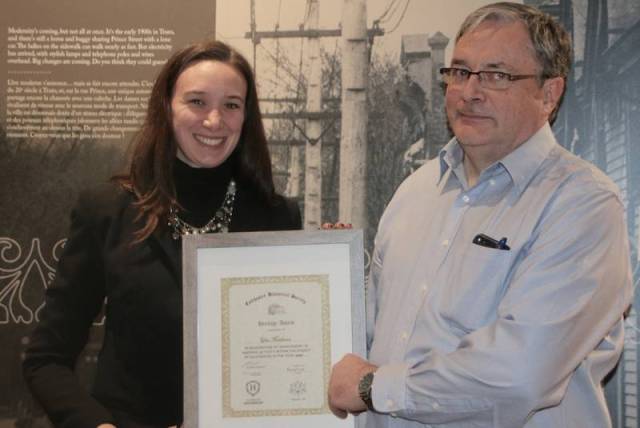
Margaret Mulrooney, curator at the Colchester Historeum, presents an award to Glen Matheson, in appreciation for his work in researching, preserving the history of the Earltown area. He maintains an Earltown heritage blog. – Lynn Curwin

It was an honor to have been selected for this award.  When I started out on this journey in the 1970’s,  G.R. Sutherland’s “Rise and Decline of the Community of Earltown” (1) had yet to be written.  “The Historical and Genealogical Record of Colchester County” (2), aka The Miller Book was silent on the area.  The “History of Tatamagouche” (3) provided a footnote.  Isreal Longworth, in 1866, did provide a brief narrative in his “History of Colchester County” (4).   I was convinced that there must have been a richer history awaiting discovery.

I had the good fortune of being raised on a multi-generational farm and met many of my grandparents’ generation who would visit our home at Balfron.  The topic of conversation would often venture into family history and stories of people in the surrounding communities.  Three of my grandparents were descendants of the people who settled at Earltown and the sister communities of West Branch and Scotsburn.  The remaining grandparent was the descendant of the Montbeliard and Lowland settlers of Tatamagouche and New Annan.

My early research took me into the homes of the elderly of Earltown, The Falls, Balfron and Tatamagouche Mountain.  These people either remembered the child settlers or the first generation to be born in those hills.  Some thought genealogy was a waste of time as everyone in those parts were related.  That turned out to be nearly true so the question became not  to whom were we related but how were we related.  A couple of trips to Sutherlandshire brought a new dimension to the story and things evolved from there.

Two mentors come to mind.   Gladys Sutherland MacDonald had a treasure of information gathered over her lifetime which she shared without hesitation.   Margie MacKenzie Wilson offered great encouragement and freely gave me most of her intellectual property.  I also have to mention my great aunt, Reta Murray MacRae.  She had scrapbooks of old newspaper obituaries which I would pour over in the dim light of her kerosene lamp.

A book has always been a goal but finding time to work on one has been a challenge.  Consequently this blog was formed to share some of these stories and findings in case the book never happens.  Unfortunately the frequency of posts has not been to my satisfaction.  We do what we can.

In addition to connecting with some fine people of the Earltown diaspora throughout the continent, the blog has opened a few doors with historians in Scotland who are studying emigration from Sutherlandshire as well as matters of faith and gender.  This led to frequent correspondence with Professor James Hunter while he was writing “Set Adrift Upon the World – The Sutherland Clearances”,  during which we were able to connect the dramatic events in the clearance of Clyne with the settlement of The Falls and West Earltown.  Prof. Elizabeth Ritchie of the University of the Highlands and Islands in Dornoch has been a tremendous help in understanding the lifestyle and faith of our people at the time they emigrated.  I also have to mention Dr. Malcolm Bangor-Jones of Lochinver, long time correspondent, who saves me from myself when writing about things that I don’t fully understand.

It is my understanding that some regular followers of this blog submitted nominations.  Thank you !

The accompanying article has a couple of facts slightly off, (my fault), but otherwise correct.   Here is the link to the  Truro Daily News article.

(1) Sutherland, G.R., The Rise and Decline of the Community of Earltown, Colchester Historical Society, Truro, NS 1980
(2) Miller, Thomas, The Historical and Genealogical Record of Colchester County, A.W. McKinley, Halifax, NS 1873
(3) Patterson, Frank, History of Tatamagouche, Royal Print and Litho Co., Halifax, NS 1917
(4) Longworth, I., History of Colchester County, circa 1886