A MOMENT IN TIME – Sept 12, 1891

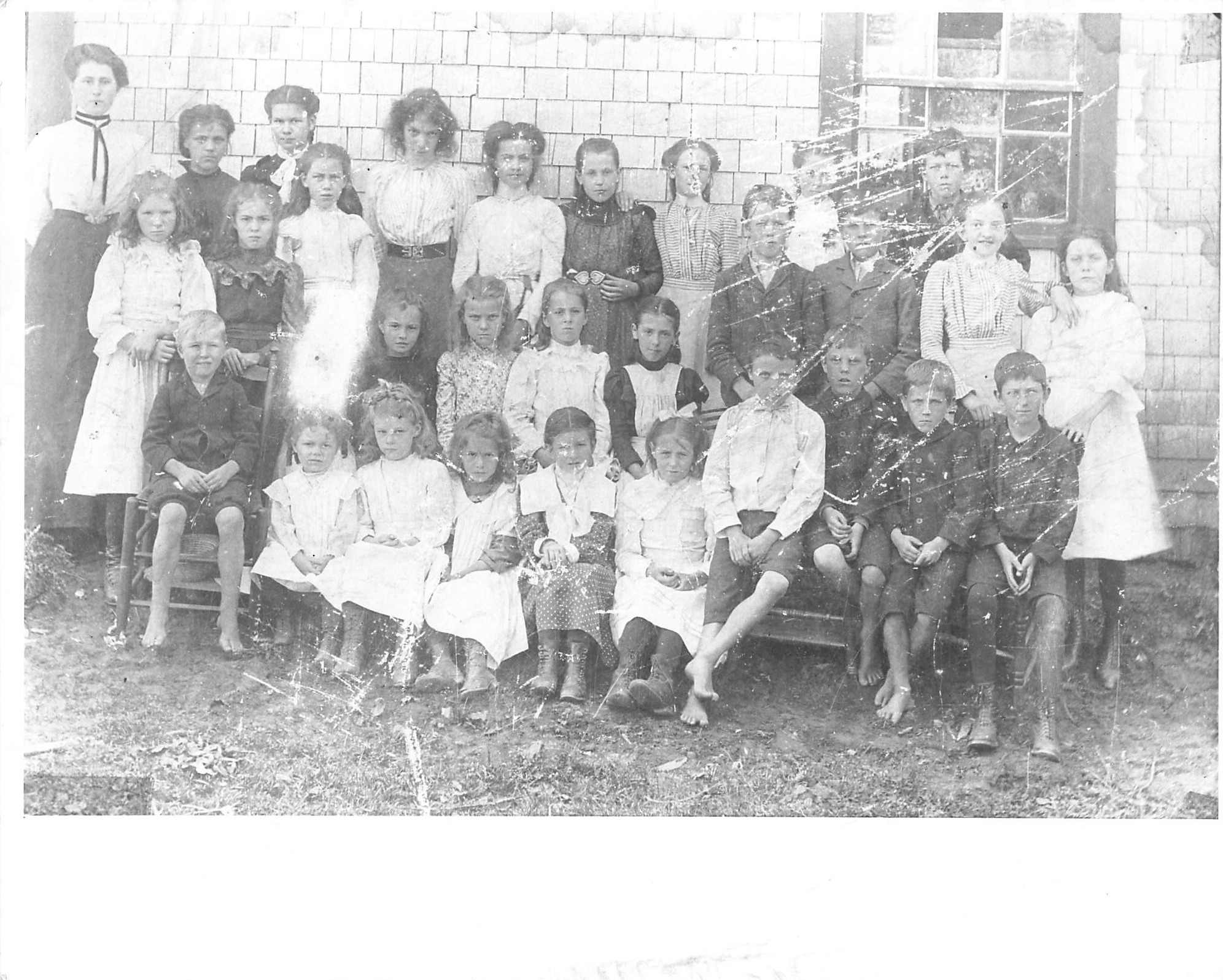
Almost 50 years ago, I was shown a group photo that has stuck in mind every since. I was visiting with our neighbours, Margie and Lawrence Wilson, where I spent many evenings mining their memories of stories, events, and people long gone. On that particular visit, an old chest was brought out containing a variety of family artifacts.

In the chest, among many interesting things, was a professional photograph taken in the 1890’s of a group of people assembled in or near Earltown Village. I didn’t realize at the time that there was a list of names, as Margie was able to rhyme off the people from memory – Little Donald, Johnny Lake, Janey Miller, etc.. A mental note was made to return and get a copy and the names. That never happened.

Fast forward to 2022 – an email arrives from Kathryn Graham of Edmonton. She was forwarding a group picture that belonged to her grandmother, Gladys Sutherland MacDonald. There were no names attached but I was certain it was the same picture.

A few days ago I ran into Frank Wilson of New York State, son of the Wilsons, home for a visit. I mentioned the picture and he was able to retrieve it as well as a complete list of names. His copy was found in the ruins of the house last inhabited by Johnny Murray “Bible”.

This was intended to be a quick post. However, I went down a rabbit hole and the results are in an expanded list later in the post.

Hopefully, some of you will be able to put a face to an ancestor or relative.

Earltown Sept 12th, 1891

Back row: left to right: John Murray “Bible”, Charlie Lynch, John MacBeth, Dan Murray “Hemlock”, Billie Lynch, Tom MacKay “Caribou”, Jim MacDonald “Uhr”, Hannah MacDonald, Mrs. John L. Sutherland, Mrs. William Sutherland “Ban”, Mrs. Alex MacDonald of Balmoral (Liney Lynch), Bessie “Lake”, Christine Murray, Dannie Munro

Second row: Janie MacKay, Mrs. Donald Sutherland, Donald Sutherland “Little Donald”, John Sutherland “Zink”, George Payne, John Murray “Hodge”, Will Murray, ____ son of Robert Murray, Sandy MacIntosh, George MacIntosh, Alex Sutherland (child on knee), Sandy Baillie with Geo. Willie Sutherland on knee, Victor “Miller”, John MacIntosh, Liza Sutherland “Lake”, Annie Lynch, Mrs. Dan Munro “College”, Dan Munro

Third row: Mrs. John MacBeth, Ena MacKay, Jennie Baillie, Peggy MacIntosh w/ Angus MacIntosh on knee, Kate Payne, Dan Sutherland, Alex Murray “Stager”, Mrs. Dan MacKay (Jennie Belle Sutherland), Mary MacKay (Mrs. Bob Deacon), Hannah MacDonald, Belle Ferguson, Ellen Taylor, Mrs. Jim Sutherland (Annabel), Christy MacDonald

Fourth row: Bob Sutherland “Lake”, John Sutherland “Lake”, Sandy Lynch, Jimmie MacDonald “Lexi”, Billie MacKay “Deacon” Bob MacKay “Murdoch’s Son”, John S. MacKay (Dr. J.S.), Rev. George Sutherland “Mighty”, Ida MacKenzie, Agnes Miller, Bessie MacKay “Deacon”

Fifth row: Billie “Miller”, Kennie MacKay “Deacon”, Margaret Baillie, Annabel Murray, Sarah Murray, Liney MacKay, Ellen MacKay “Hatch”, Bessie or Marion Sutherland “Mighty”, Maud MacKenzie, Hattie “Miller”

Front row: Neil Murray, Dave MacDonald, Sandy Douglas, Clarke (?) Sutherland

Who is who?

Back Row

John Murray “Bible” aka Johnny Bible, lived on a farm across the road from Knox Cemetery with his bachelor brother Alex. They were part of the Ardachu Murray clan. Johnny married Annie Taylor in 1914 but the marriage was short-lived, an oddity in those times.

Charlie Lynch lived at the top of Gunn’s Hill. His farm is now a large blueberry plantation. He was still single in 1891 and a few years later he married Christy MacDonald who grew up on Sutherland Road, Nuttby. They had two children, Russell and Annie.

John MacBeth was originally from Six Mile Brook and lived in the village opposite the store. He was married to Dolina MacKay “Miller”, only daughter of Angus MacKay “Miller”.

Dan Murray “Hemlock” was from Murrayfield, between West Branch and Scotsburn. The Hemlock Murrays had several ties to Earltown. Dan was married to Mary Sutherland, the youngest daughter of Alex and Nancy Sutherland “Ballem”, and they took over the Ballem farm on Gunn’s Hill. They had no family and were attended to in later years by Dan’s niece, Catherine Murray Gunn and her family, hence the local descriptor, Gunn’s Hill.

Billie Lynch was a brother of Charlie Lynch. He died in Lexington, Ma., five years after this photo was taken.

Tom MacKay, commonly known as Tom Caribou, was born and raised in the Berichon. He married Mary C. “Minnie” Murray “Gorm” of Clydesdale. They lived for a few years in the Berichon before moving to the old Nicholas Sutherland farm on the meadows north of the village.

Jim MacDonald, possibly misidentified as the brother of Hannah MacDonald standing next to him. There is another Jim MacDonald “Lexi” identified in the fourth row. This gentleman is probably Thomas Cannings, husband of Hannah MacDonald.

Hannah MacDonald, daughter of Hugh MacDonald “Uhr” and Lexi MacDonald “Paulie”of Earltown Village, would have been Hannah Cannings at this point, home on a visit from Massachusetts. She was married to Thomas Cannings of Newfoundland. They moved to Seattle.

Mrs. John L. Sutherland was Janie Sutherland, daughter of Little Donald Sutherland of the Loib Bheg Sutherlands and Christena Matheson. She and John “Mighty” lived at Central Earltown. They were the parents of George R. Sutherland, the author of the ‘Rise and Decline of the Community of Earltown”, and of Gladys MacDonald, a fountain of local history and genealogy.

Mrs. Wm. Sutherland “Ban” was born Maria MacKay “Marroch”, daughter of Strachan and Eliza MacKay who lived on what is now the large blueberry plantation as you start in the Alex MacDonald Road. Her husband, Billy “Ban” Sutherland was from The Falls.

Mrs. Alex MacDonald, Balmoral, was born Willena (Lina) Lynch at the top of the Gunn’s Hill and sister to Billie and Charlie. She was the wife of A.L. MacDonald who operated the historic grist mill at Balmoral Mills. He was originally from Sutherland Road, Nuttby.

Bessie Lake is Bessie Sutherland who lived with her unmarried brothers and sisters on a farm between Gunn’s Hill and Earltown Lake. They were of the Loib Bheg tribe of Sutherlands.

Christine Murray – There was no descriptor provided on the list so she could be one of three of that name living in Earltown at the time: Christena “Og” of Rossville, Christena “Og” of Creelman Road or Christine Murray of Spiddle Hill.

Dannie Munro was most likely Daniel Munro born in 1874 to Hugh Munro “Colin” and Henrietta Murray, Stewart Road. He married Margaret MacKay of Back Mountain.

Second Row:

Janie MacKay would be Mrs. John MacKay “Miller”. She was one of the “Canada” MacKays from Clydesdale Road. Her husband operated the grist mill in Earltown Village.

Mrs. Donald Sutherland, wife of Little Donald, was born Christena Matheson at Matheson Corner.

Donald Sutherland, better known as Little Donald to distinguish him from his uncle, Big Donald Sutherland. He was born at Central Earltown and was one of the Loib Bheg tribe. Little Donald was a carpenter, coffin maker and served in the capacity of undertaker before that profession was common in rural areas. Little Donald and Christena lived behind the village in what is now the home of Christene Lynch.

John Sutherland “Zink” also known as Red John Sutherland, lived on the Matheson Corner Road. He never married but brought up his sister’s son, Alex W. Sutherland, Piper.

George Payne – A George Payne was born in the Berichon in 1849 and migrated to Minnesota in 1870. He married Jessie Gunn whose parents lived at West Earltown before moving to Stellarton. It is possible George was home to visit his siblings in the Berichon but people rarely returned from the west. The man in picture may be George’s brother Angus Payne who was living on the family homestead in the Berichan in 1891. Angus and his family moved to North River around 1900.

John Murray “Hodge” was one of the Stager Murrays who lived a short distance from the village on the Denmark Road. The year after this picture was taken, he married Mae Sutherland “Dearg” of East Earltown and moved in with her family at MacBain’s Corner. They had two children, Geordie Murray in BC and Jennie “Hodge” MacDonald, West River.

Will Murray – a very common name but possibly William Murray “Og” of Creelman Road who settled at North River and established a dairy farm. William “Og” was married to Carrie MacKenzie of MacKenzie Settlement.

_______ Murray, a son of Robert NFI

Sandy MacIntosh, married Margaret Crowe and lived in Port Blakely, Washington, where he was a merchant.

George MacIntosh, brother of Sandy and son of George and Peggy MacIntosh, remained on the family farm most of his life. He married Josie MacLeod of College Grant.

Alex Sutherland, on knee of George MacIntosh, was the son of Little Donald and Christena Sutherland. He was an educator and Dean of Science at Acadia University.

Sandy Baillie was born on the Gunshot Road deep in the Berichon and was one of the Buidh Baillies. He was a merchant of the store later operated by Doug MacKay. He married Janet MacKay of Earltown Village, daughter of William J. MacKay, an earlier merchant. The Baillie’s had no family.

George Willie Sutherland, (on Sandy Baillie’s knee), was the youngest son of Little Donald Sutherland. He married Annie MacKenzie of West Branch. They lived for many years in New Westminster. George Willie returned to Earltown after he retired and built the house next to the United Church.

Victor Miller is actually Victor Neil MacKay of the Miller MacKays. Doctor Victor practiced in Halifax and also lectured at the Dalhousie Medical School. He never married.

John MacIntosh, another son of George and Peggy MacIntosh. He died ten years later.

Liza Sutherland “Lake”, one of the eleven children of James Sutherland “Lake” and Christy MacKay “Magomish”. She never married and is believed to have lived her whole life on the family homestead.

Annie Lynch was a sister of Charlie and Billie Lynch and daughter of Charles Lynch and Jane MacKay “Boodle”. Annie married Hugh W. MacKay “Canada” at Balmoral. Their only son, John Will MacKay “Canada” lived in Idaho and Washington.

Mrs. Dan Munro “College” was born Dolina Sutherland “Lake”, on of the eleven children of James and Christy Sutherland.

Dan Munro, husband of Dolina, was born on the mountain between Earltown Lake and Kemptown. They moved to the College Grant Road where family live to this day.

Third Row:

Mrs. John MacBeth was born Dolina MacKay “Miller” daughter of Angus MacKay, a tanner and miller with his brother John.

Ena MacKay NFI

Jennie Baillie, the wife of the merchant, Sandy Baillie, was born in Earltown Village to Wm. J. MacKay, JP and Janet Murray “Stager”

Peggy MacIntosh, born Margaret Munro, was a daughter of Alex and Ellen Munro, East Earltown. She and her husband George lived on the original MacIntosh homestead northeast of the village. They had seven offspring.

Angus MacIntosh, on Peggy’s knee, was the youngest son. He died the following year.

Kate Payne was the daughter of Angus Payne and Sybella Henderson who lived on the farm later inhabited by Lorne Murdoch and family. Kate married Kenneth MacLean of Louisville. They owned and operated a general store in Denmark for many years before selling to the MacLeod family. Among Kate’s five children, one son was a physician in Scranton, Pa., another son was a renowned eye specialist in Baltimore, one daughter was a professor of nursing in the US, and another daughter was an orthoptist whose patients included the Eisenhaurs and others in power.

Dan Sutherland, most likely “Danny Chi” who lived on the Captain’s Road in the Clydesdale. In retirement, he and his wife Bessie MacKay lived in a small house near the village school.

Alexander Murray “Stager”. Stager was a descriptor of the Murrays descended from Robert Murray, a plasterer (working on staging), who settled a farm on the first farm on the left, leaving the village towards Denmark. Alex was a son of the settler who helped bring up his two nephews, John “Hodge” and A.A. Murray.

Mrs. Dan MacKay, formerly Jennie Belle Sutherland of the “Lake” family, was the lady of the house now in ruin at Rossville. (See this post on that house). She died at the age of 29 along with an infant daughter. Her husband, known as Danny MacKay “Ross”, went west to Trail, B.C. where he married and Englishwoman before returning to Nova Scotia and establishing a dairy farm in Lower Onslow.

Mary MacKay was born in the Clydesdale to Paul MacKay “Canada” and Ellen Taylor. Five years after this picture, she would marry Bob MacKay “Deacon” and live on the farm between the Berichon Road and the community hall.

Hannah MacDonald would be a cousin of the other Hannah MacDonald in the back row. She was of the “Uhr” line on the Kemptown Road. She died unmarried at the home of her brother Jim, MacLeod Road, The Falls.

Belle Ferguson was a milliner who lived in a small house in the village where she made hats for the ladies of the community. Women needed to cover their heads while in a church or at a formal function; therefore, there was a steady market for her products. She was from Rossville.

Ellen Taylor of Taylor Lake, a daughter of John Taylor and Marion MacDonald, married John Peberdy, an Englishman, in Quincy, Ma., two years later. They later moved to Harford, Ct. where Ellen died in 1957.

Mrs. Jim Sutherland was born Annabel Sutherland, daughter of Little Donald and Christy. Jim Sutherland was of the “Ruidh” tribe of Sutherlands at The Falls. They lived at the upper end of the Jim Sutherland Road, Waugh River.

Christy MacDonald, most likely “Christy Paulie”, one of the several unmarried children of William MacDonald “Paulie” and Jane Matheson who lived at the end of the Alex MacDonald Road. In the 1900’s she moved in with her brother Paul who had a small farm near MacLeod Road at The Falls. She died at The Falls in 1911.

Fourth Row:

Bob Sutherland “Lake”, another of the eleven children of James and Christy Sutherland. Three years after this photo, Bob married Martha Sanborn in Boston and eventually settled at Thornton, New Hampshire. He was a teamster.

John Sutherland, aka Johnny Lake, never married and was the last of the Lakes to live in Earltown. He died in 1944.

Sandy Lynch, another of the children of Charles Lynch and Jane MacKay, Gunn’s Hill. Sandy married Jennie Baillie of The Falls. They lived near the top of the Nuttby Road in the house that was a picturesque ruin for photographers for the latter half of the 20th century. George Lynch of Earltown Village was a son.

Jimmie MacDonald “Lexie” would have been a brother of Hannah in the back row and the son of Hugh MacDonald “Uhr” and Lexi MacDonald “Paulie”. The family lived on the original Paul MacDonald place near the village end of the Berichon Road. Three years later Jimmie met and married Eliza Bell Sutherland of River John in Cambridge, Ma.. They moved to Seattle where Jimmie died in 1933.

Billie MacKay “Deacon”, son of William MacKay “Deacon” and Eliza MacKay “Black”, went west to Washington State where he became a carpenter. He lived near Woodland and died in Vancouver, Washington.

Bob MacKay was a son of Murdoch MacKay “Tailor” and Mary Murray “Corrigan”. He was born and brought up the original “Tailer” farm on Solitude Lane. Bob married Jane MacLeod of The Falls and farmed at Marshville.

John S. MacKay better remembered as Dr. John St. Clair MacKay, was a son of “Miller” John MacKay and Janie MacKay. He married Jessie, daughter of Paul MacKay “Canada” and Ellen Taylor, Clydesdale. He practiced for a time in the Earltown area before moving to Windsor, Nova Scotia.

Rev. George Sutherland would have been a student in 1891, likely home from college at the time or possibly teaching school to pay his tuition. He was son of John Sutherland “Mighty” and Margaret Murray. He was an ordained Presbyterian minister who served in Phoenix, BC; British Guiana; Sunnybrae, Pictou County; Kensington, PEI; and Wilkie, Sa.; He was also the principal of the Battleford School and Home.

Ida MacKenzie was the daughter of Duncan and Emily MacKenzie who lived briefly in the old Earltown Hotel behind the school. Duncan was a mail courier originally from Dalhousie Mountain.

Agnes “Miller” is properly Agnes MacKay, sister of Dr. J.S. and Dr. Victor MacKay. She died four years later.

Bessie MacKay “Deacon” went west to join a large extended family at various points on the west coast. later in life she married William Crichton of Seattle.

Fifth Row:

Billie “Miller” (William Peter MacKay), another of the large family of Miller John and Janie MacKay, never married and died three years later.

Kennie MacKay “Deacon”, a son of William and Eliza MacKay, went to BC around 1899 and worked as a blacksmith in the Abbotsford area.

Margaret Baillie NFI

Annabel Murray was born in Clydesdale to Alex Murray “Inchure” and Ellen Sutherland. She spent a few years in the United States before returning to the family farm to help her brother Duncan. She died in Pictou in 1968.

Sarah Murray, sister of Annabel, also lived with her brother Duncan in Clydesdale and also died in Pictou.

Liney MacKay, possibly Willena MacKay, daughter of Wm. J. MacKay and Janet Murray. She married John Simon MacLeod of New Lairg who held various positions in the postal services in Halifax.

Ellen MacKay “Hatch”, Hatch being a descriptor of unknown origin for the family of Murdoch MacKay “Tailor” and Mary Murray “Corrigan”. Ellen went west and met up with Peter Morrison, a native of West Earltown, who had a citrus ranch in San Dimas, California. They were married later in life and had no family. They would vacation frequently in Earltown.

Bessie or Marion Sutherland They were the youngest of John Sutherland “Mighty” and Margaret Murray. Bessie married Alex Wm Baillie of the Berichon and lived in Dedham, Ma.. Marion, a teacher, married Peter MacDonald, Balmoral Mills.

Maud MacKenzie was a daughter of Duncan and Emily MacKenzie. She married Thomas Dunn of Halifax.

Hattie Miller, properly Hattie MacKay, daughter of “Miller” John and Janey MacKay. She never married and died in 1933.

Front Row

Neil Murray, likely five year old Neil Dan Murray of Back Mountain, son of John Murray ‘Og’ and Alexandrina MacDonald. He became a blacksmith and moved to Cape Cod where Hugh Baillie of the Berichon was manufacturing equipment for the cranberry industry. He married Reba Griffith.

Dave MacDonald, “Davie Paulie” who lived with his siblings at the end of the Alex MacDonald Road. He was an eccentric sort who constantly travelled throughout the countryside on foot. He proposed to a distant relative in Scotland who accepted, came to Earltown and reconsidered – probably because he sent her the photograph of a more dapper looking cousin.

Sandy Douglas, originally of Taylor Lake Road, lived for several years on the Alex MacDonald Road and later on the property now known as Maggie’s Farm. He was a son of James Douglas and Ellen Sutherland “Ballem”. He was an auctioneer.

Clarke (?) Sutherland The author of the list was not certain of the first name. There is no record to date of a Clark Sutherland in North Colchester or West Pictou.

Acknowledgements:

Frank Wilson, Upper New York and Waugh’s River, for the loan of the original photo and the list of names.

Kathryn Graham, Edmonton, for a clearer digital version

Earltown’s First Murderer – Domhnall Caimbeul

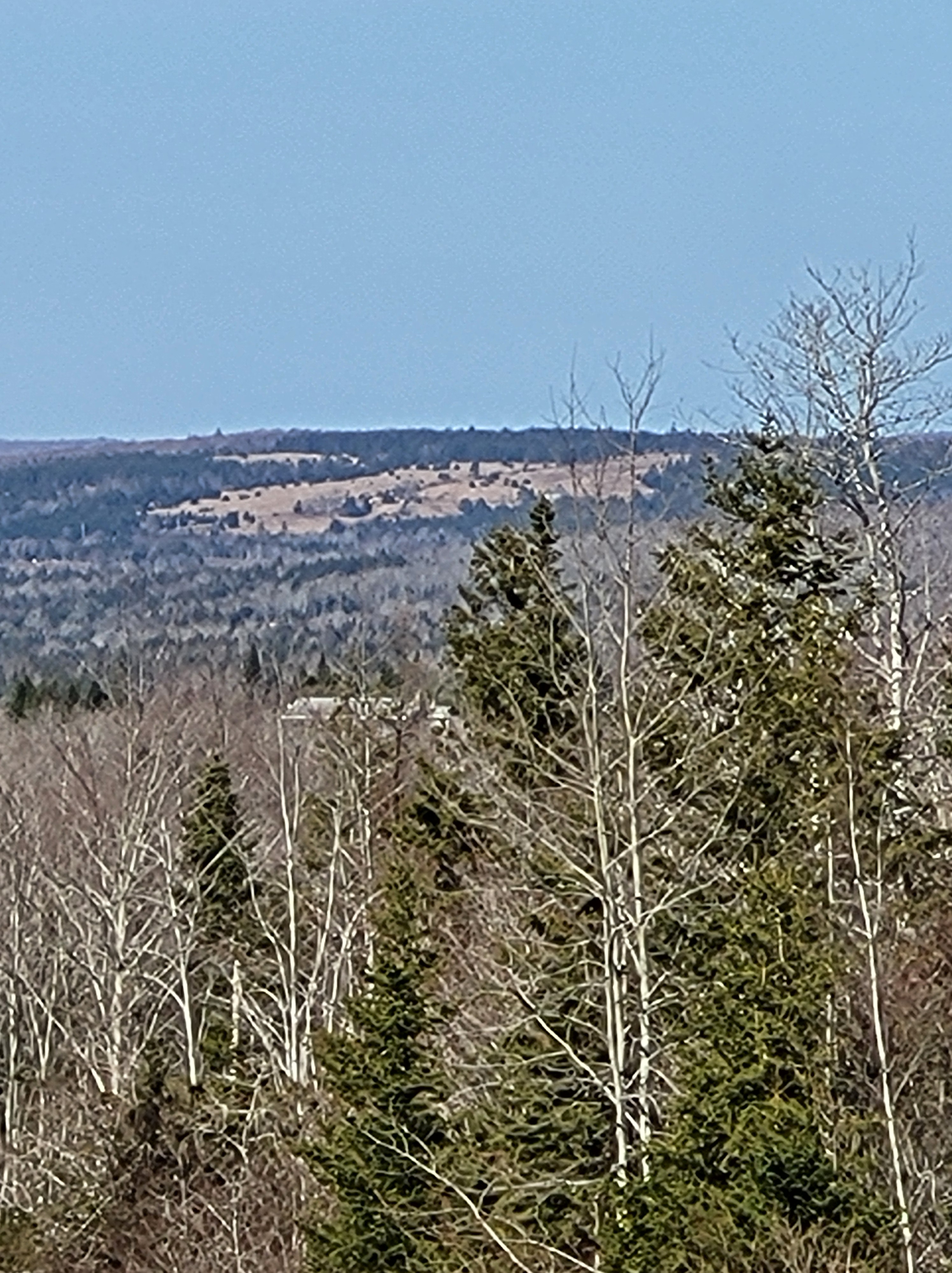
The scene above is from a view point on Campbell’s Hill, southeast of the village of Scotsburn.  It is a spring day in which the leaves are just beginning pop out. In the near distance is the tower on Bethel Presbyterian Church. A bit further in the view is a ridge adorned with farms in the community of Heathbell.  In the distance is the blue waters of the Northumberland Strait and, on the horizon, the eastern end of Prince Edward Island.  It is a peaceful spot that gladdens the soul.

It was not always that way.  In 1819, a few dozen feet from this viewpoint, the most horrendous murder in Pictou County, (at least up until 1877), was committed.

This farm was first settled by a Campbell family, probably around 18031.  They were from Rogart in Sutherland.  The next farm up the hill was also settled by a Campbell family2, most likely a sibling or near relation.  The names of the parents are presently unknown.  Their graves, whether in Scotsburn or Durham, are unmarked.  The mother died before 1819 after which the father took a second wife, also a Campbell, who was part of a Campbell clan on Scotch Hill.  Of the first marriage, we only know of one son – Donald – the principal character in this story. 

George Patterson in his 1877 publication The History of the County of Pictou, describes the events which I will paraphrase here.

Donald Campbell, then settled in the Earltown district, was returning from errands in Pictou and took the opportunity to stop at Campbell’s Hill to visit his father and stepmother. It is unknown whether something was said during the visit to upset Donald or if he was already angry when he stopped for a visit. It is believed that Donald resented the second wife of his father as he felt she was going to delay or diminish his eventual inheritance. The visit ended with Donald resuming his trip back to Earltown.  He stopped at various farms between Campbell’s Hill and West Branch, giving the impression that he was trying to get home to Earltown before it became late.

However, Donald retraced his steps back to Campbell’s Hill after dark.  He fastened the door of his father’s log cabin with withes attached to the latch handle to prevent the occupants’ escape and then set fire to the cabin while his father and stepmother were asleep.  Awakened by the fire, the father managed to force the door open and started to remove the contents.  Donald, lurking in the dark, struck the father with a stick and pushed him into the flaming house where the bones were found the next day.  While this was unfolding, the stepmother managed to get out.  She was a sturdy woman and would have won a fair fight, but was struck down by Donald’s weapon.  He only partially succeeded in putting her into the flames, as she was “quite a load” to borrow an old phrase.

Hearing shouts and seeing the fire on the crest of the hill, a MacIntosh neighbour arrived to see a man fleeing whom he then believed to be a ghost.  A small dog was also found at the scene which belonged to Donald and later aroused suspicion.

The remains were buried without an investigation.   At the funeral, Mrs. Campbell’s brother, Angus Campbell, expressed his belief that there had been foul play.  The authorities opened a case, exhumed the body of Mrs. Campbell, and determined she had been dealt a deadly blow.  The scene of the crime was examined where a missing button from Donald’s coat was found as well as a flint that matched a gun Donald owned.  It was suggested that Donald lost the flint, causing him to resort to using a bludgeon.   Upon arrest in Earltown, it was noted that Donald had scorch marks on himself.

The subsequent trial received considerable attention.   S.G.W. Archibald of Truro presented the case, which was adjudicated by a jury with Judges Haliburton and Wiswall presiding. Archibald presented a strong case after which the jury was quick to find Donald guilty.  He was immediately sentenced  “to be taken from where you now are to Prison whence you came and from thence to the place of execution and there hung up by the neck until your body is dead”.  A clerk later noted: “Exactly a week later on the 22nd September Campbell was executed at Rogers Hill within a few yards of the spot where the crime was committed, pursuant to a warrant from the Earl of Dalhousie, our Lieut. Governor”.

Executions were a spectator sport in those times, appealing to the darker side of the human spirit.  On the appointed day, Donald was loaded on a cart and transported to the Kirk then located beside St. John’s Cemetery.  This was the end of a proper road.  Access to points beyond was by way of paths.   Guarded by the militia and accompanied by a group of clergymen, the procession climbed the 3 km path to the remains of the incinerated cabin.  Once at the scene of his crime, Donald confessed to his crime but showed no interest in repentance despite the efforts of Rev. Dr. James MacGregor and other clergy. 

Acadian Recorder – October 9, 1819 – The paper didn’t report the proceedings but instead published a separate account. At least one copy survived into the 1960’s in Earltown.

The execution was supervised by the High Sheriff of Halifax County.  The ineptitude of the chosen executioner added to the drama.  Hanging, despite the image it conjures, was somewhat merciful.  The process involved releasing a trap door or a push off the gallows platform.  The sudden drop of the body would cause the noose to break the neck, thus bringing instant death.  In this case, the bolt on the trap door didn’t release fully thus causing the rope to slowly tighten instead of snapping the neck. The result was death by a slow strangulation 3. So disturbing was the spectacle that many in attendance vowed never to view another hanging.

Patterson was silent on the particulars of Donald’s own family and life back in Earltown.

Two and one half kilometers east of Earltown Village on the Berichon Road, an old road branches to the north.  This was once a listed shortcut between the Berichon and Clydesdale.  (It is now gated by the owner of the surrounding woodland).  About 250 meters in, a logging road branches northwest into a grown-over clearing.  A few meters off this road is the cellar of Senoid Sutherland.   Senoid is Gaelic for Janet and is pronounced Shawna, which morphs into Shawney, the equivalent of Jennie.  This farm was once known as the Shawney place4

The land grant map found online shows this to be the 150 acre grant to a Janet Campbell.  Another version of the land grant maps show it to be the grant of Donald Campbell.  Some deeds of surrounding properties reference the line of Janet Sutherland while others state Janet Campbell.   

This confusion of names confirms the oral tradition around Earltown that this property was that of Donald Campbell, convicted killer.  It also confirms another interesting story that Donald’s widow, in shame and horror, changed her surname and those of her children to Sutherland to distance themselves from the crime at Campbell’s Hill. 

Sutherland was Janet’s maiden name.  There is a tradition that she was connected to John Sutherland “Doula” who settled an adjoining farm but the connection has yet to be confirmed.  She was born in Sutherland and came to Nova Scotia prior to 1815.  She had at least one brother in the Scotsburn area who gave evidence at Donald Campbell’s trial.

Janet and Donald’s eldest son, John, was born at Rogers Hill in 1816 which would place their marriage around 1814-15.  Janet’s eventual land grant was among those petitioned by a group of second generation immigrants living at Rogers Hill.  These petitions were in 1817, suggesting that Donald and Janet may have begun clearing their farm that summer. The deeds would not be granted until later in the 1820’s hence Donald’s name is absent. A second son, George, was born in 1818  at Earltown.

It is hard to imagine the situation that Janet found herself in on that 22nd day of September, 1819.   Widowed, two children ages 3 and 1, a crude log cabin, a partially cleared farm, no immediate family in close proximity, and an epic scandal to overcome.  Donald Campbell was characterized as an ignorant and unsavory character with obvious violent tendencies.  The scandal may have been a blessing.  Domestic abuse is as old as matrimony. 

A return to the Rogers Hill area was not likely an option given the circumstances.  Earltown was still in infancy and new settlers were arriving with no ties to the victims or accused.  It would appear that Janet stayed on course and made the small farm work.  Undoubtedly, there would be some assistance from siblings in Roger’s Hill, possibly a kind father was still living.  The Highland culture ensured that widows had help.  Hard labour, such as the annual threshing and wood cutting, was often a collective labour in the neighbourhood.  It must be remembered that back in Scotland, the women were the gardeners and looked after the dairy livestock. 

The 1838 census confirms that “Widow Sutherland” with two males over 14 were still living on the Berichon Cross Road.  The next census in 1861 finds her son John as the head of household, which indicates that Janet had passed away in the intervening years.   No tombstone marking the grave of either Janet Sutherland or Janet Campbell exists but she most certainly rests in the village cemetery.

The eldest son John took over the homestead.  In 1857 he married Catherine, daughter of “Laughing” Sandy Sutherland and Christy Baillie of The Falls.  They had one daughter Betsy.  John’s brother George is absent from the  farm in 1871 but returned in 1881.  When John died in 1885, he left the farm to George with the stipulation that Catherine be provided a living for as long as she would live.  By 1911, both George and Catherine are absent from the census.   As for John and Catherine’s daughter Betsy, we have no further information.

The property was later purchased by George MacIntosh.  It is a short distance through the woods to the main MacIntosh farm on the Denmark Road.  The Shawney place continued to used for pasture and crops by the MacIntoshes and later the Van Veld family.

Sources:

Patterson, George “Old Court Records of Pictou County, Nova Scotia published by The Canadian Bar Review, Vol13 No 3 1935

Patterson, Rev. George  A History of the County of Pictou, Nova Scotia  Dawson Bros, Montreal 1877

Gladys Sutherland MacDonald – Interview – 1978

A. Howard Murray and Mary Douglas Murray – Interview – 1978

Layton Lynch – assistance in locating the Campbell – Sutherland homestead in the Berichon.

  1. The Dunwoodie family were the next to occupy this farm for a couple of generations. After the farm was vacated, James and Harold Forbes of Lyon’s Brook farmed it for many years. ↩︎
  2. The farm owned by Hugh and Stanley Campbell in the mid 20th century. ↩︎
  3. The executioner was brought by the Sheriff from Halifax. Pictou had its own executioner at the time who served the courts in Prince Edward Island as nobody on the Island would accept the responsibility. ↩︎
  4. The current owner has it gated to keep out traffic. His number is posted on a sign for people to call for permission to enter. ↩︎

The Kildonan Riots (The Earltown Connection)

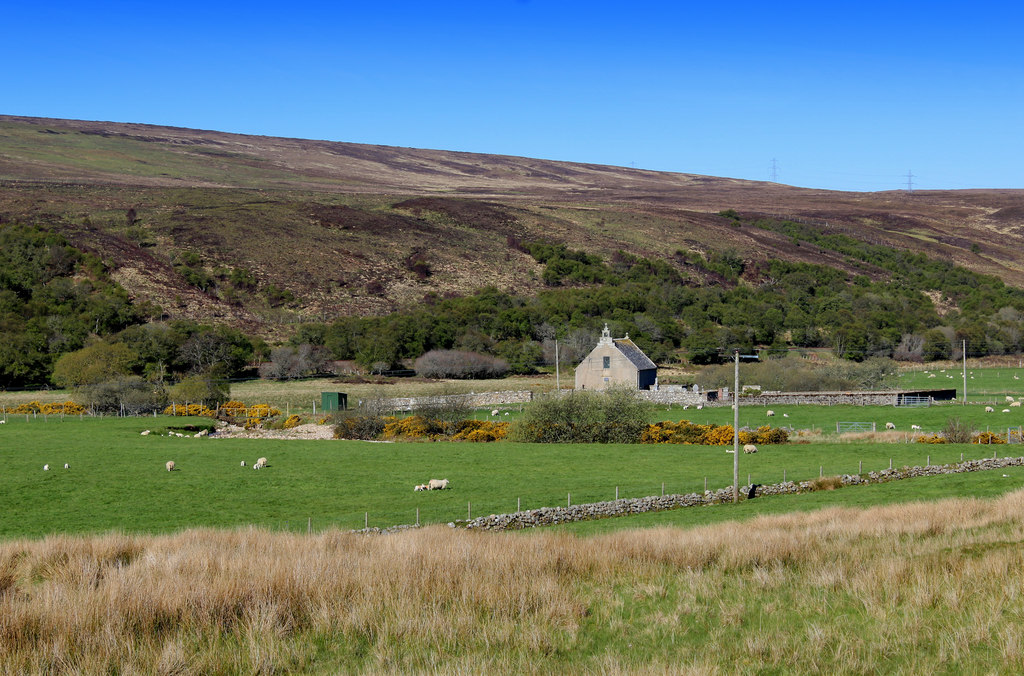
Kildonan Parish is located in the north-east of Sutherland along the Caithness border.  It begins in the high country on the watershed between Strath Halladale and Strath Ullie and follows the latter southeasterly down the Helmsdale River towards the sea.  In the early 19th century, it was home to at least 1,500 souls, predominantly Gunn, MacKay, Polson, Sutherland, Matheson, and a handful of other Highland names.  The valley floor had abundant land suitable for grains and the surrounding hills afforded thousands of acres of grazing for cattle and sheep.

Helmsdale River near Kildonan Farm – Julian Paren Photo

In 1807-1808, the Sutherland Estate created a farm in Kildonan out of three townships and leased it to an outsider.  The collection of small tenants cleared out in making this farm, offered no resistance.  In all likelihood, they were not expecting such a move nor were they organized or prepared to mitigate the situation.

On January 5th, 1813, farmers “from away” were seen exploring and surveying other parts of the parish, which raised alarm among the traditional tenants.  In the lead was the proposed new tenant for another extensive farm which would precipitate another clearance.  Major William Clunes, who already had a farm on the coast, would have been recognized by former soldiers in the parish from their days in the Peninsular War.  That evening, it was learned that Clunes had settled for the night in the manse of Rev. Alexander Sage. 

A delegation was appointed by the local tenants to confront Clunes at the manse.  They summoned Clunes to the yard for a conversation and learned that Clunes was doing due diligence on a lease near Torrish.  The delegation appealed to Clunes to abandon the plan and let them continue to farm in peace. The conversation became heated and ended with threats.

Kildonan Church Chris Heaton Photo

This was reported back to the leaders of the protest, who were awaiting word at a nearby mill. The protests were being organized, allegedly, by the local schoolmaster, George MacLeod, and an influential catechist by the name of George MacKay.  While they all realized that their actions were against the law, the catechist was able to assure them they had the moral high ground.  Overnight, tempers flared, adrenaline flowed, and the protest took on a momentum that was hard to contain.

The following morning, as Clunes was saddling his horse, he was confronted with a mob of fifty men bearing sticks and cudgels.  He was warned to take leave of the strath before blood would be shed.  Realizing there would be nothing productive happening that day, Clunes saddled up and went home.

Meanwhile, other southerners in the same party were housed with a Turnbull family further up the Strath in Suisgill.  Another party of 50 concealed themselves in the thickets and gullies surrounding the Turnbull farm.  A couple of shepherds/farmers, managed to escape on horseback across the hills into Caithness, but others were trapped in the house.  The scene became quite ugly with threats of violence.  One of the tenants, a pragmatist by the name of Alex Fraser, entered the house and suggested that the party mount up and leave.  They were advised to tell the mob what they wanted to hear and not engage in any conversation that would make matters worse.  If they obeyed Fraser’s instructions, they would likely get away unscathed.  As predicted, the men safely departed, although they continued to be threatened with harm should they ever be found in the parish again.[1]

Suisgill,- Approximate locale of second mob Julian Paren Photo

This so unsettled the southern farmers that they avoided the parish in the weeks that followed.

Complaints were presented to Sheriff Substitute MacKid by the Estate.  Sheriff MacKid attempted to get peace bonds served but was unsuccessful.  The Estate then called a meeting whereby they promised crofts on the North Coast or smaller ones within Kildonan in exchange for their current leases.  These offers were rejected.  The tenants decided they needed to counteroffer to move things along and proposed to match whatever terms Clunes had negotiated for his lease.  The bearer of this counteroffer was arrested and jailed in Dornoch which only served to raise the temperature once again.

Over time, the Sheriff learned the names of some likely ringleaders.  Summons were issued to appear at court in Golspie to give evidence.  When one of the constables, Donald Bannerman, arrived in the Strath, he discovered those named were nowhere to be found and were believed to have been hiding in Caithness.  Bannerman, later to be labeled a brutal thug in later clearances, returned to Golspie empty-handed.  Nevertheless, he posted the names of the men expected to appear for discovery on February 10th at the Golspie Inn.[2]

Once bitten, twice shy.  There was no doubt in Kildonan that the discovery was an ambush to arrest the alleged ringleaders.  Once again, the men of the Strath congregated in the mill of John Gordon to develop a plan.  It was quickly decided that all that were able would accompany the named men to Golspie to ensure their protection.  Two men were dispatched to Caithness to hopefully raise upwards of a hundred men.  Another two men, George MacDonald and John MacKay were sent south to recruit in Strathbrora.

Strathbrora (home of many of the Earltown settlers) could be expected to be sympathetic with the Kildonan tenants.   Like Kildonan, much of Strathbrora was leased by the Sutherland Estate to small tenants. It was equally suitable for large scale sheep farming.  One of the gentleman farmers present at the Kildonan Riot was Gabriel Reid, the owner of Carrol on Loch Brora, who had ambitions to expand up Strathbrora.

The two emissaries, George MacDonald and John MacKay, crossed from Kildonan into the upper settlements of the Skinsdale and Blackwater valleys which they followed down into Strathbrora.  They had instructions to go west to Braegrudy at the entrance to Rogart where John Sutherland, Tacksman of Scibberscross, was known to be opposed to the “improvements”.   The two proceeded from township to township, tapping on windows and entering wherever they were welcome.  After explaining their mission, the Strathbrora men were asked to meet the Kildonan men at the bridge in Brora and proceed together to the outskirts of Golspie.  They would then be instructed to enter the village in small parties and pretend to be on business until proceedings started at the Inn.

Reports vary as to how many showed up.  There was likely a full contingent from Kildonan.  They may have been 50 to 100 from Caithness and a similar number from Strathbrora.   The appointed time the mob assembled in front of the Inn.  The Sheriff and Clerk came forward and read the names of those to appear.  Two started forward but the crowd became agitated and unruly.  The discovery was called off and the officers retired to Dunrobin Castle for safety. 

The next move was to employ the military. Infantry was dispatched from Fort George near Inverness to bring order to Kildonan.  This seemed to bring the temperature down while the Kildonan tenants sought out alternatives to the proposed small crofts offered by the Estate.  The only violence reported was the flogging of a soldier for unwanted advances on a local woman.

Hearings, known as precognitions, were held in Golspie in March.  These proceedings would be similar to what is known as a discovery in our current justice system.  This becomes interesting from an Earltown perspective as familiar names appear among the witnesses.

The first of interest is Alexander Sutherland of Balnakyle.  Unfortunately, Sheriff Depute Cranston and his interpreter, Alexander Anderson, didn’t use descriptor names which were then prevalent, so we have no idea if this Alex Sutherland was a future emigrant to Nova Scotia.  He describes visiting at the home of Widow MacPherson, Faissalach, along with his Uncle Donald MacLeod of Achrimisdale and John Bruce of Baddenbeg.  Also present were Robert Bruce of Ardachu, William Gilcrest of Wilkhouse, John MacLeod of Gartymore and Hugh Ferguson of Rhives.   He declared that George MacDonald and John MacKay of Kildonan came into the house and said that they had come down from Kildonan to go down Strathbrora and afterwards westward to Braegruidy to invite men in those parts to come to Glasslochan to meet the Kildonan people and fifty men from Caithness who were all going to Golspie to prevent the persons cited there by the Sheriff from being committed to jail

Mid Strathbrora Jonathan Billenger Photo

Alex further declared that “… the men about Clyne had been told by Major Houston to be quiet and that they might be needed to help peace officers.”  He also mentioned that “… the men of Kildonan and their assistants were determined to take John Bannerman … out of the Dornoch jail.”

The next witness of interest is Adam MacDonald.  Adam MacDonald of Aschoilmore was the father of Alexander MacDonald “Macadie”, and early settler at The Falls and ancestor of the MacDonalds who operated the Balmoral Grist Mill and a large branch who later settled in California[3]

Adam’s testimony was very similar to that of Alex Sutherland.  He declared that George Clyne, Tailor, of Gobernausgach and his apprentices were also in the house and would have understood more of what was said as he, Adam, was sick in bed at the time.  It was noted that he was still in a very infirm state.  His testimony was read back in Gaelic as he declared that he never learned to write.

Adam recovered from his malady and was still alive when the Estate turned their attention to the clearing of Strathbrora.  As reported elsewhere, he and his brother-in-law, Mad Donald MacKay, attempted to renegotiate their leases at terms matching those of Gabriel Reid.  They successfully orchestrated resistance to the clearance in 1820 but were finally removed in 1821 with the military present.

The next precognition was that of George Ferguson.  Many in Northern Nova Scotia, myself included, descend from this man.  He was the miller of Kilpheddermore in mid Strathbrora.  His testimony is a bit longer than those preceding him, as he admitted to being at the Golspie Inn disturbance.

George “declared that he remembered when the Kildonan men were to be examined at Golspy and thinks it was about the beginning of February last but he cannot specify the day of the month;  that William Sutherland “Merchant” in Ellan told the declarant upon the day before that intended examination that the Kildonan men were to go to Golspy the next day and the declarant thereafter being solemnly sworn and interrogated if William Sutherland wanted him to attend at Golspy.  Deponed that he did not but that William Sutherland informed him that the Strath Brora people had been invited to attend by two men from Kildonan but he did not mention their names and that the purpose of their attendance was to see what would become of the persons who were cited for examination; that Sutherland said nothing of preventing those men  from being apprehended or of rescuing any person from Dornoch jail  Depones that the deponent himself went to Golspy on the day of examination, and his purpose in doing so was to get payment of a debt which a man in Kildonan owed him;  That he was present when the Officer called over the names at the door of the Inn, but he was a good way down the road and only heard the last of them; That he does not recollect to have seen the Sheriff Substitute on that occasion but he saw Mr. Taylor, Sheriff Clerk, and Mr. Leslie the Procurator Fiscal.  Being interrogated how he could see these two Gentlemen at the door of the Inn when he was a good way down the road and the crowd between him and them, depones that there was a considerable interval between them and the crowd which enabled him to see them. Deponed that he saw some of the people whose names were called come in front of the crowd, but he did not see an Officer attempt to apprehend them or the crowd close in about them.  Deponed that the deponent expressed his sorrow for having gone to Golspy that day to Adam Sutherland in Kilfeddermore and Alexander McLeod in Torrisellar both in Strathbrora – Being interrogated what the cause of his sorrow since he only went to crave payment of a debt.  Depones that it was because he saw the people were likely to make a disturbance and he was afraid of being implicated. Deponed that he saw some Strath Brora men at Golspy on that occasion in particular Donald Sutherland in Kilfeddermore, Donald MacKay, Tailor in Strath Roy, John Sutherland, Pentioner, in Duchal, Alexander Sutherland in Achnamean, the said William Sutherland, Merchant, who informed him that the Strath Brora men had been invited to attend, Donald Grant, son to Donald Grant, Tenant in Ellan, Robert Sutherland, son of Donald Sutherland, Tenant, in Kilfedderbeg, Donald and William Grant, Tenants in Urachcall, William Sutherland, Stone Dyker in Scottary, Donald Murray, Alexander MacKay and Norman Douglas all in Ballenleden, Donald MacDonald, Donald Baillie and Robert MacKay, Tenant’s sons in Aschoilmore; Alexander Sutherland, James MacLeod and Robert Baillie in Oldtown of Carrol. Alexander Sutherland, Weaver, and John Sutherland, Tenant in Brachary, Robert Bruce and John Sutherland in Aultsmerrel; Deponed that he returned home that evening in company with some of the Strath Brora men who were saying in conversation that the Kildonan men who had been cited were prevented from being taken into custody, but he did not hear them say there were determined to prevent all arrests for the future.  Depones that he was informed the day before the said William Sutherland that Strath Brora men were meet the Kildonan men on the day of examination at the Bridge of Brora and to proceed together to Golspy, but the deponent did not fall in with the party till they reached Strath Stephen.  That William Sutherland informed him that they were to be joined by men from other parishes in Sutherland and also from the County of Caithness  – that William Sutherland did not mention the number of men expected but said they were to get as many men as they wanted – all which is Truth as he shall to God and depones he can not write – the foregoing Oath being administered and the Deponent interrogated through the medium of Alexander Anderson, Wright in Brora sworn Interpreter,   signed Geo. Cranstoun   Rob MacKid “

Aside from actual ringleaders from Kildonan, this discovery was unusually lengthy and detailed as to those present at the Inn. Reading between the lines, the interrogators seemed to be doubting George’s reason for being in Golspie on that particular day and this descendant is not entirely convinced, although the opportunity to collect a debt is plausible.

Towards the end he was quite forthcoming with a list of attendees, which likely didn’t please his neighbours back in Strathbrora if they learned the content of his testimony. 

Some of the names are of interest.   William Sutherland, Merchant, lived in Ellan, the township where the Sutherlands of MacLeod Road were born.   William Sutherland of Scottary was likely William Sutherland “Ruidh” of The Falls.  Alexander MacKay, Ballenledan, is undoubtedly Alex MacKay ‘Caribou’ who emigrated to Pictou in 1815 and later settled in the Berichon.

Donald MacDonald of Aschoilmore would be a brother to Alex MacDonald, The Falls.  Donald became an employee of the Hudson Bay Company at Fort Edmonton.   Norman Douglas settled in Loganville.

George Ferguson returned to his labours at his grist mill.  Having an inkling of what would likely happen in Stathbrora in the not-too-distant future, he began to mull over the merits of emigrating to Nova Scotia.  Before that dream became a reality, he developed cancer and died around 1817.  His widow, Catherine Graham, left with six young children.  She was among a group in Scottary[4] that petitioned the estate to let them occupy their leases until they departed for Pictou in May of 1820.  Patrick Sellar, the Estate factor and ruthless promoter of the clearances, was happy to see them go believing them to be better suited to the wilds of Nova Scotia.

As for the Kildonan people, Thomas Douglas, Earl of Selkirk, had plans for them.  He needed settlers for his proposed settlement on the Red River and the hardy people of Kildonan fit the bill. In June of 1813, 90 of them sailed from Stromness to Churchill on Hudson Bay, arriving in September and overwintering in that frozen land. The following spring they were confronted by an 800 km trek through the wilderness to their new home.  By 1820,  the Strath of Kildonan was empty but for a few farmers, shepherds and their families.

Sources:

Hunter, James  Set Adrift Upon the World, The Sutherland Clearances  Birlinn Ltd  2015

National Records of Scotland, High Courts AD14-13/9 Precognitions, Kildonan 1813

Credit to Joyce Ferguson, The Falls, for noticing George Ferguson’s name in the High Court Index.

For more information on George Ferguson’s mill site and the township of Kilfeddermore, see this video by Nick Lindsay of Brora


[1] There was only one Kildonan immigrant to Earltown, John MacLeod, who later removed to North River. He would be in his late teens during this period.  James Murray, North River, and a member of the Earltown congregation, was also from Kildonan.  The Polsons of North River also had roots there.  Alexander Murray “Corrigan” was operating a mill at Aultandon in a remote part of Kildonan at this time and was later cleared. Thomas MacKay, grantee of the eastern end of the Berichon Road in West Branch was also from Kildonan.

[2] The Kildonan Riots is a complicated story that is well presented in James Hunter’s “Set Adrift Upon the World, The Sutherland Clearances”.  The story has been heavily condensed to give context to the Strathbrora portion of events.

 [3] The writer’s Great, Great, Great, Great Grandfather. 

[4] The mill lease was likely given up when George took ill, necessitating the move to a holding in Scottary down stream.

Lumber Barons from North River

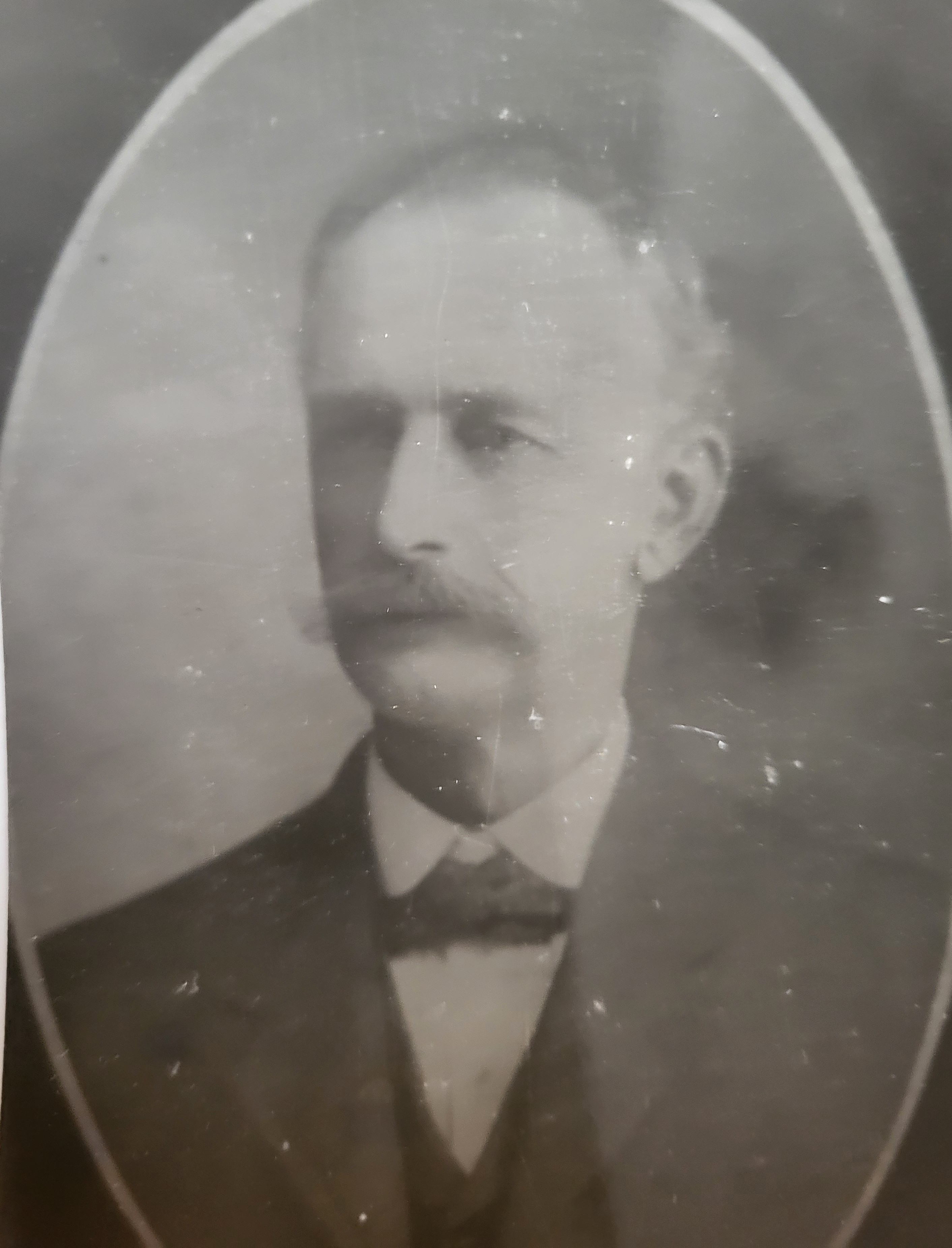
In 1876 young Alex Polson struck out from the family farm on Polson Mountain, North River,  to seek adventure.  This was a time when families were beginning to migrate from the hard life of the Cobequid Hills to the mid western states.  His travels took him first to Minnesota, followed by stints in the southwest, and finally to Gray’s Harbour in Washington.  By the time he died in 1939, he had built a substantial lumbering empire in the Pacific Northwest, amassed thousands of acres of woodland, introduced a private railroad to his logging camps, served as a state senator, dabbled in mining and managed all of this with a steady hand through good times and bad.

The Polsons were one of the North River families that were an extension of the Earltown community.  They were part of the Earltown congregation, connected with a few of the families between The Falls and Riversdale, and shared a common language, culture and Scottish homeland.

The clearing is in the distance on the MacKenzie Settlement Road and the ridge used to be commonly known as Polson Mountain. The Polson homestead was to the upper right.

Alex’s parents were Peter Polson, (1822-1909), and Catherine MacLean (1823-1909).  Peter Polson was born at Upper South River, Antigonish County, shortly after his parents,  William Polson and Isabella Sutherland, arrived there from Scotland.  The family had lived in Kildonan Parish when the older children were born.  That parish was substantially cleared in the years leading up to 1820 and the young couple, if not forcibly removed, were certainly impacted to the point where they had to relocate.

Catherine MacLean was born at Black River between Kemptown and Riversdale.  Her parents, Alex MacLean and Oighrig MacLennan1,  came to Black River from Ardindrean, Loch Broom, in 1818. Catherine was a twin of Marion MacLeod of Central North River and one of a family of 13. 

Catherine MacLean Polson (Polson Museum Collection)

Peter Polson’s oldest sister, Ellen, was married to a John Murray at West Branch.  This couple moved from West Branch to Upper North River around 1838.  This connection is likely what brought Peter to the North River area.  Peter and Catherine settled on a lofty farm on the MacKenzie Settlement Road.  The clearing is visible at the head of the North River valley from various points along the 311 Highway and vantage points around Truro.   Locally, the hill is known as Polson Mountain. 

Alexander MacLean Polson, one of nine children, was born on this homestead in 1853. In the 1871 census, he had finished school and he was farming with his father. Woods work went hand in hand with farming. Males, starting in their late teens and extending to a time when they acquired their own farm, often spent the winter in the local logging camps. Given the number of mouths to feed on the Polson farm, Alex undoubtedly did time in the woods. According to biographical sketches, he left Polson Mountain at the age of 23 in 1876 with all his possessions in a saddle bag.  His goal was to participate in the gold rush of the times and thus ended up in Deadwood, Dakota Territory, where gold was discovered that year.  It was a lawless town that attracted such characters as Wyatt Earp, Calamity Jane and Wild Bill Hickok, (who was shot in the local saloon in 1876).

Unsurprisingly, Alex only hung around the town for three months. He then relocated to the Southwestern territories hoping the dry climate would help his asthma.  His next home was in Carson City, Nevada, where he was involved in both lumbering and mining.   In 1879, he moved to Tucson, Arizona, before embarking on a 1,500 mile horseback journey to Goldendale, Washington where he was employed in supplying timber for the expansion of the railroad.   The following year he went to Olympia where he gained more experience as a foreman for a local lumbering company.   Always traveling and exploring in his spare time, he came across Montesano, a small town on the Chehalis River, where he decided to put down roots.

One of his early accomplishments was the construction of the first splash dam in nearby Pacific County.  A splash dam was used in logging to raise the water level of streams to allow for the passage of logs.   Logs would be dumped in the pond behind the dam to accumulate for a drive.  A chute allowed the water and logs to escape downstream.  The logs would eventually be collected at tidewater, the usual location of the mills.

In 1891 Alex married a college educated lady from Iowa, Ella Arnold.  They later moved to nearby Hoquiam on Gray’s Harbour where they built a spacious house.  Together, this couple had three children: Franklyn Arnold, Charles Stuart and Dorothy Kathryn.

Alexander MacLean Polson (Polson Museum Collection)

During his early years in Grays Harbour, Alex was the county assessor in addition to his logging ventures.  Then, and subsequently, he was actively involved in trading and amassing property.  If this was a conflict of interest, the journalists of the day were silent.

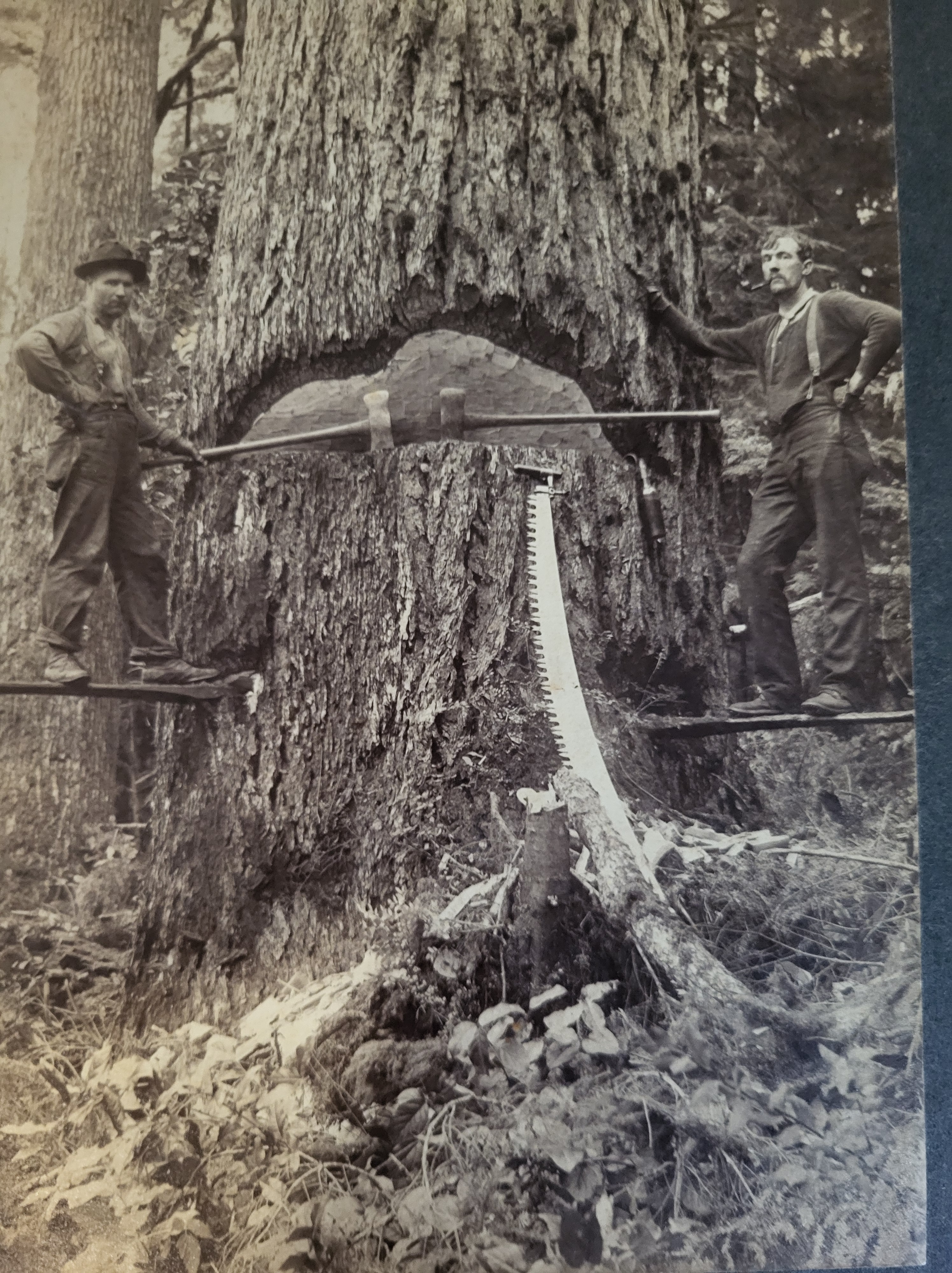
In 1887, his younger brother Robert arrived in Hoquiam, coming directly from Polson’s Mountain at the suggestion of Alex.   He was a giant of a man who had learned the blacksmithing trade back in Nova Scotia.  Blacksmiths were in high demand anywhere logging was an industry2.   Robert became more enamored with logging and spent a year in the camps around Hoquiam before heading to British Columbia to try the trade in his native country.  He was back in Hoquiam a year later, 1889, at which time he set up his own logging operation.  In 1891  Alex and Robert merged their operations into what was later known as the Polson Logging Company.

Robert Polson (Polson Museum Collection)

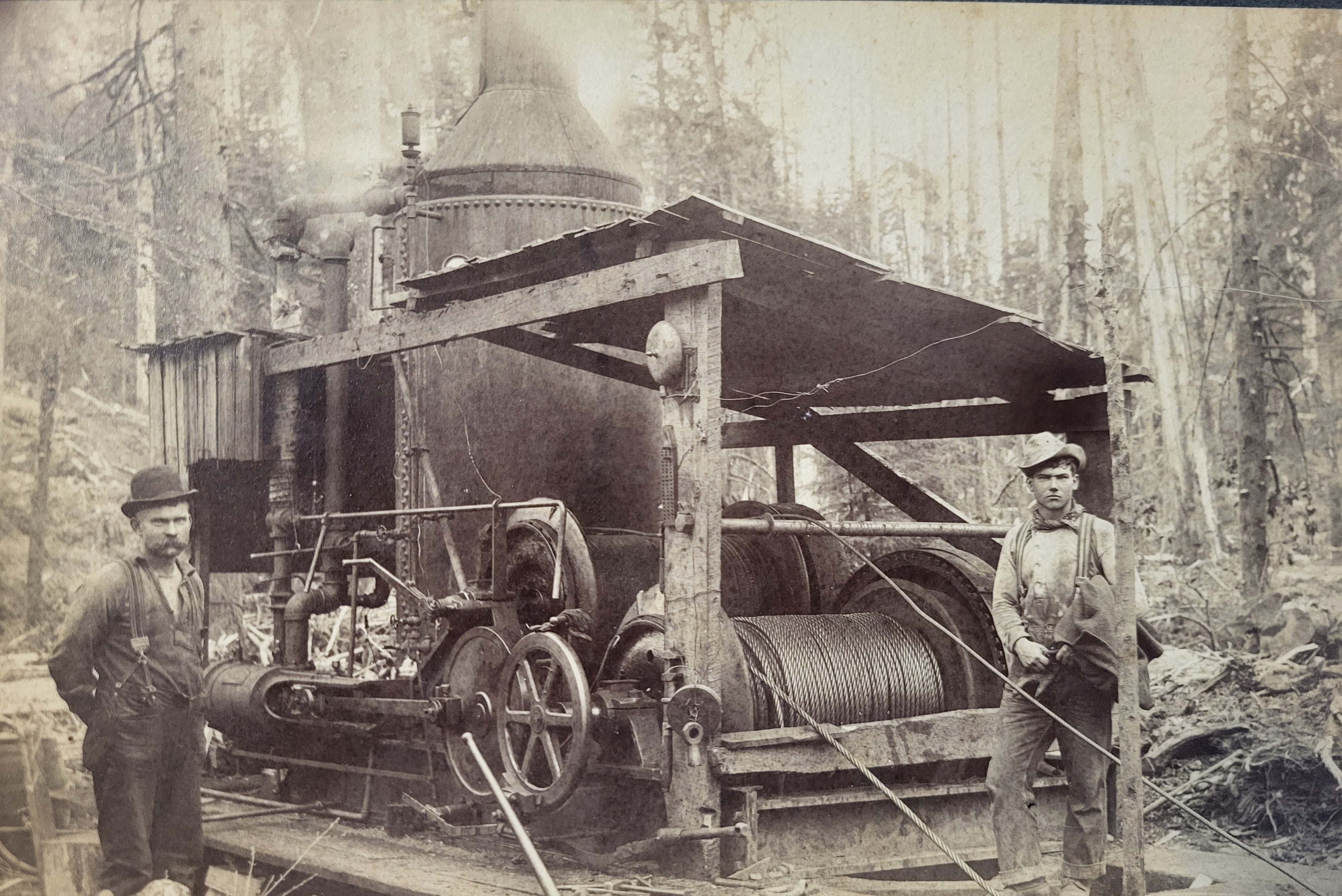
Both brothers initially operated using bull teams to skid the logs to the steams or splash dams.  They quickly transitioned to the steam donkey when those became more readily available.  By 1894, their operations were getting further inland so they set to work constructing their own railway to bring the logs to tidewater.  Their first locomotive already had a reputation.  Known as Farting Betsy, it was the first locomotive to cross the Cascades under its previous ownership.

Polson Railway Camp (Polson Museum Collection)

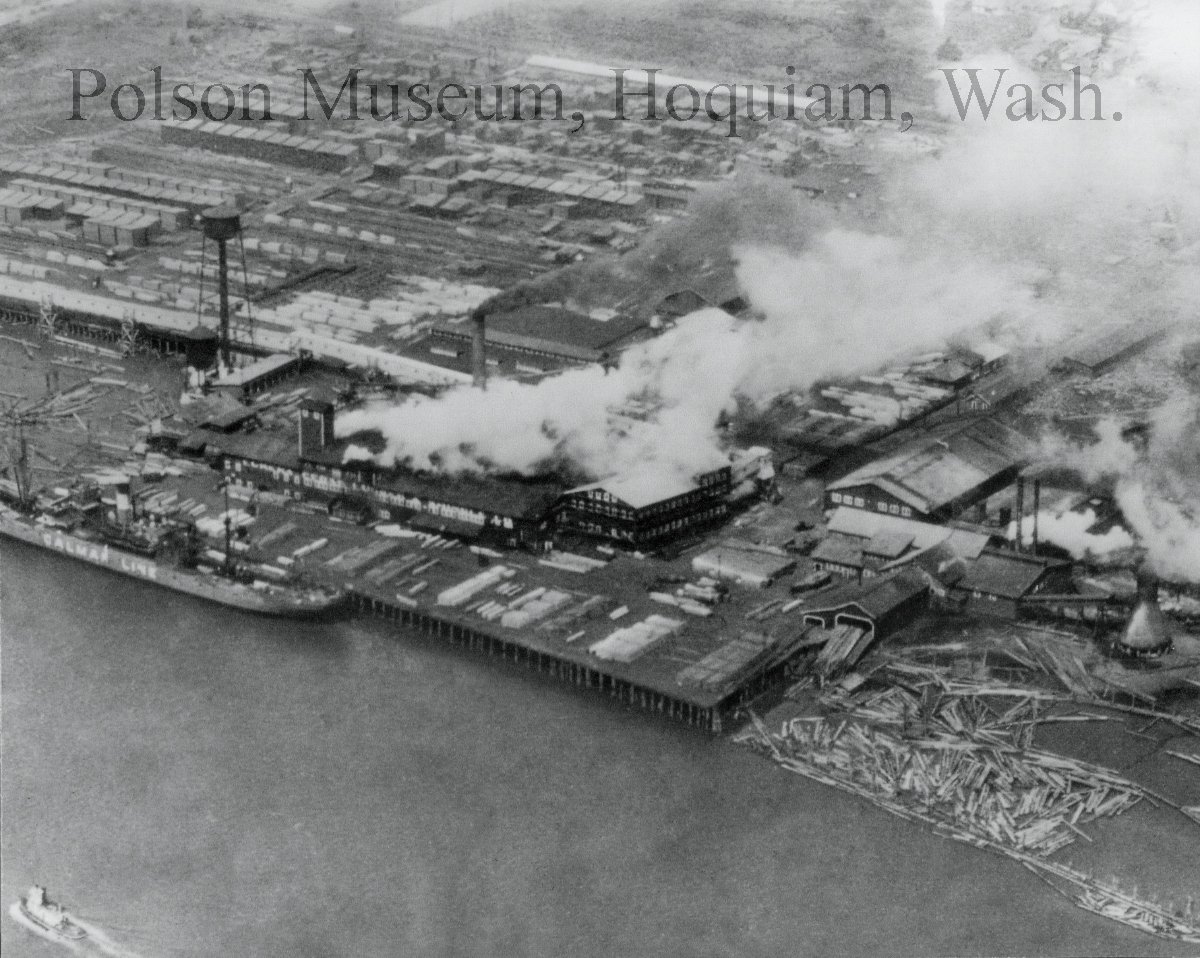
The next venture was to acquire their  sawing capacity.   Alex purchased a half interest in a Hoquiam mill.   This interest was later sold but, according to the newspaper of the day, Alex had interests in other mills.  The brothers were now on their way to be the largest lumbering empire in the Northwest.

Polson Logging Crew (Glen Matheson collection)
Smoke Break (Glen Matheson collection)

Their rapid growth was hurried along, ironically, by a forest fire.  A fire had swept through some of the best timber stands north of Gray’s Harbour.  Swift moving fires in a pine forest consume the brush but leave the main trunk.  The trunk can be salvaged for timber if harvested in the first four or five years before worms ruin it.   The Polsons,  who suffered some losses from the fire, were in a position to carry out much of the salvage in the burned-out areas which more than compensated for their fire losses.

Woods camp office with Robert Polson sitting on step (Polson Museum Collection)
The Steam Donkey was adopted early by the Polsons. They replaced teams of oxen or horse to snig logs out of the woods to the rail or waterways. It was stationary and employed pulleys, cables and spar towers to navigate the logs. The Aberdeen Herald reported that Alex Polson designed his own version for his operations. (Glen Matheson collection)
One of the Polson Camps. The bunkhouses were up on blocks so they could be loaded onto flat cars and transported to the next cut. (Glen Matheson Collection)

In 1903 Alexander MacLean Matheson3 of Upper Kemptown arrived in Hoquiam.  He was a first cousin of the brothers who was an experienced millwright and had owned a shingle mill in Oregon.  Alex Matheson and Robert Polson organized the Polson Shingle Company and opened their new facility in 1904  capable of producing  300,000 shingles per day.  In 1914, the shingle mill was amalgamated into a new company called the Eureka Lumber and Shingle Company with Robert Polson as president, Alex Polson as Vice President and Alex Matheson as the mill manager. They purchased several other mills in the following years.

Alex MacLean Matheson (Glen Matheson collection)

As for the daily management of the enterprise,  Alex Polson was the public facing partner.  He was more inclined towards negotiating, financing, and promoting.  He was active on the city council and served as a state senator for a term.   Civic duties did not come without some excitement.  In 1901 Alex and the town postmaster,  Ed Campbell,  had a heated disagreement over the disposition of certain school lands.  The argument escalated to the point where the combatants took to the street to settle the matter with fists.  Cooler heads intervened before blood was shed and the matter was resolved in a more civilized fashion.

Alex’s stint as a state senator had its moments. As the Aberdeen Herald reported on numerous occasions, Senator Polson was in the lead on a project to create Gray’s Harbour County with a portion of Chehalis County. As reported on February 28th, 1907 by the Aberdeen Herald, a competing Democratic leaning paper in Montesano “…is searching the dictionary for abusive epithets to apply to him”.

Robert, described as a gentle giant in his eulogy, was considered the boss out in the woods.  The company had twelve camps back in the bush housing over 200 employees.  There were also ten locomotives each with a crew.   Employees came and went.  Some were ruffians.  Safety was always a problem.  It would have been no easy task to manage such an operation.  However, judging from photographs of Robert, one would think twice before crossing him4. Robert had a mansion to himself on the Hoquiam waterfront next to his brother. His last years were spent with his sister, Maggie Ellis.

The sawmills were entrusted to their cousin Alex Matheson.  He was assisted by his son Gilbert and brother William.

Eureka Mill, Hoquiam, Washington (Polson Museum Collection)

Meanwhile back in Nova Scotia, Old Peter Polson and his wife Catherine died within weeks of one another in 1909 and were buried in Earltown.   Another of their sons, William, was the one who stayed behind to look after the parents and homestead.   In 1904 William married Margaret Matheson5 of The Falls, daughter of George and Christy Matheson.[1] 

Polson Family Graves Earltown Village Cemetery

In 1912 William and Margaret were summoned to Gray’s Harbour to join the family enterprise.  The Aberdeen Herold of  November 25,1912 reported that ”   Mr. and Mrs. Wm. Polson of Truro, Nova Scotia, arrived last week and are now settled in their new home just east of this city. They were accompanied by Miss Marion Polson. “   The home, pictured below, was situated on a 450 acre farm on the outskirts of Montesano.  William’s role was to manage the farm.   

Will and Margaret Polson home near Montesano (Glen Matheson Collection)

With 250 hungry men to feed in the camps, food security was an issue.  The farm supplied eggs, chicken, turnips and likely a variety of other staples for the cookhouses.   In a conversation with the writer several years ago,  Alex Polson’s grandson, (also Alex Polson), claimed the farm was part of a strategic plan.   If the timber industry were to fail, the brothers and their families could turn to farming. 

Cookhouse Crew. The cookhouses and dining rooms were on rail dollies for easy transport to the next cutting (Polson Museum Collection)

Other siblings also made their way to Grays Harbour.  John J., of whom little is known, died in Hoquiam in 1883 making him the first to join Alex.   Sister Margaret was in the area by the 1890’s.  Margaret, (Maggie), was the second wife of logger  Hiram Ellis.  Together the couple established the Aberdeen Greenhouse business near their home in Aberdeen.  Marion never married and lived with the Will Polson family.

Logging was not the only passion of Polson brothers. They always had an eye out for minerals when acquiring timberlands and also explored prospects in the north of the state. In 1910 Alex began development in relation to a sizable coal deposit near Mount Baker. It was reported years later that significant sums were spent on the property and it was not without controversy. Papers of the time reported several suits being launching both by and against Polson. A review of the mining history in the area is silent on the Polson seam leading us to believe that Polson abandoned or sold his claim. Robert was also known to dabble in the mining industry in the interior of British Columbia.

William Polson died in 1926,  Robert in 1936 and Alex in 1939.  Alex’s son Arnold had taken over the overall management in 1933. One of the key members of management team of the enterprise was Alexander MacLean Polson, son of  William and Margaret.    Mac, as he was known, was born on Polson’s Mountain in 1907 and was married to Blanche “Baie” Fulton of Marshall’s Corner, Upper Onslow. The name did not grant automatic privilege.  Mac, like all the Polson offspring, worked on the farm and in the woodlands before becoming involved in the finances of the empire6.

In 1947  Mac helped negotiate the sale of the entire empire – sawmills, camps, railways, etc. – to Rayonier Inc. with the exception of 4,000 acres retained for family members. By that time, the company appears to have mergered with a couple of other Grays Harbour lumbering families.

At the peak of their operation, the Polson Company owned and operated two tidewater sawmills, a shingle mill, twelve logging and construction camps, 125 miles of rail, a huge inventory of logging and railway equipment and boasted an annual output of 300 million feet of lumber. At the time of sale, it held 50,000 acres of virgin timber and 80,000 acres of reforested timberlands.

The founding brothers played the long game, risks were calculated, stability was valued over quick returns and their humble Scottish origins taught them not to take their good fortunes for granted. Family mattered as cousins were welcomed to Hoquiam and either employed or directed to employment. Young men from the Colchester hills were treated likewise. Some earned enough to move on to safer vocations while others settled into logging and milling

For two lads who grew up in the Cobequid Hills where there were often more times than meals, their accomplishments were monumental.


  1. Pronouced Erig and often spelled by the clergy as Erc. It loosely translates to Henrietta or Harriot as all three usually devolved into Henny in both Gaelic and English. ↩︎
  2. Blacksmithing is most often associated with shoeing horses. However this was the trade that custom manufactured machinery used on the farm or in mills. It was a particularly useful skill employed in the logging industry as new methods were constantly being adopted which required a fair degree of custom fabrication. ↩︎
  3. Alex Matheson was a son of Gilbert Matheson and Nancy MacLean, Upper Kemptown. ↩︎
  4. The writer’s grandfather, Gordon S. Matheson, “chopped” in the Polson camps at one point before moving on to explore farming in Southern Alberta. He acquired land near Lethbridge but was called back to The Falls to take over the home place from his aging father. ↩︎
  5. Margaret’s father George was a first cousin of the Polson brothers and a brother of their mill manager, Alex M. Matheson. ↩︎
  6. Daily American Republic 1985-01-25: Alexander MacLean Polson, treasurer of one of the largest logging companies in the world, died Wednesday. He was 77. Polson worked for the Polson Logging Co., which was founded by his uncles in 1891. The company sold its mammoth holdings to Rayonier in 1950. ↩︎

Sources:

Direct correspondence, Dr. Robert Polson, Ithica, NY, 1975
Hunt, Herbert Washington, West of the Cascades SJ Clarke Publishing, 1917
Van Sycle, Edward They Tried to Cut It All,  Grays Harbor–Turbulent Years of Greed and Greatness. Seattle, WA :Pacific Search Press, 1981
1871 Census – Onslow, Nova Scotia
1900 Census – Washington
1910 Census – Washington
Multiple issues of Aberdeen Herald 1890-1917
Personal conversations – Alex Polson, Seattle
Lillian Polson Henkle, Oregon
Don and Kay Daemkar
Ruth Matheson Renner, Ariel, Washington
Special thanks to the Polson Museum, Hoquiam, for permission to use their photographs

The Lubeag Sutherlands

Late in the summer of 1819, Robert Sutherland “Lubeag”, his second wife Eliza MacKay as well as the sons to his first wife, found themselves on a Pictou wharf beginning a new chapter in their lives.  They were collateral damage in an agricultural and social experiment beyond their control.  Their arrival in Pictou was within their control. While they had the option of remaining in their native shire, Northern Nova Scotia offered more opportunity – or so they hoped.   

Lubeag comes from the Gaelic lub, which means a loop or curve, and beag, which means little. In this case, it perfectly describes the geographic setting where this family lived prior to the clearances.  It is the name of a pre-clearance farming hamlet on the Skinsdale River in the back country of Clyne Parish in Sutherland.   It is over a dozen miles from the parish center near Brora and was home to six or seven families.  One of those families was that of Robert Sutherland (1779-1861).

Lubeag from the air. (Crown Copyright- Canmore)

The aerial photo shows the pronounced curve in the river, giving the area its name.  Lubeag is located on the far side of the river.  Arable land for crops is found along the river, while the homes and animal enclosures are located on a terrace above the fields.  Beyond is an expanse of rough grazing land on Cnoc na Lubeag and beyond.  In the foreground is another pre-clearance settlement known as Muiemore. 

Lubeag to the right with Cnoc na Lubeag in the background (George Brown Photo)

Wild and remote today, that was not always the case in those times.  It was located along a droving route through the centre of Sutherland.  The route commenced near Kinbrace in Kildonan where cattle were aggregated from various routes coming out of Caithness and the northern valleys of Sutherland.  The cattle were driven down this trail collecting more cattle from communities along the way.  It passed through Lubeag and continued on to Sciberscross, then crossed into Rogart and ultimately crossed into Easter Ross at Invershin. The cattle would end up at livestock markets in the south of Scotland.  Cattle were the primary cash income for farmers before the influx of sheep.

Strath Skinsdale was originally not part of the Sutherland Estate.  It was owned at the beginning of the 19th century by William Munro of Uppat.  His leases with his tenants were due for renewal in 1819.  In 1812, Munro sold Strath Skinsdale to the Sutherland Estate with the existing leases being assumed.  After 1812, Widow Sutherland appears as the sole tenant of Lubeag1. That doesn’t mean that her family was the sole occupant.  Tenants would usually sublet portions of their lease to a secondary class of farmers and labourers.   

Grazing land near Lubeag (Andrew Tryon Photo)

Small and targeted evictions had been occurring in Clyne for several years as leases expired or opportunities arose.  Most of Clyne was slated for removal in 1819 however most of the downstream communities were spared that year for a variety of reasons.  Skinsdale was not.  It was cleared in May along with parts of Kildonan and Strath Naver.  There is no indication that violence was employed in the Skinsdale communities however the constables did set fire to the dwellings to prevent re-occupation by the evicted2.

This was not unexpected.  Those with means likely had an exit strategy in place as would appear to be the case with Robert.  He was among a boatload that left Sutherland that May for Pictou and beyond.  This passage was known about the previous year when Donald Ross of Earltown reported to the Court of Sessions in Truro that twenty-five families from the highlands were expected in Earltown the following year.  Most of these families were from Rogart and most of those had ties to the upper settlements of Strath Brora within the Rogart boundaries. 

From the obituary of Angus Graham, Plainfield, we learn that he was a passenger on the ship Diana in 1819 that brought many of the first settlers to Earltown3.  Robert and his family were most likely on this passage as well as future next door neighbour, Alex Sutherland “Ballem”. 

We know that Alex Sutherland “Ballem” left his wife with relatives or former Rogart neighbours in Scotsburn while he went ahead to construct a crude cabin and start a clearing.  There is no narrative as to how Robert handled this first step but he likely left Eliza with connections in the Caribou-Toney River area4.  That area has been receiving Sutherland immigrants since 1813.  One of those families, also a Robert Sutherland family, was said to have been closely related.

Roads in Earltown in 1819 were still rough trails through the forest marked with blazes on trees.  Their guide would have been Donald Ross, an early settler at Rossville, who seemed to working in tandem with Donald Logan of Lyon’s Brook.  Logan, a native of Creich, was an active recruiter in Ross and Sutherland.   Robert’s ticket of location was a 200 acre parcel of land which began at the junction of Highway 311 and Kemptown Road and then extended along the left side of the road leading up Gunn’s Hill.  The parcel extended southerly almost to Earltown Lake.   His fellow passenger, Alex Sutherland, settled on the right of the road leading up Gunn’s Hill.   The cabin and eventual house were located over a ridge from the current 311 highway.

The site of the Lubeag Sutherland farm on Gunn’s Hill. (David Heatley site confirmation and photo)

As already indicated, Robert was married twice.  His first wife, Elspeth, died in Clyne.   She was the mother of two sons,  Donald (Big Donald, and  Alexander (Alex Lubeag).  Before leaving Scotland, Robert married a second time.  His new wife was Eliza MacKay, daughter of Donald.   She was the mother of Betsy, James, John, Annie, William, Isabel and Donald M.5.  

“Big Donald”  (1811-1881) married Catherine Sutherland “Ballem”, the girl next door.  She was born near Scotsburn in 1819 shortly after her parents arrived in Pictou.  Donald and Catherine lived on the north branch of the Alex MacDonald Road.  They had no family.

Alex “Lubeag” (1813-1866) married Marion Baillie, daughter of Marion Baillie (later married to Donald MacKay “MacComish”).  Alex and Marion lived at Central Earltown on what is now the Alex and Linda McNutt farm.  They had six children:

  1. Robert on the home place and was married to Annie Sutherland “Mighty”;
  2. Christy, unmarried;  
  3. Nancy, unmarried;
  4. Donald “Little Donald”  was a carpenter and coffin maker in Earltown Village. He was married to 1. Christena Matheson and 2. Isabel Lynch;
  5. Isabel married 1. William Matheson, Matheson Corner and 2. Alex Graham of Graham Settlement;
  6. William who died young.

Betsy (1820-1892), never married and lived on the home place.

James (1823-1878), remained on the original farm.  He married Christy MacKay “MacComish” of West Earltown, daughter of Donald MacKay and Marion Baillie6.  This branch of the family was more commonly known by the descriptor “Lake” due to their proximity to Earltown Lake.  Their issue:

  1. Elspy 1848-1932  unmarried
  2. Donald 1850-1858
  3. Marion 1851-1931  married Alex MacKay “Tailor” who lived further up Gunn’s Hill on the left.  After his parents died, they moved to Boston.
  4. Ann  1853-1907  married William Ferguson, Rossville
  5. Margaret 1855-1931 unmarried
  6. Elizabeth  1856-1932 unmarried
  7. Dolina  1858-1938  married Dan Munro of Upper Kemptown and lived on the College Grant Road.
  8. Robert  1862-1945  went to Boston as a young man and married Martha Sanborn.  They lived in Plymouth, NH.
  9. Alexander 1863-1947  went to Boston as a young man and married Clista Sherburne of New Hampshire.  He died in Boston.
  10. John William 1865-1944   aka  Johnny Lake.  He remained on the home farm unmarried with his sisters. 
  11. Jennie Bell 1869-1898  married Dan MacKay “Ross” of Rossville. 

Johnny Lake worked at carpentry for a brief period in Halifax and was employed by Strachan Matheson of Upper Kemptown.  Johnny observed the importance of family devotions until death.  Ruth Sutherland Chisholm of Bible Hill recalls his evening visits to her family’s home on Sutherland Road and he would conclude visits by asking that the “books be brought down” and prayers be said kneeling by the kitchen table.

After Johnny’s death, Finley and Jessie MacDonald lived in the house briefly, as did their son, Willard Kitchener MacDonald, who would later become well known as the Hermit of Gully Lake.

Annie  1827- 1870’s married Alexander MacKay “MacComish”.  They lived on Cnoc Na Goidthe, West Earltown where they raised twelve children.  Many of them left home young for unknown destinations.

William 1828-1862  unmarried

Isabel 1831-1864   married William MacKay “MacComish”, brother of Alexander and Christy noted above and a half brother of Marion Baillie, wife of Alex Lubeag.   They had six children.  Isabel died relatively young after which Will married Ellen MacKay “Hector” of West Earltown7.  They removed to New Truro Road.

Donald MacKay 1833-1921 was better known as Donald M and gave rise to another descriptor – the M’s.  Although Robert already had a Donald to the first wife, this Donald was named for Eliza’s father. It was rare not to have a child named for a particular grandparent.   Donald M. first married Mary MacKay “Judge” from Rossville.  They appear in the 1871 census as living near her parents on Stewart Road.   Donald was a lumberman so this may have been a temporary home while working in the woods nearby.   Mary died in in 1873.  They had the following issue:

  1. Robert William  1865-1874  
  2. Janie                       1866-1927 
  3. Alex MacKay        1869- before 1893
  4. Lila                          1872-1973   married John Baillie, East Earltown
  5. Thomas                   1872-1907   in Plymouth, NH.

Donald M’s second wife was Catherine Graham of Graham Settlement.  They were married in River John in 1877.  By this time, the family had moved to a farm at Nuttby which is still in the family.  He continued in the lumber business.   Donald and Catherine’s family:

  1. Daniel G.          1881-1941   married Georgie Matheson and operated a mill at Balmoral.
  2. James A.           1880-1976  married Sadie MacLean and lived in Roxbury, Ma.
  3. Robert              1878-1947  married Minnie Myers. He lived in Winnipeg for many years but returned to Nova Scotia and died in Bible Hill.
  4. Hugh Finley “Hughie M” 1887-1976  lived on the home place at Nuttby. He was married to Mildred Purdy. He continued his father’s sawmill and lumbering business.
  5. Isabel                1883-1924  married John Blakely, Brookside, Colchester County
  6. John J.  “Johnnie M”  1885-1980  married Christena Matheson and farmed on Sutherland Road, Nuttby.  They retired to Balmoral.
  7. Alexander Murdoch “A.M.” 1893-1943 married Catherine MacKenzie.  He took over the Earltown general store from his mother in law.  He was the local county councillor for twelve years and the Warden of Colchester County for six years.  The family moved to Bible Hill where he operated a store before his death.

John 1837-1928    married Jessie Sutherland “Ballem” from next door.  They lived in Bigney near River John where John was a tailor.  They had no natural family but brought up at least one girl.  John died at her home in Trenton in 1928.

There is a local tradition that Robert Lubeag had at least one brother who emigrated to Ontario and settled in the predominantly Sutherlandshire settlements of Zorra and Nissouri.  A descendant, Donald Sutherland, was a senator. 

Final resting place of Robert Lubeag – Earltown Village Cemetery

Footnotes:

  1. We can only speculate that the Widow Sutherland was Robert’s mother. Based on naming patterns of his children, Robert’s father was likely a Donald Sutherland. ↩︎
  2. These areas were hard to police. The estate learned from previous evictions that former tenants would return to the area and reoccupy the houses. Therefore the estate field officers, much to the dissatisfaction of the administration, sensitive to bad press, burned the dwellings. Some of the roof timbers belonged to the tenants. These were assessed and paid for by the estate but not before deducting eviction costs ! ↩︎
  3. Angus Graham received a grant at Earltown Village. He quickly lost interest in favour of Plainfield and sold the property to John MacKay “Miller” and Neil MacKay “Tailor” who made permanent homes thereon. ↩︎
  4. Maria Sutherland, wife of John Ferguson, Matheson Brook, had a blood connection to Lubeags. Her father, also Robert Sutherland, settled in the Caribou district. ↩︎
  5. The genealogy which follows is bare bones to give a sense of how the family spread out in the community and beyond. More precise details are available from the author of this post. ↩︎
  6. This family lived at Dalvait, Strath Brora. They were cleared out in 1821 and came directly to West Earltown. ↩︎
  7. Ellen’s father Hector and her grandmother Eleanor emigrated to West Earltown from Muiemore, across the river from Lubeag. ↩︎

Sources:

Adamson, Donald Beck Commercialisation, Change and Continuity: an archaeological study of rural commercial practice in the Scottish Highlands 2014

Hunter, James Set Adrift Upon the World , The Sutherland Clearances Birlinn Limited, 2015

MacDonald, Gladys The Lake Sutherlands unpublished manuscript

WIlson, Margaret The Lake Sutherlands unpublished genealogy

Sutherland Estate Records – Rent Rolls

Nova Scotia Crown Land Grant Map 79

1871 Canada Census, Earltown, Colchester County

Special thanks to David Heatley of Nuttby for the generous sharing of geophysical data in locating old homesteads.

East Earltown School 1901

Recently we were able to share a picture of the 1889 class of the East Earltown School. Since then, Ian MacCara has shared the following picture of the 1900-1901 class of the same school. There are a few older students who appeared in the 1889 photo but the majority are new faces.

Unlike 1889, this group includes a couple of families from across the line in Pictou County. The Munro and MacLeod families lived on the College Grant Road. College Grant had its own school for many years, located near the junction with the main road between West Branch and River John. It would be a similar hike either way for the MacLeods but East Earltown was 1.5 km closer for the Munro family.

What the future had in store for these students was typical of most rural schools in that era. Some of the girls married local boys and settled into rural life. Some of the boys, not many perhaps at this stage, took over the family farm. Several went west across the continent for better opportunities. Some died before finishing school and in this class, one died on the battlefield.

The names were documented at the time. The comments are mine and subject to correction

Doorway L-R

Jessie MacKay – Teacher
Jane Matheson -Daughter of John and Annie (Murray) Matheson, Back Mountain

Back Row L-R

Josie MacLeod – Daughter of Dan and Jessie (MacKay) MacLeod, College Grant.
She married George MacIntosh, Earltown.
Sarah Gratto – Adopted daughter of Peter and Christy (MacKay) Gratto, MacBain’s
Corner. She married Ed Carruthers in Boston in 1902 and settled in Claresholme,
Alberta where she died in 1907.
Bertie Langille – Albertena Langille, daughter of Solomon and Emily (Langille) Langille,
Mountain Road. She married William Haldane, Red Deer, Alberta
Bessie Sutherland – Possibly from Mountain Road
Christy Baillie – Daughter of John and Johanna (Sutherland) Baillie, Balmoral Road
She married Allister Hamilton and lived on Brule Point.
Alex Matheson – Son of John and Annie (Murray) Matheson, Back Mountain.
He married Ellie McNutt and took over the family farm and later moved to
MacBain’s Corner.
Jamie Murdoch – Foster son of James and Ann (MacKenzie) Langille, Balmoral Road.
Believed to have gone west after finishing school.
Lawson Langille – Son of Solomon and Emily Langille, Mountain Road. Lawson died at
Vimy in World War I.

Middle Row LR

Margaret MacLeod – Daughter of Dan and Jessie (MacKay) MacLeod, College Grant.
She married Bert Rae of West Branch. She died in 1916.
Millie Priest – Daughter of Barbara “Pensioner” MacKay and George Priest, Vasselboro,
Maine. She lived for a few years with her grandparents, Dan and Jane MacKay “Pensioner” before returning to Maine.
Bessie Matheson – Daughter of John and Annie (Murray) Matheson, Back Mountain.
She married George Ferguson of Balmoral. They first lived in Montana, returned to Balmoral and later moved to Brule Point.
Gus Gunn – Angus Gunn was a son of Dan and Jessie (MacKay) Gunn, Squire MacKay
Road. The family moved to New Glasgow when the father took ill. Gus married Margaret Hadley and lived in Moncton.
Willie Munro – Son of Dan and Dolina (Sutherland) Munro, College Grant Road. He married Libbie MacKay and lived at East Branch River John.
Jim Munro – Son of Dan and Dolina (Sutherland) Munro, College Grant Road.
He married Jessie MacKinnon and lived in Massachusetts
Jack Gunn – Son of Dan and Jessie (MacKay) Gunn. He married Irene Douglas, New
Glasgow.
Peter Matheson – Son of John and Annie (Murray) Matheson. he married Hilda
Poignant and lived in Bellingham, Wa.
George Murray – Son of John Murray “Hodge” and Mae Sutherland “Dearg”, MacBain’s
Corner. He married Berte Handschu and lived in Ashcroft, BC

Front Row L-R

Stanley Langille – Son of Solomon and Emily Langille, Mountain Road. He married
Jennie Murray of West Branch. He was a merchant.
Johnnie Munro – Son of Dan and Dolina (Sutherland) Munro, College Grant Road. He
married Bessie Baillie and lived at College Grant Road.
George Robert Munro -Son of Dan and Dolina (Sutherland) Munro. Died young
Georgie Matheson – Daughter of John and Annie (Murray) Matheson, Back Mountain.
She married 1) Dan G. Sutherland, Balmoral 2) John D. “Jack” MacKay
Christena Matheson – Daughter of John and Annie (Murray) Matheson, married
John J. Sutherland. They farmed at Nuttby and retired to Balmoral. Christen lived to 103.
Rena Ferguson – Raised by Jim and Ann Langille, Balmoral Road
Little Willie MacKay – This guy is a mystery at the moment but seems to be connected to the Achany MacKays. (Notice that the plaid leggings match the dress panels of the two MacKay girls).
Lena MacKay – Daughter of Robert and Margaret (Murray) MacKay “Achany”. She
married Gardiner Forbes, Denmark Merchant.
Marion MacKay – Daughter of Robert and Margaret (Murray) MacKay. Died in 1903 age 12.
Lena Munro – Likely Tena Munro, daughter of Dan and Dolina (Sutherland) Munro
and wife of Dan Bain, West Branch.
Jennie Murray – Daughter of John Murray “Hodge” and Mae Sutherland “Dearg”,
MacBain’s Corner. She was better known as Jennie Hodge. She married Dan MacDonald of PEI and lived at Saltsprings.

Jessie MacKay, the teacher, was a student in the 1889 photo when she was living with her aunt, Marion A. MacKay who was the teacher that year. Jessie was the daughter of Joe MacKay “Strathy” and Margaret MacKay, Spiddle Hill South, West Earltown. Jessie’s mother was from East Earltown. In 1905, she became the wife of Thomas Murray, “Bonesetter”, formerly of Earltown and then the minister at Mount Stewart, Prince Edward Island. Not finding the ministry to his liking, he went to work in the Westville mines until he secured the position of Town Clerk of Westville. Jessie died in 1919.

Janie Matheson, standing next to the teacher, would have been 18 at the time. With only
eleven grades offered in those days, she was likely assisting the teacher on this occasion. She showed great promise as a teacher her career and life was cut short on December 29, 1903 when she died of TB1.

Janie Matheson (Ruth Sutherland Chisholm Collection)


Many may have seen this last photo which is in the North Shore Archives. This digital copy was provided by Alex and Mary Ann MacKay. It was taken inside the school in 1909 and shows what a difference eight years can make.

East Earltown School – 1909 (Alex and Mary Ann MacKay Collection)

Back to Front, Left to Right

Georgie Matheson, __________ , Tena Munro, Jennie Murray, John Munro, John A. MacKay, Margaret Matheson.
Georgie Matheson, Tena Munro, Jennie Murray and John Munro are described after the first picture.

John A. MacKay “Bratten” lived on the farm behind the school most of his life. He was a son of Alexander F. MacKay of Diamond and Marion MacKay, East Earltown. The father died when John A. was an infant compelling his mother to return to her home at MacBain’s Corner. He married Jessie Murray.

Margaret Matheson was the daughter of John Matheson and Annie Murray, Back Mountain. She died in 1922 age 22 of TB.

Sources:

Census of Earltown, Nova Scotia 1901

Census of River John, Nova Scotia 1901

MacCara Reid, Mary, John Alexander Matheson – A Collection of Family History and Memories, 2019

Ian MacCara


  1. TB was fairly common in those days and followed certain families. Georgina and her sister both died of TB. Two other sisters successfully survived it. Their mother Annie died of it in 1904. She was a Bonesetter Murray from The Falls. Many in her family were afflicted with TB which was traced to the house at The Falls. That house burned down around 1900 thus sparing future generations. ↩︎

Earltown’s Catholic Priest

It may come as a surprise to most that Earltown, a bastion of Presbyterianism, the host of an Orangeman’s Lodge, and the settlement of former soldiers who “kept order” in the future Republic of Ireland, produced a prominent Roman Catholic Priest who served congregations in Massachusetts.

As explained in an earlier post here, Earltown’s western front extended almost to East New Annan and thus encompassed the old school district and postal station of Kavanagh’s Mills. While not thrilled over their association with the “gallick” speakers of Earltown, they did identify as natives of Earltown when referring to their homeland. Among those families outside the Earltown Gàidhealtachd were a sprinkling of Irish Catholics who settled upstream of the Kavanagh Mills bridge. This gave rise to the locally dubbed community of Corktown.

While searching the online archives of the Boston Globe, I came across the following:

Boston Globe Fri December 12, 1913

“William Henry Fitzpatrick was born in Earltown, Colchester County on November 21, 1832” reported the Boston Globe. “His father was an Irishman and his mother, Jane Jardine1, a native of Ayr, Scotland, was born next door to Robert Burns’ cottage… her father being personal acquaintancesof the immortal poet”.

The father was Stephen Fitzpatrick, a native of Enniscorthy, County Wexford. How he came to be in Pictou in the late 1820’s, and by what route, is unknown. Here he met and married Jane “Jennie” Jardine, a native of Middebie near Ecclefehan, Scotland. Shortly thereafter, Stephen and Jennie acquired an acreage near Kavanagh’s Mills. The property was located in a remote location off the Kennedy Hill Road2. A number of other families of Irish Catholic origin were in the immediate area with names such as Ryan, White, Burke, Canary and Woodlock.

William attended the school at Kavanagh’s Mills3 for as long as it would take him. In his late teens, he taught at the same school for two years and “.. filled that exacting office to the satisfaction of all concerned”4. At the age of 20 he left his native land and went to Massachusetts and worked for a few years in Bilerica, Bolton and Dedham to save money for college. He enrolled in Holy Cross College in Worcester and graduated in 1862. His theological training took place at the Sulpician Seminary in Montreal, where at the end of four years he was ordained on May 26, 1866.

His early priesthood was spent in Milford, the Boston Cathedral, and East Boston. This was followed a successful attachment to a church in Stoneham where he expanded the parish by purchasing former Protestant churches in Stoneham and Melrose and modified them for his own faith. He also led the building of a church in Wakefield.

Dorchester Today

In 1875 he was sent to St. Gregory’s Church in Dorchester, Massachusetts, where he would labour for 38 years. Social outreach was his passion and during his lengthy tenure at St. Gregory’s, he established four separate parishes out of the original. His expertise in land transactions and construction were an asset to the diocese. In addition to building churches for the four new parishes, he also acquired land and planted the seeds for a high school, convent, and grammar school. Beginning in 1894, a substantial renovation to the main church was started resulting in its impressive towers and facade.

St Gregory’s

Father William’s three brothers also lived in Massachusetts and his parents left Kavanagh’s Mills for Hazelton around 1871. His father only lived for two more years. His mother lived for a time in the rectory but spent many years in a nursing home in Boston. For many years the workings of the rectory were ably managed by Christy Munro, a native of Pictou County. After much research, it turns out that she was a maternal first cousin of Father William. She continued in the employ of Father William until his death and was generously remembered in his will.

The Father was not shy of the powers to be. In 1908, while in Washington, he was invited to the White House to visit President Roosevelt. In 1906 at the age of 74, he took his first major leave of four months. During that time he visited the native parishes of both his mother and father, toured the continent, the Holy Land and went to Rome to pay a visit to the Pope. He was warmly received and had a grand chat with Holy Father5.

Nor did he forget his humble beginnings. He came back to Kavanagh’s Mills on occasion to visit old acquaintances. The Catholic community of Corktown migrated out shortly after the Fitzpatricks but the relationship between Catholic and Presbyterian was always cordial in that area. My grand aunt, Reta Murray MacRae6, recalled that a Fitzpatrick priest would come and stay with her family while visiting the neighbourhood. There was no mention of grand schemes or powerful personalities. Like any former teacher, he was likely more interested in the lives of his former pupils.

On Friday, December 12th, 1913, Rev. William Henry Fitzpatrick LL.D. was found dead in bed by one of the assistant priests. There had been no indication of ill health, although he had written a brief sketch of his life history days before. “Last Monday in the church which Father Fitzgerald had built, and at whose alter he had so often broken the Bread of Life to his people, his funeral service was held. The spacious church could not contain all who wished to attend th obsequies, and many waited outside. Several hundred priests were in attendance, included a number of Monsignori, and Cardinal O’Connell occupied the throne in the sanctuary”7.

In the old Dorchester Cemetery are the graves of Father William and his parents James and Jennie, his birthplace not forgotten.

  1. The Ayr connection to Robert Burns is often mentioned in articles celebrating Father Fitzpatrick’s milestones. The Old Parish Registers show that Jane’s parents, Robert and Ann Jardine lived in Middlebie near Annan in 1816. The connection between Burns and Jardine most likely happened when Burns was moving about in Dumfries-shire. Father Fitzpatrick would make humorous complaints about daily papers getting his life record wrong. ↩︎
  2. Locals will be familiar with the old homestead of John Will Sutherland on Studivan Mountain. The Fitzpatrick place was southeast of this. ↩︎
  3. The school was located near the west end of the Kavanagh Bridge close to where the Hiltz cottage stands today. It closed around 1900 as the backcountry emptied out. ↩︎
  4. The Sacred Heart Review, Vol 5, No 24, 29th November 1913 ↩︎
  5. Pilot, Vol 69, No. 23, 9 June 1906 ↩︎
  6. The visit came up in a conversation with Reta in 1980. I don’t recall if the visit was when she was girl or she was recalling what her parents had told her. My grandmother often mentioned the Fitzpatricks but I don’t recall mention of the priest. One of Reta’s uncles was named Alexander Fitzpatrick Murray in honour of the family friendship. The late Andrew MacKay of Tatamagouche Mountain also mentioned a Fitzpatrick priest from Boston visiting the neighbourhood. ↩︎
  7. The Sacred Heart review Vol 51, No 1, 20 December 1913 ↩︎

Sources:

Several articles at Newspapers.com taken from the Boston Globe during the lifetime of Rev. Fitzpatrick

Pilot Vol 69 No 23 9 June 1906 Boston College Libraries

The Sacred Heart Review Vol 51, No 1 20 December 1913

1838 Census, Earltown, Colchester County

Registry of Deeds Index, Colchester County

Interview – Mrs. Reta Murray MacRae 1980

Interview – Andrew MacKay 1982

Assistance of David Heatley, Forester, with locating the site of the Fitzpatrick house at Kavanagh’s Mills

East Earltown School 1889

Here is an old school photo courtesy of Ian MacLean. It was among the personal effects of his step-grandfather, John D. “Long Jack” MacKay, who is one of the pupils. The teacher standing in the doorway is Jack’s big sister, Marion A. MacKay, age 19 at the time.

Scholars in the area surrounding MacBain’s Corner, (colloquial name for East Earltown), first attended the North Earltown school conducted by George Ross near his home at Rossville. At that time families paid a tuition to the schoolmaster although records show that a blind eye was cast on those families who couldn’t afford the tuition or were blessed with a surplus of children. As the surrounding settlements grew, North Earltown was split into three school districts: Rossville, Clydesdale and East Earltown.

It is not known exactly when the East Earltown district constructed its first school. It was likely long before free education was legislated in 1864. School was conducted in the community until 1968 after which elementary pupils were transported to Tatamagouche. Towards the end of its tenure, children inside the Pictou County line also attended this school. The last teacher was Christene Murray MacDonald of Balmoral.

Marion A. MacKay was a local girl. She was the daughter of Big Jim MacKay and Annie Murray, born in Clydesdale and raised near the Squire MacKay Road. She may seem young to be teaching by today’s standards but the trustees of the day would hire young people who had completed a grade higher than who she or he had to teach. The main qualifier was the ability to maintain order. If the teacher hadn’t gone straight to Normal College from school, they usually received their training after earning sufficient funds to attend college. Marion appears two years later teaching at Loganville and living with the family of her uncle, Andrew Murray. By 1911 it appears she had given up teaching to look after her aging parents. By 1931 she was being looked after by Bella Sutherland in Denmark and she died in 1943 at Balfron in the care of her sister Margaret.

Here are the names attached to the picture. The commentary is mine:

Isaac Murray                 Plainfield name.  Likely a foster child of a local family

Alex H Sutherland         Son of James and Jessie (MacPherson) “Croucher”1.   Lived

in vicinity of John Matheson’s place on Back Mountain Road. He was a homesteader in Michici, Alberta

John J. MacBain              Isaac MacBain’s son.  Lived in the New Glasgow area

Neil Sutherland               Son of James and Jessie (MacPherson)   Lived in Winnipeg

John D. MacKay              Jack went to Hanna, Alberta. He retired to Nova Scotia and

was the 2nd husband of Georgie Matheson Sutherland

Libbie Baillie                    Daughter of Alex Baillie & Johanna Sutherland “Croucher” 

The Baillies lived on the Manning place.  Libbie married Robert Whigham,

Beverly, Ma.

Janie Gratto                      Daughter of Peter Gratto and Christy MacKay, south of MacBain’s Corner

Bessie Ross                       Younger sister of Sandy Ross on Russel MacKay’s place.  Daughter of John Ross and Christy Sutherland “Croucher”

Laura Munro                     Possibly niece of Angus MacBain

Marion Murray                 Daughter of Adam and Christy Murray, first clearing in Denmark area after leaving East Earltown. She married George Chandler, Lowell, Ma.

Ena Baillie                         Hughena, daughter of Alex and Johanna above, married Sam Cinnamond, Beverly, Ma.

Janie MacBain                 Possibly Mary Jane MacBain who married William Stewart, Scotsburn and daughter of Alex and Annie (Murray) MacBain

Robert Murray                  Unknown

Alex Murray                       Unknown

John A. MacBain             Son of Alex and Annie (Murray) MacBain. Lived at MacBain’s Corner all his life

Dan Munro                        Possibly nephew of Angus MacBain

John A. Murray                 Son of Adam and Christy who lived in Lethbridge

John Pacey                        Foster son of  “Mountain” Jim Langille

George Murray                 Son of Adam and Christy, Vancouver

Willie K. Sutherland      Son of James and Jessie (MacPherson) Sutherland

Janie Matheson               Daughter of John and Annie (Murray) Matheson, Back Mountain

Bessie Sutherland         Daughter of James and Jessie, married James Lane, Bashaw, Ab

Christy Baillie                  Daughter of Alex and Johanna (Sutherland) married Allister Hamilton, Brule Point.

Jessie MacKay                 Possibly daughter of Joe and Margaret MacKay, West Earltown, a niece of the teacher

Lena MacBain                  Daughter of Alex and Annie, married Danny Ross, Balmoral

  1. Croucher was a Gaelic term for fool’s gold. Traces of the deceptive mineral were to be found on the family leasehold in Sutherlandshire. The name followed them to Nova Scotia. ↩︎

Earltown Area in 1894

The above photo recently appeared in my inbox from Mary Ann and Alex MacKay of East Earltown and Vancouver. It was among the photographs of Alex’s grandmother, Marion MacKay.

The event that gave rise to this portrait is unknown. Perhaps it was a community picnic, or it may have been agathering to take advantage of a travelling photographer. Identifying the subjects will be a challenge, but I am optimistic that readers may recognize an ancestor or discover a match to one of their own family pictures. Leave a comment or contact me when you do.

We know that some are from East Earltown, particularly the gentleman in the middle of the back row. The man second from the right seated on the front sideboard is most likely Little Donald Sutherland of Earltown Village and the man next to him somewhat resembles a picture of John L. Sutherland.

The Mathesons of Upper Kemptown

This article is being presented for two reasons.  First, it is a good example of how families, once established in North America for a generation, quickly spread across the continent.  Second, it is my direct paternal line.  I also descend from another Matheson settler in Earltown which have been styled the “weavers”.  If the family in this post had a descriptor, I have never heard it.

When traveling from Kemptown to Earltown one crosses a hilltop upon which sits the Urquhart Cemetery across a field to the left.  The road then dips down a long hill to a hollow where a small brook crosses the road.  This brook appears on maps as Matheson Brook and marks the beginning of the Gilbert Matheson land grant. The grant stretches along both sides of the Earltown Road through a recent housing development for about a half-mile. 

On a relatively level area on the right near the brook,  Gilbert Matheson, his wife Catherine Watson and infant son Gilbert Watson Matheson, started a new life in Nova Scotia.

Gilbert was born in the hamlet of Balblair, on the shores of Loch Fleet in the Parish of Golspie, on September 19th, 1798. His father, also Gilbert, was a corporal in the Sutherland Fencibles stationed at Fort George at the time of his discharge in 1799.   Gilbert Sr’s discharge papers indicate that he was to return to his native parish of Rogart although this young family was clearly settled at Balblair both before and after 1799.   His wife was Christy MacPherson, a native of Balblair and daughter of John MacPherson and Isabel Murray.  In addition to Gilbert of Upper Kempton, the couple had children George, John and Ann.

Balblair, now a nature reserve, overlooking Loch Fleet – Thompson Photo

In the Sutherland Land Papers1, Gilbert Sr appears as a small tenant at Balblair along with Christy’s parents. In 1809, both the Mathesons and MacPhersons appear on a list to be evicted. For reasons unknown, this didn’t happen, as they appear on a subsequent list in 1818 as still living at Balblair. This second eviction was put into force, at which time they were instructed to remove their roof timbers2 and leave. They moved to a small holding at Morness in the Parish of Rogart.  Morness is a community in the hills north of Strath Fleet where some earlier families had vacated and moved to the Scotsburn area of Nova Scotia.  It was also the community where one of the “Weaver” Mathesons settled after being cleared from Leatty, Parish of Rogart.  Most of the “Weaver” family emigrated to Earltown in 18203.

We lose track of Gilbert Sr, Christy and the children except for Gilbert Jr.  One family tradition claims the family moved on to work in the woolen mills in Roxbury-shire.  Another tradition claims that a brother or half brother of Gilbert Jr. settled in Ontario.

We next find a trace of Gilbert Jr. on January 7, 1831, when the Rogart Parish Register lists a child, Gilbert Watson, born to Gilbert Matheson and Catherine Watson, Morness.  Catherine has been difficult to find in the records.  Some claim she was from Galashields where the Mathesons seemed to have lived at one point.  It is plausible as Watsons were a name associated with that area.  Others suggest she was the daughter of southern shepherd who had come north to work the large sheep farms that gave rise to the clearances.  This too is plausible as the Watson name starts appearing in Sutherland around that time.

Morness in Rogart – Alan Reid Photo

 Gilbert and Catherine, with their infant son, joined a sizable group that emigrated to Nova Scotia in 1832.  Upon arrival in Earltown, a logical destination given the sizable Rogart community already established there, they discovered that land available from the crown had been parceled out.  Fellow passengers with financial resources purchased grants from absentee grantees.  Those without resources, or a willingness to part with them, accepted grants at Upper Kemptown.

Gilbert Matheson, the emigrant

Gilbert received a 100 acre grant at the location described above.  Two other members of the party settled nearby,  Strachan Gordon and George Bannerman.  Both had ties to Balblair in Golspie.

Gilbert constructed a crude cabin beside the brook that would later take his name.  There were no further recorded children to Catherine Watson.   Life in the forests of Nova Scotia was not kind to Catherine.  She died December 28th, 1836 and was laid to rest in the Earltown Village Cemetery.

During this rough period, neighbours Elizabeth and Strachan Gordon came to the rescue and took over the upbringing of young Gilbert Watson Matheson.  The oral tradition in Earltown was that Elizabeth Gordon was a near relative of Gilbert, (by now known as “Old Gibbie”),  The name Strachan Gordon entered into the naming patterns of these Mathesons for the next four or five generations.

In 1842 Gibbie married for the second time.  His bride was a young woman 22 years his junior.  She was Nancy MacLean, eldest daughter of Alexander MacLean and Eiric MacLennan, Riversdale, whose parents had settled in that area a year before she was born.  It was a productive union with the couple bringing 11 children into the world, all of whom survived childhood. It was a busy homestead and quite a feat to feed that many mouths on a hundred-acre upland farm. By the time the youngest two children came along, the older ones were leaving home.

Education was near at hand with the schoolhouse being the crest of the hill to the south.  In religion, they adhered to the Free Church congregation in Earltown where services were available in Gaelic. 

Gilbert died on December 18th, 1883, survived by his second wife, 12 children and 16 grandchildren. 

Shortly thereafter, the old farm was vacated and Nancy went to live with her daughter on the farm immediately to the north on the Earltown Road.  She lived to 1897.  She was survived by 10 of her 11 children and 35 grandchildren.

Gilbert Watson Matheson  (1831-1906)

By all accounts, Gilbert Watson remained with Elizabeth and Strachan Gordon after his father remarried.  His relationship with his half-brothers and his half-sisters was agnostic at best, tense at worst.  The Gordons,  who had no natural children of their own, are remembered as exacting in moral standards and the way things were done.  This appears to have rubbed off on Gilbert Watson. The Gordon farm was immediately behind the Urquhart Cemetery.  Today it is a large blueberry plantation.  When the Gordons passed on, it was left to Gilbert Watson.

Gilbert W. married Catherine Ross of whom nothing is known at the present.  They had no natural children but were foster parents to Theresa Baker and Thomas Myers. 

Gilbert was a staunch member of the Earltown Congregation and observed the strict Calvinist rules of the old Free Church.  One story handed down through the Mathesons tells that Gilbert W. was so strict in the observance of the Sabbath that he harnessed the horse on Saturday afternoon in preparation for the trip to Earltown the following day.  On Sunday, the poor beast would have to stand in the traces of the buggy or sleigh until the Sabbath was over on Sunday evening.   Another story comes from Gertrude MacLean Wright.  She and her father were crossing the mountain from Riversdale to Earltown one day and met Gilbert W. heading home.  He was “fit to be tied” over the condition of the Earltown church on the previous Sunday.  A group had decorated the church for Thanksgiving with sheaves of oats and garden produce.  This was not okay with Gilbert W. who believed the sanctuary must be stark and unadorned in respect.  She vividly remembered him striking the wagon repeatedly with his horsewhip to make his point.

Gilbert and Catherine are buried in Earltown.

Catherine Matheson Jollimore  (1843-1920)

Catherine is listed as living with her parents at Upper Kemptown in 1871 but is also listed as living in Halifax at the same time.  With so many mouths to feed at Upper Kemptown, she likely had to leave the family in her mid to late teens to enter domestic service.  In 1871 she appears as a domestic servant in the household of Archibald Patterson on Victoria Road in South End Halifax.  Her fellow servant, Mary MacKay, was likely from Kemptown as well.  Patterson was an Inspector of Inland Revenue.

In 1874 Catherine, aka Kate, married James (Jimmie) Jollimore of Jollimore Village on the Northwest Arm near Halifax.  Jimmie’s father and uncles settled next to what is now the Dingle Park. They were originally from Terrance Bay and moved to the “Arm” to be nearer the markets in Halifax.  Jimmie was a successful farmer and gardener. 

Jimmie Jollimore in his Jollimore Village garden

They had three children.  (1) Gilbert Watson Jollimore left home young after a dispute and settled in New Waterford, Cape Breton.  He dropped the Jollimore name and was known the rest of his life as Gilbert Watson.  His descendants still live in the Sydney – New Waterford area. (2)   Gordon Jollimore took over the family farm and married Isabella MacDonald of Scotland.

(3)  Lucy Jollimore married Joe Boutilier.   Joe and Lucy operated a ferry service between Jollimore and peninsular Halifax.  The business was acquired from one of Lucy’s cousins.  They lived in a large house on the shore.  In addition to the ferry, they rented rowboats and canoes and later provided service to motor boats when they came into fashion4.

The Boutilier house with the boathouse and ferry terminal to the left. Dingle Tower would be to the right. Both were demolished in the late 1960’s.

Alexander MacLean Matheson

Alex is also listed in the 1871 census at Upper Kemptown with his parents. Again, this is false as Alex left for the west in 18665 and never returned to Nova Scotia. At an early age he was trained as a blacksmith, perhaps in Truro, before heading to Maine where he worked on the railroad for a short time. This was followed by a year in Illinois on a farm followed by a stint in Wells, Minnesota where he assisted in the building of a roundhouse for the Minnesota Southern Railroad.  He had entered Freemasonry while in Nova Scotia which enabled him to help organize the first Masonic Lodge in that town.  From there he moved to St. Paul where he furthered his knowledge in metal work in the railroad shops of that city.

Alex Matheson, Hoquiam

His next move was to Georgetown in Colorado, a mining town on the rise, where he presumably continued with blacksmithing.  While in Georgetown, he met and married Rachel Jeanetta Shawl of Philadelphia.

The stay in Georgetown was short and the couple proceeded to Butte, Montana, another mining town where he continued in the blacksmithing business.  Further opportunities beckoned on the West Coast.  Alex and Rachel acquired a team of horses and a wagon to cross the mountains on a route leading to Spokane, Washington.  Now a substantial city, then it consisted of a general store, saloon and butcher shop. This adventurous journey landed them near the village of Baker City in Oregon where he settled on the Owyhee River and engaged in farming.  Farming never seemed to satisfy Alex and he became involved in the promotion and construction of the Owyhee Ditch, an early and substantial irrigation project in Eastern Oregon.

By 1892, opportunities further north in Washington captured his interest.  He obtained employment with a shingle mill as an engineer and millwright in Ballard to the north of Seattle.  After a few years in this capacity, he struck out on his own and built a shingle mill with two partners of which he was the promoter and lead manager. Once well established, he sold his share to his partners and moved to Hoquiam on Gray’s Harbour.

Two first cousins, originally from North River, Nova Scotia, were in the midst of creating what would become a major logging empire on the Pacific Coast.   Together with Robert Polson, Alex organized and built the Polson Shingle Company to add value to the timber being extracted from the surrounding area.  The mill produced 300,000 shingles a day.  The other Polson brother, Alex, entered the picture and the mill was discontinued and a modern sawmill was built under Alex Matheson’s supervision.  The new mill, Eureka Cedar Lumber and Shingle opened in 1914 with Alex Matheson as managing director. It was capable of 125,000 board feet per day. 

Alex’s name was associated with several companies in Hoquiam.  He and others acquired a sash and door company of which he was president.

Alex and Rachel had a son Gilbert who was a foreman in the sawmill and continued in the employ of the Polsons after Alex’s death in 1917.  

On the personal side, A. L. Matheson6 was an unapologetic Republican and an unwavering promoter of the Masonic movement. 

George Gordon Matheson  (1847-1928)

Unlike all of his full brothers, George remained in Nova Scotia and stuck with farming.  He is listed with his family at Upper Kemptown in 1871 as a farmer.  With so many younger siblings, George likely spent considerable time working in lumber camps to take the strain off the family food supply.  He also spent time helping his maternal uncle, “Ally Og” MacLean at Nuttby, with his farm as that uncle had no sons to help with the crops.  Ally Og’s daughter, Harriet, was married to Alex MacDonald, MacAdie, of The Falls and through them, George met his future wife Christena MacDonald.

The couple married at the Earltown Manse in 1875 and acquired the Dan Baillie farm at Balfron. Although it was fully cleared and set up for immediate farming, it was an expensive property.  Unable to keep up with the mortgage held by the previous owner, it was returned to Mr. Baillie and two remained friends for many years thereafter.

Ally Og came to the rescue and helped George purchase an undeveloped property at the end of a branch of the MacLeod Road near The Falls. George constructed a small house and sizable barn and began clearing the timber off what would eventually become a 75-acre farm. The property was conveniently located a short distance through the woods from Christena’s mother’s farm on the New Annan Road.

George G. Matheson, The Falls

George and Christena had four sons and four daughters. 1) Adam married Jane Lynch and farmed at Nuttby before moving to Montesano, Washington where he had a ranch, 2) Gilbert married a) Maude Hiscox and 2) Ellen Campbell.  He learned the carpentry trade in Boston, had a contracting business at Balfron for a few years before settling in Trenton.  He built coffins for 50 years in New Glasgow; 3) Donald William (Bill) was also a carpenter in Boston before heading to Hoquiam where he became a saw filer.  He married Mary Welsh and settled outside of Olympia before his untimely death at age 32; 4) Gordon working in local logging camps before heading to Gray’s Harbour to work with cousins.  He acquired land near Lethbridge but was called back to take over the home farm before the dream became a reality. He married Grace Murray, a teacher from College Grant. 5)  Margaret married William Polson. They took over his parent’s farm on Polson Mountain, Upper North River.  In 1912 they moved to Montesano, Washington, and lived on the 500 acre Polson ranch which supplied food for the Polson logging camps. 6) Cassie died young of TB: 7) Tena married Percy MacIntosh of Oliver.  She also died young of TB; 8) Bessie married Ira Nelson, a farmer at New Truro Road.  They moved to Nappan near Amherst.
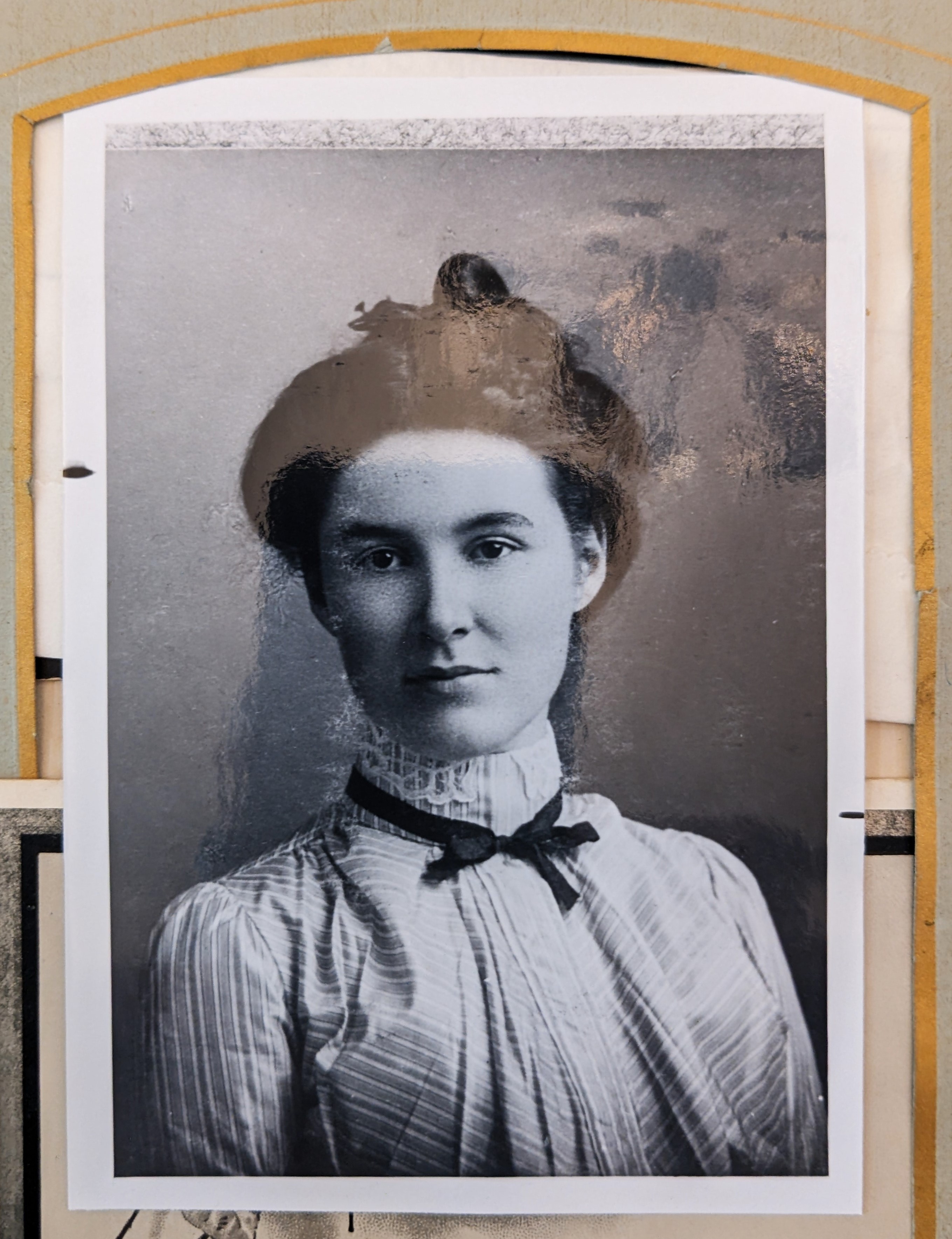
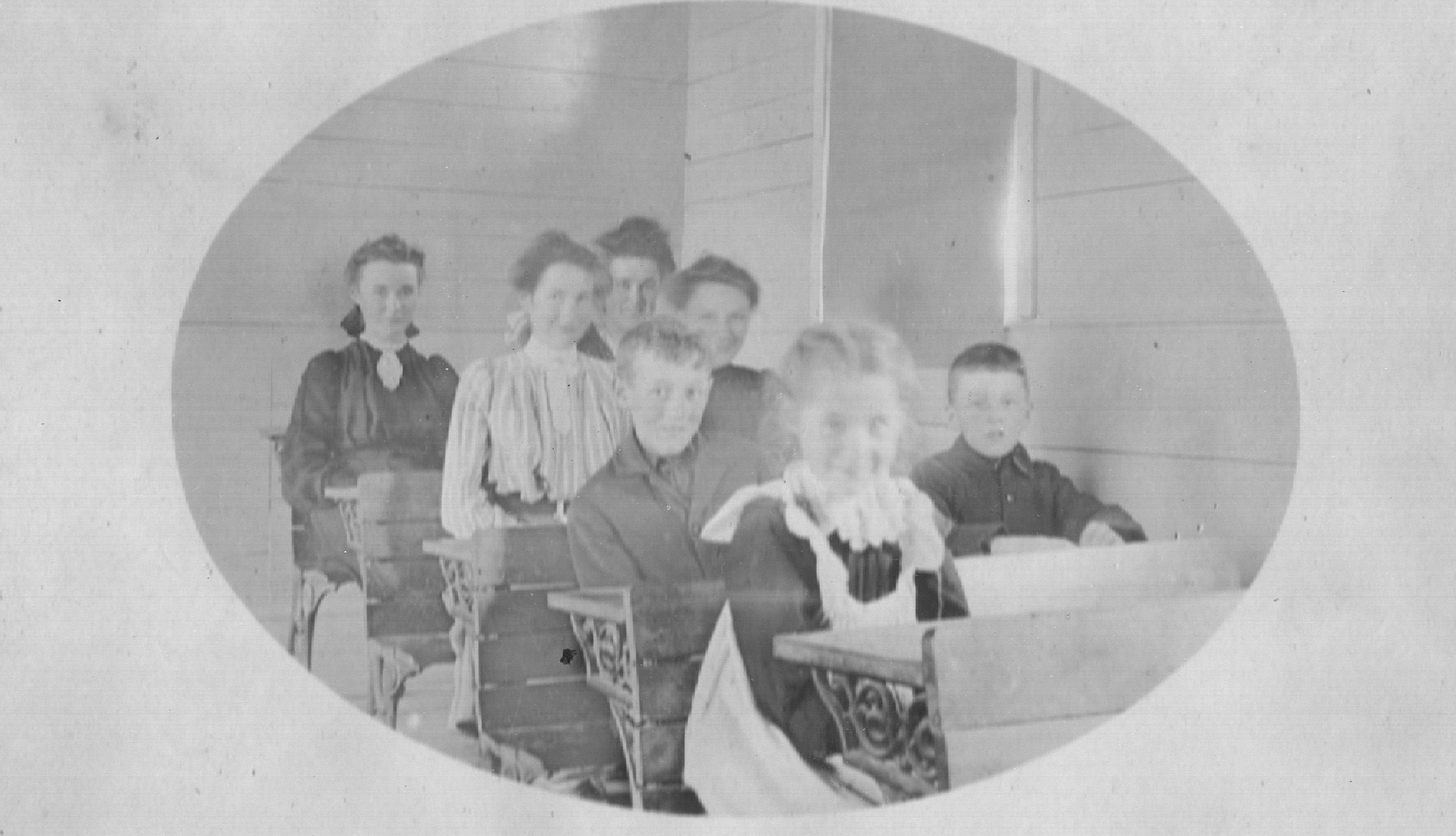
George and Christy Matheson Homestead, The Falls

George died on May 1st, 1928.   It was a late spring and the road to the farm was still blocked with snow although the roads coming from Tatamagouche were bare.  In order for the undertaker to reach the farm, the men of the community formed a work party to shovel a kilometer long road. 

Strachan Gordon Matheson  (1850-1914)

Strachan became a carpenter at an early age and was first employed in Halifax where we find him rooming downtown in 1871.  In 1874 he married Isabella MacDonald of East Earltown, daughter of Donald MacDonald and Betsy Matheson.  She was working in Halifax at the time.  This was not a chance encounter in the city.  Isabel’s mother, Betsy, was born in Rogart, Sutherland, and came with her mother and stepfather to Upper Kemptown in the 1840’s.

In 1880 Strachan, Isabell, sons Gilbert and Gordon were living Ivanhoe Street in Halifax where Strachan was listed as a builder.  Living with them at the time were Isabel’s brother Dan Matheson MacDonald and John Sutherland  “Johnny Lake”.  Both men were carpenters.   Strachan’s younger sister Elizabeth was living with them as a domestic.

In 1882 the family moved to Winnipeg and first lived at 540 Main where Strachan had a shop producing picture frames. By 1890 he was back in the contracting business. His brother in law, Dan MacDonald also settled in Winnipeg and continued to work with him.

In a surprising turn of events, Strachan, Isabel and the younger children were back living in Upper Kemptown in 1911.  Strachan was heir to the estate of his half-brother Gilbert W. who had died in 1907.  The sojourn may have been brief as his grandchildren had no recollection of this move.

Strachan died in Winnipeg in 1914.  

Strachan and Isabel Matheson, Winnipeg

His sons were Gilbert, Gordon and John.  The daughters were Elizabeth Loos, Caroline Skidmore, Bell MacCallum and Sophie.   John was a grain inspector and later a grocer. Bell MacCallum’s husband John was a Nova Scotian from Greenfield, Salmon River.  Sophie came back to Earltown in the early 1920’s and eventually became engage to William “Billy Pentioner” MacKay at East Earltown.  Tragically Sophie died in 1923 before they were married. 

Eiric (Henrietta) Matheson  1851-1887

Eiric was an old Gaelic name often entered in church records as Erc.  Henrietta and Harriet are both translations.  Henrietta never marred nor did she ever leave the homestead at Upper Kemptown.  She is buried in Earltown.

John Matheson  1853-1932

John also started his working career as a blacksmith and most likely apprenticed in Truro.  Like his brother Alex, he migrated west to Colorado and settled in Silver Plume to ply his trade.  In 1879 he met a young lady from Blue Mountain, Pictou County, by the name of Catherine Stewart Austin.  The following year their daughter Una Jeanetta was born in Silver Plume.

Their only other child, George Stewart Matheson, was born in San Francisco in 1885 where they were still living in 1892 on Treat Street.  In 1886, John acquired vacant land in Langley Prairie, British Columbia.  For six years, John spent the winters clearing land and building a road to his property.  His family remained in San Francisco until 1894 when the whole family became full residents of the area.   In 1898, they constructed a farm house which today is a protected heritage site in Langley Prairie and the only 19th century farmhouse still extant in the immediate area. 

Matheson Heritage House ca. 1894
John and Cassie Matheson, Langley, with Una and George in background.

John and Cassie were successful dairy farmers and passed the farm along to their son George.  The writer’s father arranged a visit to the farm while on furlough from his Vernon posting during the second war.  Although the area is now a city, it was a sparsely populated farming community at the time.  He was instructed to inform the bus driver to watch for swinging buggy lantern when passing through area at night.  As expected George Matheson was waiting at the end of a rural road with a lantern late at night.  It was a bittersweet visit as the Mathesons were just getting over the loss of a son in a military air crash.

Elizabeth Matheson 1855-1901

Elizabeth (Bessie) followed her sisters to Halifax and made her home with her brother Strachan.  When Strachan relocated his family to Winnipeg, she followed.  In 1893 she married Albert G. Perry, a native of Pimlico, England, in Winnipeg.  A few years later they moved to Vancouver where Albert worked on the trolley system.  The couple had a child in 1895 who didn’t survive.  Elizabeth died “before her time” in 1901 and is buried in Vancouver.  Albert remarried and died at age 95 in 1960.

Christena Matheson  1857-1934

Christena followed her sisters to Halifax and in 1881 married Alexander Jollimore, first cousin of Jimmie Jollimore, her brother-in-law.  He also farmed on a hill in Jollimore Village and worked locally as a labourer. 

Four of their children died within days in November of 1891.  Annie, Bessie, John W. and Violet are buried in the Old Anglican Cemetery on Purcell’s Cove Road.  Henrietta, (Etta), lived unmarried on her home place.  Alexander, (aka Bert), lived nearby and was a bridge builder with the Province. Strachan Gordon Jollimore was a painting contractor in the city.

Christy (Matheson) and Sandy Jollimore in front. George G. Matheson and unknown in back

Bert’s son Jack, who died in 2024, was the last of this pioneer family living in Jollimore.

William Lane Matheson 1859-1920

William, at age 20, set out from Upper Kemptown for the United States and eventually settled in the mining town of Butte, Montana.  In 1888 he married Annie Hier, a Welsh girl from Maestege, Wales. Around 1905 the family moved to Hoquiam, Washington where his cousins, Alex and Robert Polson along with his older brother Alex, were developing a shingle mill and later a full lumber mill.  William worked in the mills. 

William Lane Matheson, taken in Butte, Montana

William (Bill) and Annie had nine children:  Margaret Olson; Gilbert W, a sawyer; Glen J. a merchant; Dr. George, a dentist; Ruth Day; Elmer died in Butte; Ethel Sparling; Dr. John, a dentist; and Robert, a lumberman.

Many of his descendants remain in the Gray’s Harbour area.

Marion Matheson  1862-1909

While her brothers and sisters scattered to Washington Territory, Colorado, British Columbia, Winnipeg, Halifax and The Falls,  Marion moved a half mile down the road.  In 1881 she was living with her half-brother Gilbert W. and her sister Henrietta as a servant.  In an interview with her son Richard a century later, he related that it was not a good experience as Gibbie W.  was a “difficult old bugger”.

On February 11, 1885 in Truro, Marion became the wife of George Richard Munro, son of Donald Munro and Janet Urquhart.  He was only a year old when his father died and two when his mother died.  He was brought up his Urquhart relatives on the farm opposite the cemetery.

George and Marion continued on the Urquhart property. They had five children:  Dan Gilbert, Annie and Jessie, all of whom died young of TB.  John Alexander “Sandy” worked for the railroad in Truro before an injury after which he retired to The Falls;  Richard continued as a farmer on the home place.

George died in 1902, leaving Marion with the five children to raise.  Sometime before 1905, Sandy and Richard were dispatched west to live with George Munro’s sister in San Francisco.  No doubt this move was to alleviate the strain at home and also shield the two boys from TB which often lurked in an infected household.  The boys experienced the San Francisco earthquake of 1905. While in his late teens, Richard went to Hoquiam to work for the Polsons. After a year, he left Hoquiam to stay with his Uncle John Matheson in Langley.   While there, an aunt persuaded him to enroll in a college at New Westminster.  In his first year, a virus broke out necessitating a quarantine.  After being released from quarantine, he returned to the farm at Upper Kemptown.

Marion died in 1909.  She and her husband are buried in Earltown.

Robert Matheson  (1866-1954)

Robert went to New England as a young man where he apprenticed to be a stone mason.  While in New England, he met up with a girl who was born in Kemptown, Delia Florence Fenton.  They married in 1887 in Laconia, New Hampshire.  Together they returned to Kemptown for a few years where their eldest daughter, Florence, was born in 1891.   Shortly thereafter they moved to Winnipeg where Robert, no doubt, worked with his brother Strachan in the building trade. In 1895 they were living in Michigan when daughter Mabel was born and by 1900 they were permanently settled in Goffstown, New Hampshire, where Robert continued to work as a mason.

Robert Matheson and a Marshall grandchild in Goffstown, NH

They had four children:  Florence married Paul Marshall, Goffstown; Annie married 1. Melvin Radford and 2. Raymond Brown in Massachusetts; Mabel married Forest Johnson and lived in Enosburg, Vt. and William Robert married Josephine Leland and lived on the home place in Goffstown.

Sources:

Canadian Census – Kemptown – 1838, 1861, 1871,1881,1891,1901,1911

Canadian Census – New Westminster, BC 1901

US Census 1910 – Salem, Oregon

US Census 1910 – Hoquaim, Gray’s Harbour, Washington

US Census 1900 – Hoquaim, Gray’s Harbour, Washington

US Census 1900 – Butte, Montana

US Census 1880 – Silver Plume, Colorado

Montana Marriages 1865-1987

Colorado Marriage Records 1879

Hunt, Herbert Washington, West of the Cascades, SJ Clarke Publishing 1917

Van Sycle, Edward They Tried to Cut It All, Pacific Search 1981

Shea, Iris Ferries on the Northwest Arm – A Fond Memory Mainland South Heritage Society

Newspapers.com Various articles pertaining to the Polson Logging Company, A.L. Matheson and William Matheson.

Free Church Records, Earltown Congregation

Jollimore Cemetery

Deeds – Nova Scotia Property Online

Interview – Richard Munro – circa 1978

Interview – Margaret Munro circa 1977

Correspondence – Ruth Matheson Renner, Ariel, Washington

Correspondence – Shirley Jollimore Fraser, St. Margaret’s Bay, NS

Correspondence – Myrtle Boutilier Burton, Jollimore Village

Interview and correspondence – J. Stuart Matheson, Winnipeg

Interview and correspondence – Ronald MacCallum, Calgary, Ab.

Correspondence – Caroline Matheson, Langley, BC


  1. Adams, R.J. Papers on Sutherland Estate Management 1802-1816 ↩︎
  2. While the estate owned the stone buildings, the roof timbers belonged to the tenant and thus could be removed. ↩︎
  3. There is an oral tradition that the two Matheson families had some connection back in Scotland. George MacKenzie of Earltown, a weaver descendant, claimed relationship to Richard Munro, son of Marion Matheson. The connection could also be through the MacPhersons as George Matheson “Weaver” was married to an Elspeth MacPherson while Gilbert Matheson’s mother was also a MacPherson. ↩︎
  4. The operation of the ferry had its challenges. In addition to weather conditions, calls for service from the Halifax side would come at all hours. Lucy was very much “hands on” in the operation. The Boutiliers son continued the service until the mid 1960’s when Halifax Transit began bus service to the Northwest Arm. ↩︎
  5. Per the 1900 Census. His biography in Washington, West of the Cascades claims he left home in 1867. ↩︎
  6. Alex, like some of his MacLean cousins, changed MacLean to Lane after settling in the United States. There was considerable bigotry towards the Irish in the later half of the 19th century therefore those with a “Mac” surname or middle name often dropped the Mac. ↩︎