The Bonesetter

Physicians, as we know them today, were not readily available in the remote valleys of Sutherlandshire nor in rural Nova Scotia. When they did become assessable to the rural population, their services dealt mostly with internal medicine. Routine matters, such as obstetrics, remedies for common illnesses, and skeletal injury fell upon traditional holistic practices by members of the community.

The herbalists, with their arsenal of natural plant material, seemed to be few in number among the immigrants to the Scottish neighbourhoods. The lack of familiar plant material in their new surroundings likely led to their demise. The midwife was an important member of all rural communities. Some practised at large while others tended only to their extended family. The lessor known medic today is the bonesetter.

The bonesetter, or fear fuidhachaidh chnamh, as known in Gaelic, was once ubiquitous in many cultures. As the name suggests, they primarily set broken bones – human and animal. They also repaired dislocated bones and joints and performed many of the treatments common to chiropractors today.

In Earltown, the earliest practitioner was Peter Murray, alias The Bonesetter.
Peter was born around 1778 and brought up in DailfeusaigDailfeusaig, Rogart  (Peter Murray) in the Parish of Rogart. This hamlet was located on the upper portion of the Brora River that formed the boundary between Rogart and Clyne. His father John was a labourer, likely a cattle herder, for a more substantial tenant of the Sutherland Estate. Both John and Peter show up in an 1812 militia list as living at Dailfeusaig with Peter listed as a “residenter”.

On November 3rd, 1814, Peter married a childhood friend named Eliza. She was born in 1795 at nearby Scibberscross to Alexander Murray and Christy Sutherland. Her father had moved to a remote area called Altandoin in the Parish of Kildonan when Eliza was a young girl. That family was uprooted by the clearances of 1812 and found refuge on the heights of Slettil Hill during 1813 before moving into Strath Halladale to the north. The young couple took their vows in the manse of Kildonan on the above date before Rev. Alexander Sage.

We assume that the young couple returned to Dailfeusaig where things were much more stable than in Kildonan and further north. However, this was not to continue. Dailfeusaig was part of a holding over which John Sutherland of Scibberscross was tacksman. Sutherland of Scibberscross was an antagonist of the Sutherland Estate management. It was no surprise when the Scibberscross tack was taken from John Sutherland and given to John Hall in 1818. In 1819 the area along the Brora, between its source and Scibberscross, was cleared. Most of the people took flight to Pictou including several families who eventually landed in Earltown that summer.

In the land petitions of 1822, Peter claims he was a recent arrival from Scotland. However various traditions, settlement patterns and other evidence would suggest he arrived in 1819 with brother in law Alex Sutherland “Ballan”, his former neighbour and militia buddy, Robert Douglas, and a host of other families that settled in the vicinity of Earltown Village.  Some of these early emigrants temporarily lived in the Scotsburn area with earlier emigrants while waiting for location tickets or made that area a home base while clearing their new land.

Peter, Eliza and their two eldest children settled on what is now Sugar Moon farm. Remains of an early dwelling  can be found on the Rogart Mountain trail. In its day, itBonesetter's ruin, Alex MacDonald Road (Peter Murray).jpg looked out over the blossoming settlement in the basin and surrounding hills.
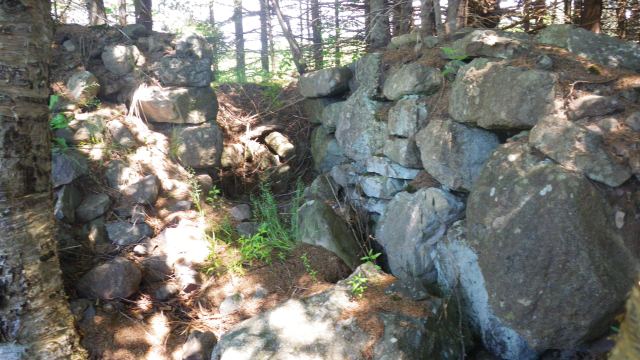
Peter became a leader in both the spiritual and physical life of the community. He was one of the first elders to be elected after the Presbyterian church formally organized in the 1840’s. He was credited with being the one who selected the site of the Village Cemetery in 1824.

Peter’s most important contribution was his bone setting skills. This was something he obviously learned in the old country. During the settlement years, the nearest medical professionals were located in Pictou and, as already noted, were not apt to respond to cases involving broken bones. No doubt there were many bones to heal as land clearing was a dangerous task and few of the settlers had any experience with an axe or bringing down trees. Sprains and dislocations were likely rampant as well. The treatments were likely harsh and painful but the long term relief and rehabilitation endeared him to the community.

To be continued

Part II will deal with Peter’s later life and the bonesetters among his descendants.

Sources:

  1. 1812/13 Sutherland Militia Muster Lists
  2. Correspondence and notes of Mrs. Ida MacKay,  Dartmouth, NS
  3. Whiston, Norris,  Land Petitions of North Colchester, NS
  4. Correspondence of Dr. James Hunter, Scotland
  5. Correspondence of Alexander Murray “Banker” , Inverness, Scotland
Joseph MacKenzie – Catechist of Strath Halladale

When Joseph MacKenzie was born, Strath Halladale in the Parish of Reay was still in the hands of the MacKays, ancient overlords of the far north of Scotland. The area escaped the wide scale clearances of the early 1800’s. In fact, the area was a refuge for people fleeing the shackles of the Sutherland Estate. That came to an end in 1830’s when MacKay of Bighouse, of the ancient MacKay lineage, sold his holdings to the Duke of Sutherland.   Thus the Sutherland Estate acquired a large slice of land in the Parish of Reay. Shortly after this out migration began which resulted in a few families from the area finding their way into Earltown.

Joseph was born in the township of Coull in Reay to Alexander MacKenzie and Ann MacKay. At the time of his marriage to Esther Bruce of Bighouse, he was living in Croik, a hamlet in the upper part of the Strath.   Around 1840, Joseph, Esther, their young children, Joseph’s brother Hector, and brother in law Hector Bruce sailed for Pictou. Hector MacKenzie remained in Pictou County.   Joseph located a farm at Central Earltown while Hector Bruce settled on Boodle Hill. (The Boodle MacKays appear to have emigrated at the same time).

Joseph’s grandson, Kenneth MacKenzie of Toronto, recorded the family story in a small book called “Sabots and Slippers”. Kenneth tells us that Joseph was a devout man and schooled in religious leadership. Upon reaching Earltown, Joseph became a leader at local prayer meetings and also travelled throughout the district teaching the Gospel.

It was on one such trip that Joseph became lost in a blizzard. His health rapidly failed thereafter and he died of pneumonia the following summer. This would be in the year 1848.

Many of Joseph’s offspring died young and are buried in the Earltown Village Cemetery including a daughter Josephine who was born posthumously but didn’t survive long. Only two sons continued with a full life.

William was a merchant who started a small trade in the family house at Central Earltown. He later moved the business to the village. The business has been in continuous operation to this day. The other son, Hugh, became a lawyer and conducted a successful practice in Truro.


William Murray “Inchure” – Catechist

The Murrays were inhabitants of Strath Fleet in Rogart for centuries. Their introduction to the eastern portion of Sutherland harkens back to the time of Bishop Gilbert of Moray, (d. 1245), when he and his extended family were planted there by the King to establish order in what had been a barbaric hinterland.   Gilbert was later known as Saint Gilbert of Dornoch.

From this saintly past came a humble family of Murray’s who lived in Acheilidh, one of the more fertile situations in Strath Fleet. They lived on a holding that was known as Inchure, a name that has been a descriptor of this line of Murrays to this day.

The father of this post’s subject was John Murray “Inchure”, a catechist in his own right, who tended to the flock of his native parish of Rogart during the later years of the 18th century. The biographies of the day make no mention of John however his term was short due to an untimely death.

One of his students in matters of Grace was his son William. William was born 1784 and, as a teen, would have been witness to his father’s spiritual work.   William, so the family tradition goes, also received the training to be a catechist although it is not known whether he practiced in Rogart before emigration.

William married Christena Matheson of Strath Cornaig, a remote part of Dornoch Parish bordering on Rogart. She was a near relation of Rev. George Matheson, a blind preacher in Edinburgh and writer of several well known hymns.

In 1822 this couple joined the tide of migrants to Nova Scotia. This did not seem to be caused by eviction but rather a need to find a better living in the soon to be prospering parts of Nova Scotia. They arrived in Pictou of that year and then took passage to the port of River John. From there they found their way to their new home on the Clydesdale Road. Traces of this homestead can be found near the junction of the Clydesdale and Captain’s Roads.

As mentioned in previous posts, it would be some time before the people of Earltown would have the full attention of ordained clergy. William was one of those who conducted neighbourhood prayer meetings and continued his calling to the catechisms without compensation.

It will come as no surprise that his teaching left an impression on two of his sons, William and Robert, who went on to study theology.   William, in addition to a successful ministry in the Annapolis Valley, also served as a missionary in Jamaica. Rev. Robert was less inclined towards pastoral care but aspired to become the editor of the widely read “Presbyterian Witness” for many years. In addition to sound writing on religious matters, Rev. Robert was a proponent for confederation and debated his preference in his paper in response to the anti-confederate views of Joe Howe. Robert was also a hymn writer, From Ocean unto Ocean being the better known.

William Inchure’s other children were: Nancy, (Donald Murray), of Spiddle Hill, John – customs officer in Halifax, Alex, (Ellen Sutherland), on the home farm, Christy died young, Catherine, (married twice – Robert Sutherland and Andrew Campbell), and Hugh, a prospector in the Yukon.

William died at the early age of 57 in 1841. He is buried in the Village Cemetery.


______________________

Sources:

Goodwin, William Murray, The Inchure Murrays,   unpublished manuscript

The Catechist of Coiranscaig – Part II

We ended part I with George, Catherine and young family arriving in Pictou and being dispatched to Earltown.

It was August in 1822 when the Baillie family, along with others from their home parish, set out from Pictou to find their new home. Old friends and familiar faces were to be found along the way in the Caribou District, West Branch and finally in the Berrichan. The Caribou people were already well established. The Berrichan people, particularly the Baillies of Kilbraur, were two years into the pioneer experience.   Most of this group migrated down the Waugh River valley towards Tatamagouche and extended the 1821 settlement of West Earltown towards The Falls.

George took a 200 acre parcel on the west facing slope of Spiddle Hill. At the top of this slope is an outcropping of rock much reminiscent of the Carrol Rock near Coiranscaig in Clyne. This familiar looking landmark probably convinced George that this would be home.   According to tradition, he chose to clear the hilltop rather than the more fertile valley bottom next to the river.

In addition to the rigors of establishing a viable farm, George assumed a self appointed role of a Highland catechist.   It would be many years before the mother church would secure a permanent minister for the growing district. Thus George had a potential mission of several hundred souls to nurture.   In the years to come, William Murray and Joseph MacKenzie, both trained catechists, settled in the Earltown area and lightened the load.   However, George did not contain his zeal to Earltown. As evidenced by the marriage of several descendants into the Gaelic Presbyterian community surrounding Wallace in Cumberland County, it appears that he was a regular apostle to Kirk people in that area.   There were also strong associations with the Caribou District in Pictou.

“Records of Grace in Sutherland” relates how George Baillie “by his holy life, he continued to adorn the doctrine of God his Saviour” in North America. “One day, it is affirmed, he had occasion to go to a place some distance from his new home. On his return, he completely lost his way in the pathless forest. In his helplessness, he had recourse to prayer, and when he rose from his knees, he saw a strange dog approaching and fawning upon him and then moving in a certain direction. He followed the sagacious animal until at least he came in sight of his own log cabin.”[i]

In addition to weekly prayer meetings and catechising in the settlers’ homes, he continued to exercise his debating skills at four day communions in the scattered districts of North Colchester and Pictou. It was reported in a paper in the 1840’s that “prominent among the men speaking to the question at a recent Tatamagouche communion, was the venerable George Baillie of Earltown, whose grasp of the doctrines could match or exceed that of the attending clergy”. Therefore, George was a powerful speaker in both Gaelic and English, as Tatamagouche would not have conducted their communion in the tongue of the Gael.

Not everyone was enamoured by his religious zeal. An elderly lady once related to this writer that George Baillie was a regular visitor to her grandfather’s home.   Although her grandfather was an elder and pious, he dreaded these visits and would have the whole family hide in the hopes that Baillie would move along to the next farm.   Although the clergy describe him in the most flattering of terms, he could be very dour and not bashful about rebuking parents and children alike for lapses in their scriptural knowledge or attention to family devotions.

When a church structure finally came to Earltown, both the Kirk and the Free Church, George was one of two elders elected to represent The Falls District of the Earltown Congregation under the auspices of the Free Church of Scotland.

Of his family, his eldest son, Alexander, settled the lower 100 acres of his grant beside the river. Alex was more commonly known as “Doctor Baillie”, supposedly due to a practice of setting broken bones. His eldest daughter Christy married Alexander Sutherland, “Laughing Sandy”, of MacLeod Road. Several tales survive of “Laughing Christy” who apparently had the second sight for which her Grandmother Baillie was renowned.  Four daughters, Margaret, Ann, Mary and Elizabeth, married in the Wallace area as did a son John. Their youngest son, Dan, was a successful farmer at Balfron.

The August 12th, 1854 edition of the Presbyterian Witness gave notice of his death: “At Earltown, June 26th, Mr. George Bailie, age 72 years. Mr. Bailie was a native of the parish of Clyne, Sutherlandshire, Scotland. He gave evidence early of a saving acquaintance with God, and at the early age of 23 he became a member of the Church of Scotland. He emigrated to America in the year 1822 and on this side of the Atlantic he still maintained his Christian profession.   Possessed of an exceedingly retentive memory….”[ii]

His remains lie in Murray Cemetery, in the shadow of his home on Spiddle Hill.


_______________

[i] Munro, Rev. Donald, “Records of Grace in Sutherland”, Free Church of Scotland 1953 (A biographical collection compiled by Rev. Munro of Rogart in the mid 1800’s)

[ii] Presbyterian Witness, August 12, 1854 Microfilm   PANS

Iii Interview, Mrs. Gladys MacDonald, 1982

The Catechist of Coiranscaig (Part I)

Coiranscaig is a pre-clearance hamlet situated on a hillside overlooking the narrows of Loch Brora. It was a place long associated with the Baillies, probably back to 1500 or prior when they were a prominent family under the Earl of Sutherland.   By the late 18th century, Coiranscaig became well known as the home turf of a pious family of Baillies who ranked high among the laity of Sutherland.

One of “Men” of Strathbrora was a Hugh Baillie who was born at Coiranscaig in the mid 1700’s.   He was “a most impressive speaker, and, latterly, on account of his years and ripe experience, he was usually one of the first Strath Brora “men” to be called at Fellowship meetings. It was an inspiration to see him rise on a communion Friday. His venerable appearance, his solemn and subdued manner, and even the quiet flow of his address, always os fresh and savoury, drew upon him the eyes of hundreds in the congregation and sustained their attention until he sat down.”   Hugh was a fixture at communions throughout the Highlands, often travelling for a week over mountain passes and down glens to reach destinations on the west coast.

Hugh’s wife, whose name has not been documented, was outstanding among the women of her parish for her kindness and piety. She seems to have been gifted with the second sight. On one occasion, after entertaining some travellers with refreshments, she sensed that the men were going to experience something serious. Some of the travellers drowned later that day while crossing Loch Brora.

This good couple had only one child, a son George. George was born September 22, 1782 on Coiranscaig. He grew up being a witness to his father’s evangelism and often attended the sacraments with his father. “ In his religious training he was exceptionally favoured, for not only did he come under home influences greatly fitted for fostering true piety, but he enjoyed rare opportunities of associating with the many outstanding saints in the neighbourhood, at whose feet he considered it a privilege to sit.”[i]

In a time when the fathers of Sutherland were reluctant to bring young men into their saintly circle, George was granted a high standing among the catechists and elders. It was also an era in which full membership to the Kirk was reserved for people mature in biblical instruction and experience. However, George was confirmed at the exceptional youthful age of 23.

George was married twice. His first wife, Jane Stewart, died at an early age leaving George with a young son John. John was put in the care of his mother’s people who raised him. John’s descendants still live in Clyne.

George was married the second time to Catherine Grant on August 8, 1808. She was the daughter of Alexander Grant and Margaret MacKenzie, Alexander being one of the prominent churchmen of Strath Brora and a tenant of some means.   George and Catherine had six children at Coiranscaig of which four survived before emigrating in 1822.   A daughter, Mary, was born at sea in 1822.   Three more children were born in Nova Scotia.

As mentioned already, the Baillies were tenants of some means during their early tenure in Sutherland and held lands on the shores of Loch Brora.   With the ascendancy of the Gordon family, they lost their status and became small tenants of the Carrol Estate under the Gordon’s of Carrol.   They seemed to have had a satisfactory relationship with the Gordons for several generations. However, this came to an end in 1812 upon the death of John Gordon.   His heirs sold the estate to the Countess of Sutherland in order to pay off accumulated debts.   The Countess gave assurances to the heirs that the tenants would not be disturbed.[ii]

Agents of the Countess had other plans, and set out to gradually depopulate the estate to turn it into a large sheep farm. Portions were cleared as early as 1813 with the removals reaching their height in 1820.   In that year, George and Catherine were issued writs of removal.   We are not certain what became of them at that point but they most likely moved to the coast to claim a small holding being offered to the evictees. It was the grand scheme of the estate to use the displaced farmers as labourers in various industries around Brora. Like many of their former neighbours, they found the small lots to be unsatisfactory and longed to emigrate. By 1822, an opportunity presented itself.   Joseph Gordon, son of their former landlord, arranged for subsidized passage to Pictou. Gordon had solicited funds from merchants in Bengal, India, to assist the evictees in leaving Sutherland. He had motives other than of a benefactor. He wanted to “get even” with the Countess for failing to keep her promise with respect to his father’s former tenants.

George, Catherine and their six or seven children arrived in Pictou in August of 1822[iii] along with several dozen families from Strath Brora. A few were given location tickets in East Pictou but many were dispatched to Earltown where they joined family and friends who had preceded them in 1819 and 1820.

The next post will tell of George’s spiritual calling in the New World.


[i] Munro, Rev. Donald, “Records of Grace in Sutherland”, Free Church of Scotland 1953 (A biographical collection compiled by Rev. Munro of Rogart in the mid 1800’s)

[ii] Hunter, Dr. James, “Set Adrift Upon the World, The Sutherland Clearances”,   Birlinn 2016

[iii] Church records: Earltown Congregation, Family Register, Microfilm, Provincial Archives of Nova Scotia

iv Correspondence – Hugh Baillie, Brora, Sutherland


Catechists in the New World

The traditional titles, offices and vocations of the pioneer mainline churches are largely unknown today in rural Nova Scotia, having slowly transitioned into more casual forms of religious observance or, in most cases, into a secular lifestyle with a Christian ethical code. Gone are the days of ruling elders, precentors, Clerk of Session, stewards, etc..   Long gone is the Catechist, the subject of this post.

The term Catechist comes from Greek meaning to teach by spoken word. It was a recognized position in the Catholic laity prior to the reformation and thus migrated into the early Protestant church.

By the 18th century, the Catechists were a highly regarded group of religionists in the North Highlands of Scotland. There were initially appointed from among the laity to assist the Parish Minister with Christian education matters, such as instructing parents on baptism, preparing adults for confirmation and presiding over what we now call “bible study meetings”.   The parishes in the north were geographically large and remote.   People living in the out lying areas would be unable to attend the Parish church on a regular basis therefore the Catechist would be dispatched to those areas to instruct a particular family or group of families in their homes.

These Catechists were chosen from the laity by the minister and occasionally by the people. They were men of unwavering piety, deep thought and high functionality in Gaelic. English was not necessarily required and they often supplemented the preaching of the ministers who were not necessarily as proficient in Gaelic.   Some had basic education and could read in both languages however many relied upon a high capacity to remember everything they ever heard including extensive tracts of scripture.   Some received a stipend from the Church of Scotland for those duties performed under the supervision of the clergy. Others simply served as part of a personal calling.

The Catechists were the core of a unique group in the northern shires known as “The Men”.   The Men would assemble at the various sacrament events in the neighbouring parishes.   During the four day communion, Friday was reserved for “The Men”.   A scriptural passage would be presented by a presiding minister and “The Men” would rise in turn and speak extensively as to the meaning. Some were very eloquent and philosophical. Others used the occasion to speak impressively but without substance. The minister would conclude the day long event by correcting scriptural references and summarizing the debate.   Some Catechists became quite famous over the whole of Highlands for their insight and speaking abilities.

By the start of the 19th century, just prior to the clearances, the Catechists had risen to great prominence, surpassing the elected elders and clergy in popularity. This was particularly true in the Parish of Clyne where the pulpit was occupied by Rev. Walter Ross.   Rev. Ross was an appointee of the Countess and, transparently, was a voice of the Sutherland Estate. He was a cattleman, often absent from his duties.   The Catechists filled the spiritual void and often conducted services in the outlying areas as well as in the school in Strath Brora.   In the messy politics of the Strath Brora clearances, Rev. Ross clearly took sides with the Estate.

It will come as no surprise that the Catechists received no special treatment during the upheavals of 1819 to 1822 in Clyne and beyond.   They were among those evicted from their homes and sent elsewhere to start over.   Three such men found their way to Earltown. They came from separate parishes and at different times. But none the less, they came as a result of social upheaval during which their church remained silent.

In Northern Nova Scotia, particularly in North Colchester, Pictou County and parts of Cape Breton, the Presbyterian population exploded in the first decades of the 19th century.   Ministers were scarce and of those that were established in the towns, most did not adhere to the Church of Scotland.   Although disappointed with the Church of Scotland, (The Kirk), the settlers out of the far north of Scotland still clung to it. It would be many years before the infant settlements, such as Earltown, would receive a settled minister.   In the mean time they traveled to Pictou, New Glasgow or Hopewell for baptisms and marriage. Occasionally a missionary would pass through the settlement and handle the backlog. Weekly worship fell upon themselves.

In the case of Earltown, the three Catechists filled the void. They visited families in their remote homesteads, presided over burials and conducted prayer meetings in homes or barns. By the mid 1830’s, Rev. William Sutherland was living at West Earltown as a farmer. He was never called but availed himself to those who would adhere to him. It appears that some families, for whatever reason, stuck with the Catechists until the arrival of the Free Church and a settled minister in 1846.

Proceedings of the Presbyterian Church indicate that the “Catechist” designation was still recognized as late as the 1860’s but only as it related to trained missionaries sent to labour in remote areas not served by a minister.   These Catechists appear to have been student ministers or experienced teachers aspiring to be in the pulpit. “The Men” in the communions of the new world included some former Highland Catechists but now included the elders who now had Christian education as part of their job descriptions.   As the Catechists of old died off, the elders became the sole leaders in education and outreach.

The three following posts will follow the travels of George Baillie, William Murray and Joseph MacKenzie, all active Catechists in Earltown.

Sources:

MacPhail’s Edinburgh Ecclesiastical Journal and Literary Reviews:

     Letter to the Editor by anonymous Highland Parish Minister

 Munro, Rev. Donald, “Records of Grace in Sutherland”, Free Church of Scotland 1953 (A biographical collection compiled by Rev. Munro of Rogart in the mid 1800’s)

 Patterson, Rev. George, “A History of the County of Pictou”, Dawson Bros., Montreal 1877

Report of the Proceedings of the General Presbyterian Council, Edinburgh, 1877

 Correspondence: Dr. Elizabeth Ritchie, University of the Highlands & Islands, Dornoch

Youth of The Falls

thefalls

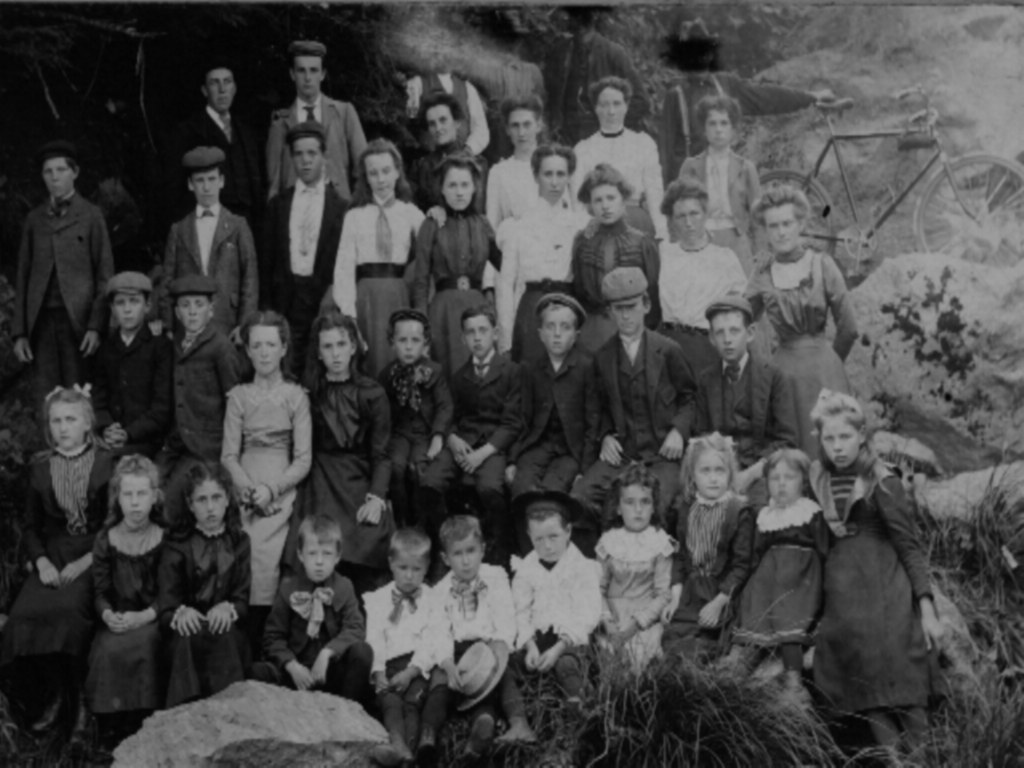
This picture was taken around 1900, very likely by E.W.L. Haskett-Smith of Tatamagouche.  It was posed on the bank of the Waugh River near The Falls school.  A more complete biography on the subjects will follow however here are the ones identified to date:

Back row:  (faces blurred)  Mr. Grant,  Gib’s Alex Sutherland,  Hughie Sutherland “Kemptown”, Peter Murray

Second from back: L-R  Willie A. MacLeod, Gib’s Willie Sutherland, Gib’s Barbara Sutherland, Mary Sutherland “Sandy”, Jessie Bell Sutherland “Caribou”,  Tillie Sutherland “Sandy”

Third from back: L-R   John Gallie, Kennie’s Jim MacKay,  Geordie MacLeod, Janie MacLeod, Barbara Ann MacLeod (Dan’s), Tena MacLeod,  Jennie Sutherland “Ban”, Cassie Matheson,  Kennie’s Maggie MacKay

Fourth from back: L-R   Dan R. MacLeod, Dan’s Johnny MacKay, Tena Matheson,  Cassie Sutherland “Sandy”,  Farquhar Sutherland “Sandy”, Wesley Sutherland “Sandy”, John Will MacLeod, Dan’s George W. MacKay, Murdoch Sutherland “Ban”

Front row:   Jessie Ann MacLeod, Barbara MacLeod,  Jessie Sutherland “Sandy”, Leslie MacLeod, Willie Murray “Corrigan”,  Dan Murray “Corrigan”,  Daniel Sutherland “Caribou”,  Bessie Matheson, Marion MacLeod, Alice Sutherland “Ban”,  Margaret Sutherland “Ban”

MacBain’s Corner Group Photo

MacBain's Corner  ca. 1900

MacBain’s Corner ca. 1900

This is one of a series of group pictures taken in the area around 1900 by a travelling photographer.  It was most likely taken by E.W.L. Haskett-Smith, a surveyor from England, who was working in Tatamagouche at the time.   A list of those in the picture was not attached.  If anyone can identify their relatives in this picture or have a list to accompany the picture, please contact me.

Clydesdale School

Clydesdale School

Clydesdale School Courtesy of Carol Driscol

The Clydesdale School was located on the Clydesdale Road about one kilometer southwest of the junction of the Clydesdale and Stewart Roads.  It served the area once known as Spain and appears to have been labeled as the South Earltown school in the 1830’s.  The section extended from the Captains Road to just beyond the county line.  The Baillie family, who actually lived in Pictou County, attended this school due to its close proximity.  The district also covered the east end of the Berrichan.

The exact date of closure is not known.  At the time of the first war, Johanna Murray McGonagle, claimed that the building was in very poor repair.  The sills were rotten and snow would drift in under the walls.

Back Row (Left to Right):   Mrs. Tuttle – teacher;  Georgie Baillie (Mrs Herdman McNabb), Barbara MacKay “Achlean”, Tena Graham, Bessie MacIntosh (Mrs. Shier), Christy Baillie, Annie Murray “Gorm”,  Josie Murray “Gorm” (McGonagle), Margaret Baillie, (1st Husband Wm. Graham, 2nd Husband Wm. Baillie, River John),  Agnes Murray “Gorm”, Agnes Murray,  Bill Baillie (later of River John),  Mrs. Dan MacIntosh;

Front row from right to left:  Dan MacIntosh,  Annie MacIntosh,  Willie Murray “Gorm”,  Jack Graham,  Jack Baillie,  John Will MacKay “Achlean”,  J. Murray,  Bessie MacIntosh, Alice MacKay “Achlean”,  Annie MacIntosh, Agnes MacIntosh,  Lawson Baillie.

Approximately location of Google Maps:  https://mapsengine.google.com/map/edit?hl=en&hl=en&authuser=0&authuser=0&mid=zWuNe7Aar9m4.ksfCUGlYm48k

Fiddler MacIntosh

Robert MacIntosh 1819-1904

Robert MacIntosh
1819-1904   (Collection of Kathryn Sutherland, Mn.)

When not immersed in the never ending toil of farm and forest,  the Scots turned to the pipes or the fiddle to lift their spirits.  Every corner of the settlement had someone with the talent to play the melodies brought from the old country.

The most notable fiddler in the settlement during the 19th century was Robbie MacIntosh.  Robbie was born in Rogart in 1819, the eldest son of William and Betsy MacIntosh.  The family left Rogart in 1825 to come to Earltown and join up with William’s brother, Donald, who had come over a few years earlier.   This MacIntosh family settled on the west end of the Clydesdale Road – a short distance in from the Denmark road.  Robert was the eldest of six children and took over the family farm from his parents.  He had five siblings, none of whom married.

Robbie’s father was an accomplished fiddler in the Old Country and entertained his fellow passengers on the voyage to Nova Scotia.  Robbie took up the fiddle at an early age and became a well known musician.  He was in demand throughout Earltown and West Pictou at dances, fairs, folics and weddings.  He competed in contests and was often the victor.

His most noteworthy engagement was in 1860 when the Prince of Wales,  later King Edward VII, visited Halifax. A ball was held to honour the Prince and Robbie was invited to play the Scottish reels for the Royal Dance.  Robbie had an audience with the Prince and was given a tall silk hat from the Prince’s wardrobe.

Like many of today’s accomplished fiddlers in Cape Breton,  Robbie could step dance while playing the fiddle.  He was still able to master this technique at an advanced age.

When Fiddler MacIntosh became too old to look after the farm,  he went to live with the Graham family at the other end of Clydesdale.  He died in the care of the Graham family in 1904.  His grand silk hat was lost in a subsequent house fire.

Sources:

Interview:  Josie MacIntosh Graham  ca. 1980

G.R. Sutherland : “The Rise and Decline of the Community of Earltown”  1980

Map:   https://mapsengine.google.com/map/edit?hl=en&hl=en&authuser=0&authuser=0&mid=zWuNe7Aar9m4.ksfCUGlYm48k