Earltown’s Catholic Priest

It may come as a surprise to most that Earltown, a bastion of Presbyterianism, the host of an Orangeman’s Lodge, and the settlement of former soldiers who “kept order” in the future Republic of Ireland, produced a prominent Roman Catholic Priest who served congregations in Massachusetts.

As explained in an earlier post here, Earltown’s western front extended almost to East New Annan and thus encompassed the old school district and postal station of Kavanagh’s Mills. While not thrilled over their association with the “gallick” speakers of Earltown, they did identify as natives of Earltown when referring to their homeland. Among those families outside the Earltown Gàidhealtachd were a sprinkling of Irish Catholics who settled upstream of the Kavanagh Mills bridge. This gave rise to the locally dubbed community of Corktown.

While searching the online archives of the Boston Globe, I came across the following:

Boston Globe Fri December 12, 1913

“William Henry Fitzpatrick was born in Earltown, Colchester County on November 21, 1832” reported the Boston Globe. “His father was an Irishman and his mother, Jane Jardine1, a native of Ayr, Scotland, was born next door to Robert Burns’ cottage… her father being personal acquaintancesof the immortal poet”.

The father was Stephen Fitzpatrick, a native of Enniscorthy, County Wexford. How he came to be in Pictou in the late 1820’s, and by what route, is unknown. Here he met and married Jane “Jennie” Jardine, a native of Middebie near Ecclefehan, Scotland. Shortly thereafter, Stephen and Jennie acquired an acreage near Kavanagh’s Mills. The property was located in a remote location off the Kennedy Hill Road2. A number of other families of Irish Catholic origin were in the immediate area with names such as Ryan, White, Burke, Canary and Woodlock.

William attended the school at Kavanagh’s Mills3 for as long as it would take him. In his late teens, he taught at the same school for two years and “.. filled that exacting office to the satisfaction of all concerned”4. At the age of 20 he left his native land and went to Massachusetts and worked for a few years in Bilerica, Bolton and Dedham to save money for college. He enrolled in Holy Cross College in Worcester and graduated in 1862. His theological training took place at the Sulpician Seminary in Montreal, where at the end of four years he was ordained on May 26, 1866.

His early priesthood was spent in Milford, the Boston Cathedral, and East Boston. This was followed a successful attachment to a church in Stoneham where he expanded the parish by purchasing former Protestant churches in Stoneham and Melrose and modified them for his own faith. He also led the building of a church in Wakefield.

Dorchester Today

In 1875 he was sent to St. Gregory’s Church in Dorchester, Massachusetts, where he would labour for 38 years. Social outreach was his passion and during his lengthy tenure at St. Gregory’s, he established four separate parishes out of the original. His expertise in land transactions and construction were an asset to the diocese. In addition to building churches for the four new parishes, he also acquired land and planted the seeds for a high school, convent, and grammar school. Beginning in 1894, a substantial renovation to the main church was started resulting in its impressive towers and facade.
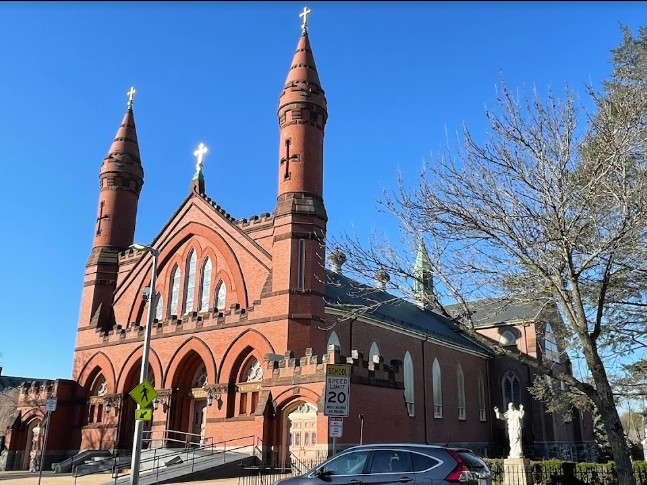
St Gregory’s

Father William’s three brothers also lived in Massachusetts and his parents left Kavanagh’s Mills for Hazelton around 1871. His father only lived for two more years. His mother lived for a time in the rectory but spent many years in a nursing home in Boston. For many years the workings of the rectory were ably managed by Christy Munro, a native of Pictou County. After much research, it turns out that she was a maternal first cousin of Father William. She continued in the employ of Father William until his death and was generously remembered in his will.

The Father was not shy of the powers to be. In 1908, while in Washington, he was invited to the White House to visit President Roosevelt. In 1906 at the age of 74, he took his first major leave of four months. During that time he visited the native parishes of both his mother and father, toured the continent, the Holy Land and went to Rome to pay a visit to the Pope. He was warmly received and had a grand chat with Holy Father5.

Nor did he forget his humble beginnings. He came back to Kavanagh’s Mills on occasion to visit old acquaintances. The Catholic community of Corktown migrated out shortly after the Fitzpatricks but the relationship between Catholic and Presbyterian was always cordial in that area. My grand aunt, Reta Murray MacRae6, recalled that a Fitzpatrick priest would come and stay with her family while visiting the neighbourhood. There was no mention of grand schemes or powerful personalities. Like any former teacher, he was likely more interested in the lives of his former pupils.

On Friday, December 12th, 1913, Rev. William Henry Fitzpatrick LL.D. was found dead in bed by one of the assistant priests. There had been no indication of ill health, although he had written a brief sketch of his life history days before. “Last Monday in the church which Father Fitzgerald had built, and at whose alter he had so often broken the Bread of Life to his people, his funeral service was held. The spacious church could not contain all who wished to attend th obsequies, and many waited outside. Several hundred priests were in attendance, included a number of Monsignori, and Cardinal O’Connell occupied the throne in the sanctuary”7.

In the old Dorchester Cemetery are the graves of Father William and his parents James and Jennie, his birthplace not forgotten.

  1. The Ayr connection to Robert Burns is often mentioned in articles celebrating Father Fitzpatrick’s milestones. The Old Parish Registers show that Jane’s parents, Robert and Ann Jardine lived in Middlebie near Annan in 1816. The connection between Burns and Jardine most likely happened when Burns was moving about in Dumfries-shire. Father Fitzpatrick would make humorous complaints about daily papers getting his life record wrong. ↩︎
  2. Locals will be familiar with the old homestead of John Will Sutherland on Studivan Mountain. The Fitzpatrick place was southeast of this. ↩︎
  3. The school was located near the west end of the Kavanagh Bridge close to where the Hiltz cottage stands today. It closed around 1900 as the backcountry emptied out. ↩︎
  4. The Sacred Heart Review, Vol 5, No 24, 29th November 1913 ↩︎
  5. Pilot, Vol 69, No. 23, 9 June 1906 ↩︎
  6. The visit came up in a conversation with Reta in 1980. I don’t recall if the visit was when she was girl or she was recalling what her parents had told her. My grandmother often mentioned the Fitzpatricks but I don’t recall mention of the priest. One of Reta’s uncles was named Alexander Fitzpatrick Murray in honour of the family friendship. The late Andrew MacKay of Tatamagouche Mountain also mentioned a Fitzpatrick priest from Boston visiting the neighbourhood. ↩︎
  7. The Sacred Heart review Vol 51, No 1, 20 December 1913 ↩︎

Sources:

Several articles at Newspapers.com taken from the Boston Globe during the lifetime of Rev. Fitzpatrick

Pilot Vol 69 No 23 9 June 1906 Boston College Libraries

The Sacred Heart Review Vol 51, No 1 20 December 1913

1838 Census, Earltown, Colchester County

Registry of Deeds Index, Colchester County

Interview – Mrs. Reta Murray MacRae 1980

Interview – Andrew MacKay 1982

Assistance of David Heatley, Forester, with locating the site of the Fitzpatrick house at Kavanagh’s Mills

Distinct Society Issues in 1857

There is a saying that all politics are local.   That was certainly the case in 19th-century rural Nova Scotia. 

Today, the municipality or province funds and manages local public services.  While a municipal district had representation on the county council or a group of municipal districts had a member of the provincial legislature, rural districts had very little control over local public works.

Communities along the north shore of the Minas Basin adopted the New England model of townships.  This enabled the residents of each township to appoint their own officers, levy rates, maintain records and deal with petty offenses and petitions.  The Court of Sessions[i] governed the remaining communities and was based in Truro and later assumed jurisdiction over the old townships.   This arrangement continued after the formation of Colchester County in 1835 and was replaced by the Municipality of Colchester County in 1879.

In 1841 the districts in North Colchester presented petitions to the colonial assembly asking to be granted township status.   Earltown, Tatamagouche, and New Annan each wanted more control over local spending priorities.  This was never granted.

In 1857 another petition[ii] materialized.  This time, the residents of the western communities of the Earltown district requested that they be annexed to New Annan.  The primary reason stated was “as the business of Earltown is generally done in “Galick” which they do not understand”.

Most of us think of Earltown’s boundaries as that portrayed on A.F. Church’s Map of Colchester County (1874).    It shows the western boundary starting at the northwest corner of The Falls, (near Drysdale Falls), and following  Baillie’s Brook south towards Kavanagh’s Mills.  It then branches easterly and follows the Baillie Brook to its source near the Nuttby towers and then on to the southwest corner of the community of Nuttby.

However, the original western boundary was approximately 2.25 km. west of the revised boundary, roughly where the Four Mile Brook crosses the New Annan – Balmoral Road.   It went in a southerly direction across the ridge between Tatamagouche Mountain and East New Annan and on to Nuttby.   It encompassed the communities of Tatamagouche Mountain, Kavanagh’s Mills and Corktown.

The aforementioned communities were diverse when compared to the rest of Earltown.  Several of the Tatamagouche Mountain families were Ulster Scots who relocated from Truro.  There were Irish Catholics in the Corktown area as well as two German families – one Catholic and one Anabaptist. There was a Norwegian, a Swede, a Lowland Scot, a family from eastern Caithness with no Gaelic and a half dozen Highlanders.   

 The bulk of Earltown was inhabited by Gaelic-speaking Scots – the majority of whom had roots in the eastern parishes of Sutherlandshire.  Layered on top of that, they were clannish to a fault with little appetite to mix genes with other European families.  Religion also played a role.  The Earltown folk were all attached to the Established Church of Scotland, a different breed of Presbyterian than those of Ulster background.  Throw into that the unfortunate views held by Protestant Scots towards Catholics.

The annexation didn’t involve expenditure.  The Earltown folk were silent on the matter as they had no intention of being more inclusive.  The magistrates wisely decided to grant the request.

Below are the families involved in the annexation as per the 1838 census:

Jacob Kisselbach     –   German Catholic in Corktown[iii]

Jacob Wortman       –  German, Baptist;  Family came to Onslow via New Brunswick; He settled in

                                                    Corktown

Richard Hyslop         –  Scot from Dumphries; lived at Kavanagh’s Mills

Stephen Fitzpatrick   –  Irish Catholic;  Corktown.

John Ryan                 – Irish Catholic;  Kavanagh’s Mills

George Crowe          – Onslow native of an Ulster family

Alex Shearer             – Scot from Caithness living at Tatamagouche Mountain

William Murray          -Father came to Pictou on the Hector and settled in Merigomish.  William

                                              married into the Crowe family and came to Kavanagh’s Mills to upgrade                                             theGrist mill;  [iv]

John MacKean           – Ulster and New England background; Kavanagh’s Mills

James Mullany           – Irish Catholic

George Smith           – Lived at Tatamagouche Mountain

William MacKean      – Ulster and New England background; Lived  near East New Annan

Hiram Downing         – From Onslow; lived at Tatamagouche Mountain

Richard Wooden       – Kavanagh’s Mills – Corktown area

Robert Miller             – Remote farm off the Old Truro Road

John MacKean Sr.     – Kavanagh’s Mills

David Aikenhead      – Between Corktown and Old Truro Road

Michael Terry            – Between Corktown and Old Truro Road

James Drysdale         – Came from Truro area; Lived at Tatamagouche Mountain

Jerimiah McCarthy     – Irish Catholic;  Corktown

John McCarthy          -Irish Catholic;  Corktown[v]

Hector Sutherland     -Property unidentified at the moment but possibly the Hector Sutherland who                                                settled at Balfron in 1841

Hugh Tucker             -Corktown

Edward Studivan    – Swede; servant with the Denoon family; Lived first between

                                      Kavanagh’s Mills and West Earltown, later on Studivan Mountain

From the 1861 Census we can add these families:

Robert Harris              -Descendant of Dr. John Harris of Maryland, Pictou and Truro

Alexander Conkey      – Relocated from Old Barns to Tatamagouche Mtn.

William Thompson  – Native of Norway, married to Mary Hayman

William McNutt         – Relocated from North River to Tatamagouche Mtn.

Robert Hodge           – Studivan Mountain

Donald Henderson  – From Scotland via Middle River to Studivan Mountain

Michael White         – Irish Catholic in Corktown

David Canary               – Irish Catholic in Corktown briefly before settling at South

Tatamagouche

Phillip Burke                 – Corktown

Henry Porter                 – Corktown

Peter MacDonald           – One time miller at Kavanagh’s Mills later Tatamagouche Mtn.

George Carter                  – Corktown

Thomas Lynds                  – Corktown

Hugh MacKay                   – Hugh “Uhr”  then living at Tatamagouche Mountain before moving to the

                                                    Corktown Road

William Kaulback           – Tatamagouche Mtn.   Removed to Truro

Robert Kent                       – Tatamagouche Mtn

Illustration of approximate boundaries here.https://www.google.com/maps/d/u/0/edit?mid=1ol-7kuK8URtHSf-_0-coZ9AadPEVaSc&usp=sharing


[i] Nova Scotia. Court of General Sessions of the Peace (District of the County of Colchester) – MemoryNS

[ii] RG5 Series P Vol 16 #28  PANS  Feb. 13, 1857

[iii] Patterson “History of Tatamagouche”  relates that Kisselbach, (Kisslepaugh), fought on the opposite side of the Napoleonic Wars than his Earltown neighbours.  The battles continued in Earltown.

[iv] The writer’s ancestor. He was likely fluent in both Gaelic and English.  None of his children spoke Gaelic and reportedly were annoyed when neighbours would switch to Gaelic when conversations became juicy.

[v]  Corktown did not have the most suitable land for farming.  Supposedly a Priest counselled the Catholic families to vacate or starve.  Several moved to Middleton while others moved to New England.