On June 25th, 1821 Hugh MacLeod and his four children caught their last glimpse of their native hills of Eastern Sutherland from the deck of the Ossian bound for Pictou in far off Nova Scotia. Until May 30th of that year, the family had lived for generations in the declivity they could see on the horizon, the river valley known as Strathbrora.
They were not alone on this adventure. They were one of twenty-one households all from the same parish of Clyne in Sutherlandshire and some would become their neighbours in the new land.
On the morning of May 30th of that year, and not without warning, an eviction crew under the direction of the Sutherland Estate began the removal of the final inhabitants of the Strathbrora. There had been previous evictions in Clyne and several folks left voluntarily the previous year for either Caithness to the north or the colonies in North America. Most of those families had the financial means to acquire farms elsewhere or pay passage across the ocean. The last remaining group first delayed the action by claiming an exemption brokered by their minister[1] when eviction became a possibility. Although small lots had been offered near Brora, the remaining inhabitants waived the offer and were prepared to mount a resistance. [2]
While the actual work of eviction was carried out by some thuggish characters in the employ of the estate, a small regiment was dispatched to the area as a violent resistance was expected. In most cases, the families gathered their belongings and left while the more militant fled through the back country to Caithness. As was the pattern, the homes and crops left behind were burned to discourage people from returning.
Assurances from their minister aside, the evictees of 1821 were mostly of limited means otherwise they would have emigrated to Pictou during the previous two years. By 1821, a son of their former laird, Joseph Gordon, an Edinburgh lawyer, had raised funds to subsidize passage to Nova Scotia. The funds were primarily raised by his brother George Gordon, a merchant in Bombay, India.
Between May 31st and June 25th, Hugh MacLeod and his family made the journey south to Cromarty in Easter Ross. No legends were handed down as to how they lived during this three week time period but other accounts would suggest they lived in the open or sought shelter in byres of people along the way.
The manifest of the Ossian’s voyage lists Hugh MacLeod, age 50, as head of a party of six adults which would most likely include his wife, Mairead Sutherland, and four known children: Marion, Margaret, Donald and John. The fare was four Guinies and half for each adult which equates to $102 Canadian dollars in 2024. [3]
The departure of an emigrant vessel from the port would draw spectators both acquainted and just curious. As the sails snatched a breeze and proceeded to glide from the bay, many on shore would be greatly affected and brought to tears.
Pre emigration
The MacLeods, as a clan, were primarily based in the Northwest Highlands and Islands. It is not known how they came to be in Clyne in the 18th century or if they even had ties to the main clan. Hugh and Mairead (Margaret) first appear in the Old Parish Register in 1799 presenting their daughter Marion for baptism. They are listed as living at Kilbraur. This residence was also listed for the baptism of Margaret and Donald. By the time John came along, the residence was noted as Dalvait and Hugh is noted as being a tailor.
Hugh is not listed on the various rent rolls as a direct tenant of the Estate. Most likely he was a subtenant. Pre-clearance Strathbrora was arranged in a manner that tenants or sub-tenants would have a strip of arable land along the river and grazing privileges in the back country. For a subtenant, this would not be a substantial farm hence the need for Hugh to ply another vocation as he did tailoring.
Hugh’s likely marriage around 1798 at age 31 would suggest that he likely served in the military like many of his neighbours and fellow emigrants.
Arrival in Pictou – Now what?
It is not known how long it took the Ossian to cross the ocean to Pictou but the time would be measured in weeks. Whatever the exact date, summer was well along and there would be no crop that year. The scene that greeted the passengers would be much different than their countryfolk would have seen back in 1773 or even in 1803. Pictou was now a well-established town accustomed to a stream of emigrants landing on the wharves and looking for directions to a possible new home.
Hugh Denoon, a former emigration agent in the Highlands, was now employed as the land agent in Pictou doling out acreages of unsettled land along the Northumberland watershed. The land agent would assist with preparing a petition to the colonial government for a grant of land. In the meantime, he would direct migrants to the main settlements receiving settlers. By 1821 this could be the upper settlements of Barney’s River, the upper settlements of the Middle and West Rivers of Pictou or the headwaters of rivers ending at River John and Tatamagouche.
A contingent of Clyne immigrants arrived in Pictou in 1820 with a noticeable proportion taking up land in the Earltown area including The Falls. Consequently, it made sense for the MacLeods to head in that direction where there would be some familiar faces with experience in pioneering. Hugh was a given a ticket of location on the Tatamagouche River.[4] A petition dated February 5th, 2022 describes Hugh MacLeod, about 50 years of age, wife and 4 children emigrated from Scotland in 1821. MacLeod asks for land at Earltown. He was approved for 200 acres.[5] This eventual grant was located on what is now known on the Spiddle Hill South Road approximately a half mile north of Highway 311 at West Earltown The grant straddled the river, included some potential meadowland on the east side of the river and extended up the slope of Spiddle Hill.
Across the river on the hill, three generations of the “Black” Robert MacKay family put down roots. They were fellow passengers on the Ossian and hailed from Aschoilbeg near Dalvait. To the east was land granted to Robert and John Baillie of Clyne who chose not to settle in Earltown and likely settled in Pictou County.
While most settlers were very content with the land they were granted, ownership being something neither they nor their ancestors had ever experienced, Hugh later petitioned the government to exchange his grant for another location. The land, he explained, was wet in places and was situated in a valley that was very susceptible to early frosts. His request was denied and the family remained at West Earltown for the time being. In 1830 John and Susannah Moore[6] started selling off their substantial reserved land grant at The Falls. In that year individual deeds were granted to each of Donald MacLeod and John MacLeod. Donald, his wife and one child were settled on their land at the time of the 1838 census but John was still living on the original farm at West Earltown with his bride, infant son, mother and sister.

The elder son Donald settled on the west side of the river and a homestead was established on MacLeod Road where it exists almost 200 years later. Many will identify this as the John Will MacLeod property. The younger son, John, acquired 150 acres on the east side of the river. The homestead was on site of the current house and barn which is still owned by descendants.
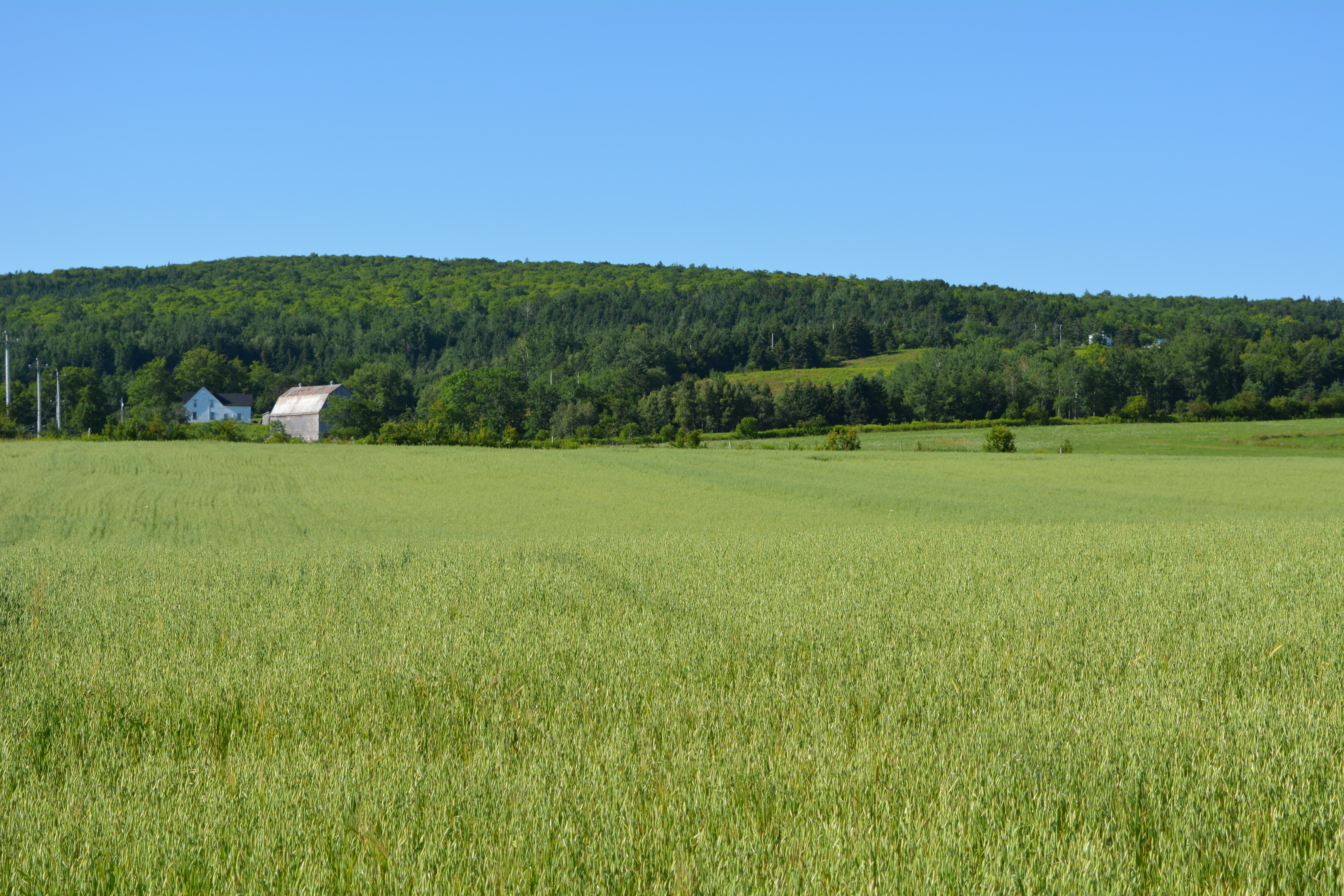
Immediately to the south of Donald lies the homestead of Hugh’s eldest daughter Marion and her husband William Sutherland “Ban”. The barn still exists on the shoulder of Highway 311 at the junction with the Gil Sutherland Road. This lot was also acquired from the Moore family in 1830.
Hugh died on April 13, 1830 at his home at West Earltown. He transformed his family from being lotters or sub-tenants to collective owners of a picturesque 350 acre chunk of The Falls. It is interesting to note that the neighbours on either side of this lot were former residents of Kilbraur, Hugh and Mairead’s original home. William Sutherland “Ruaidh” lived to the north and Gilbert Sutherland “Square” to the south.
Over the following four generations, the tentacles of this family wove its way through the majority of the local inhabitants of The Falls. Almost nothing is known about Mairead Sutherland. She would appear to be living in 1838 and the head count of Donald’s family in the 1861 census would indicate she was still on this earth at that point. Hugh’s stone in Murray Cemetery makes no mention of his wife. It is worth noting that Hugh is the first recorded adult burial at that location.
[1] The minister was Rev. Walter Ross. Ross was not well liked by the common folk having been appointed by the Countess, as was the case in those days, and was more attentive of his four legged flock than the two legged variety. He was often absent from duty which led to the catechists being the true spiritual leaders in the community.
[2] Hunter, J. (2015). Set Adrift Upon the World. Casemate Publishers; and direct correspondence with Dr. Hunter is the primary source for the events surrounding the evictions from Strathbrora
[3] Campey, L. H. (2002). Fast Sailing and Copper-Bottomed. Dundurn. Appendix B
[4] Tatamagouche River was the description in early documents in The Falls and West Earltown. The name did not survive and the river is Waugh River and named after an early settler of Tatamagouche.
[5] Whiston, Norris (2009) Northern Colchester Land Grants
[6] Susannah was the daughter of Dr. John Harris, Truro, one time shareholder in the old Philadelphia Company that owned most of West Pictou and the hilly sections of North Colchester. Their prior stature enabled the descendants of Dr. Harris to acquire some strategic land grants throughout the regions. John Moore was a miller and had grants on steams suitable for constructing mills. The Moore’s settled near the junction of the West and East branches of River John.
I
 earltown