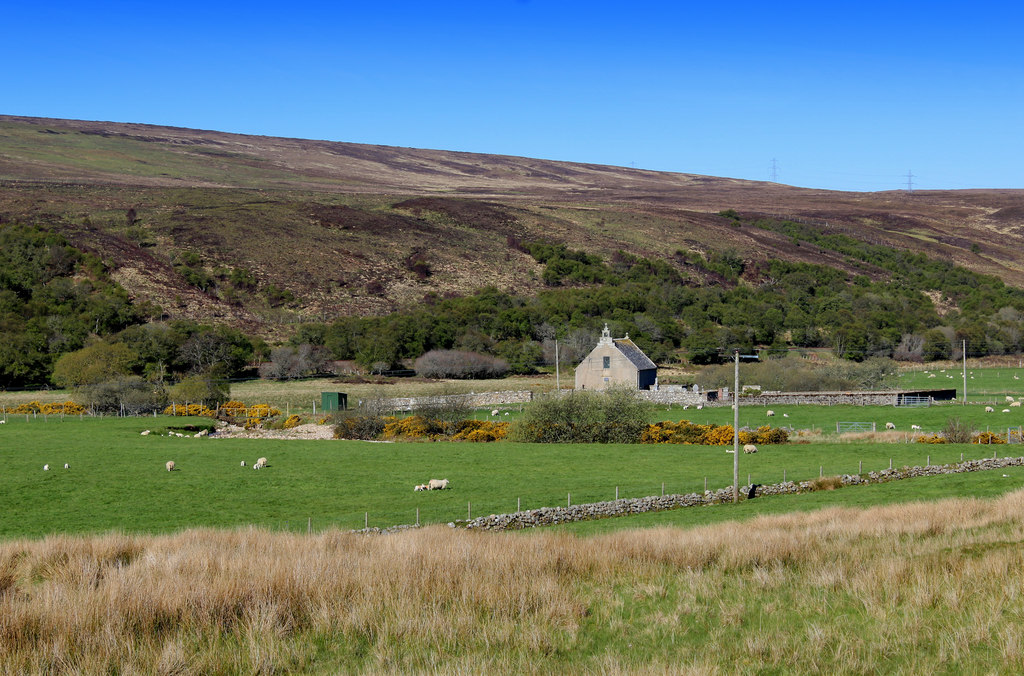
Kildonan Parish is located in the north-east of Sutherland along the Caithness border. It begins in the high country on the watershed between Strath Halladale and Strath Ullie and follows the latter southeasterly down the Helmsdale River towards the sea. In the early 19th century, it was home to at least 1,500 souls, predominantly Gunn, MacKay, Polson, Sutherland, Matheson, and a handful of other Highland names. The valley floor had abundant land suitable for grains and the surrounding hills afforded thousands of acres of grazing for cattle and sheep.

In 1807-1808, the Sutherland Estate created a farm in Kildonan out of three townships and leased it to an outsider. The collection of small tenants cleared out in making this farm, offered no resistance. In all likelihood, they were not expecting such a move nor were they organized or prepared to mitigate the situation.
On January 5th, 1813, farmers “from away” were seen exploring and surveying other parts of the parish, which raised alarm among the traditional tenants. In the lead was the proposed new tenant for another extensive farm which would precipitate another clearance. Major William Clunes, who already had a farm on the coast, would have been recognized by former soldiers in the parish from their days in the Peninsular War. That evening, it was learned that Clunes had settled for the night in the manse of Rev. Alexander Sage.
A delegation was appointed by the local tenants to confront Clunes at the manse. They summoned Clunes to the yard for a conversation and learned that Clunes was doing due diligence on a lease near Torrish. The delegation appealed to Clunes to abandon the plan and let them continue to farm in peace. The conversation became heated and ended with threats.
This was reported back to the leaders of the protest, who were awaiting word at a nearby mill. The protests were being organized, allegedly, by the local schoolmaster, George MacLeod, and an influential catechist by the name of George MacKay. While they all realized that their actions were against the law, the catechist was able to assure them they had the moral high ground. Overnight, tempers flared, adrenaline flowed, and the protest took on a momentum that was hard to contain.
The following morning, as Clunes was saddling his horse, he was confronted with a mob of fifty men bearing sticks and cudgels. He was warned to take leave of the strath before blood would be shed. Realizing there would be nothing productive happening that day, Clunes saddled up and went home.
Meanwhile, other southerners in the same party were housed with a Turnbull family further up the Strath in Suisgill. Another party of 50 concealed themselves in the thickets and gullies surrounding the Turnbull farm. A couple of shepherds/farmers, managed to escape on horseback across the hills into Caithness, but others were trapped in the house. The scene became quite ugly with threats of violence. One of the tenants, a pragmatist by the name of Alex Fraser, entered the house and suggested that the party mount up and leave. They were advised to tell the mob what they wanted to hear and not engage in any conversation that would make matters worse. If they obeyed Fraser’s instructions, they would likely get away unscathed. As predicted, the men safely departed, although they continued to be threatened with harm should they ever be found in the parish again.[1]

This so unsettled the southern farmers that they avoided the parish in the weeks that followed.
Complaints were presented to Sheriff Substitute MacKid by the Estate. Sheriff MacKid attempted to get peace bonds served but was unsuccessful. The Estate then called a meeting whereby they promised crofts on the North Coast or smaller ones within Kildonan in exchange for their current leases. These offers were rejected. The tenants decided they needed to counteroffer to move things along and proposed to match whatever terms Clunes had negotiated for his lease. The bearer of this counteroffer was arrested and jailed in Dornoch which only served to raise the temperature once again.
Over time, the Sheriff learned the names of some likely ringleaders. Summons were issued to appear at court in Golspie to give evidence. When one of the constables, Donald Bannerman, arrived in the Strath, he discovered those named were nowhere to be found and were believed to have been hiding in Caithness. Bannerman, later to be labeled a brutal thug in later clearances, returned to Golspie empty-handed. Nevertheless, he posted the names of the men expected to appear for discovery on February 10th at the Golspie Inn.[2]
Once bitten, twice shy. There was no doubt in Kildonan that the discovery was an ambush to arrest the alleged ringleaders. Once again, the men of the Strath congregated in the mill of John Gordon to develop a plan. It was quickly decided that all that were able would accompany the named men to Golspie to ensure their protection. Two men were dispatched to Caithness to hopefully raise upwards of a hundred men. Another two men, George MacDonald and John MacKay were sent south to recruit in Strathbrora.
Strathbrora (home of many of the Earltown settlers) could be expected to be sympathetic with the Kildonan tenants. Like Kildonan, much of Strathbrora was leased by the Sutherland Estate to small tenants. It was equally suitable for large scale sheep farming. One of the gentleman farmers present at the Kildonan Riot was Gabriel Reid, the owner of Carrol on Loch Brora, who had ambitions to expand up Strathbrora.
The two emissaries, George MacDonald and John MacKay, crossed from Kildonan into the upper settlements of the Skinsdale and Blackwater valleys which they followed down into Strathbrora. They had instructions to go west to Braegrudy at the entrance to Rogart where John Sutherland, Tacksman of Scibberscross, was known to be opposed to the “improvements”. The two proceeded from township to township, tapping on windows and entering wherever they were welcome. After explaining their mission, the Strathbrora men were asked to meet the Kildonan men at the bridge in Brora and proceed together to the outskirts of Golspie. They would then be instructed to enter the village in small parties and pretend to be on business until proceedings started at the Inn.
Reports vary as to how many showed up. There was likely a full contingent from Kildonan. They may have been 50 to 100 from Caithness and a similar number from Strathbrora. The appointed time the mob assembled in front of the Inn. The Sheriff and Clerk came forward and read the names of those to appear. Two started forward but the crowd became agitated and unruly. The discovery was called off and the officers retired to Dunrobin Castle for safety.
The next move was to employ the military. Infantry was dispatched from Fort George near Inverness to bring order to Kildonan. This seemed to bring the temperature down while the Kildonan tenants sought out alternatives to the proposed small crofts offered by the Estate. The only violence reported was the flogging of a soldier for unwanted advances on a local woman.
Hearings, known as precognitions, were held in Golspie in March. These proceedings would be similar to what is known as a discovery in our current justice system. This becomes interesting from an Earltown perspective as familiar names appear among the witnesses.
The first of interest is Alexander Sutherland of Balnakyle. Unfortunately, Sheriff Depute Cranston and his interpreter, Alexander Anderson, didn’t use descriptor names which were then prevalent, so we have no idea if this Alex Sutherland was a future emigrant to Nova Scotia. He describes visiting at the home of Widow MacPherson, Faissalach, along with his Uncle Donald MacLeod of Achrimisdale and John Bruce of Baddenbeg. Also present were Robert Bruce of Ardachu, William Gilcrest of Wilkhouse, John MacLeod of Gartymore and Hugh Ferguson of Rhives. He declared that George MacDonald and John MacKay of Kildonan came into the house and said that they had come down from Kildonan to go down Strathbrora and afterwards westward to Braegruidy to invite men in those parts to come to Glasslochan to meet the Kildonan people and fifty men from Caithness who were all going to Golspie to prevent the persons cited there by the Sheriff from being committed to jail

Alex further declared that “… the men about Clyne had been told by Major Houston to be quiet and that they might be needed to help peace officers.” He also mentioned that “… the men of Kildonan and their assistants were determined to take John Bannerman … out of the Dornoch jail.”
The next witness of interest is Adam MacDonald. Adam MacDonald of Aschoilmore was the father of Alexander MacDonald “Macadie”, and early settler at The Falls and ancestor of the MacDonalds who operated the Balmoral Grist Mill and a large branch who later settled in California[3].
Adam’s testimony was very similar to that of Alex Sutherland. He declared that George Clyne, Tailor, of Gobernausgach and his apprentices were also in the house and would have understood more of what was said as he, Adam, was sick in bed at the time. It was noted that he was still in a very infirm state. His testimony was read back in Gaelic as he declared that he never learned to write.
Adam recovered from his malady and was still alive when the Estate turned their attention to the clearing of Strathbrora. As reported elsewhere, he and his brother-in-law, Mad Donald MacKay, attempted to renegotiate their leases at terms matching those of Gabriel Reid. They successfully orchestrated resistance to the clearance in 1820 but were finally removed in 1821 with the military present.
The next precognition was that of George Ferguson. Many in Northern Nova Scotia, myself included, descend from this man. He was the miller of Kilpheddermore in mid Strathbrora. His testimony is a bit longer than those preceding him, as he admitted to being at the Golspie Inn disturbance.
George “declared that he remembered when the Kildonan men were to be examined at Golspy and thinks it was about the beginning of February last but he cannot specify the day of the month; that William Sutherland “Merchant” in Ellan told the declarant upon the day before that intended examination that the Kildonan men were to go to Golspy the next day and the declarant thereafter being solemnly sworn and interrogated if William Sutherland wanted him to attend at Golspy. Deponed that he did not but that William Sutherland informed him that the Strath Brora people had been invited to attend by two men from Kildonan but he did not mention their names and that the purpose of their attendance was to see what would become of the persons who were cited for examination; that Sutherland said nothing of preventing those men from being apprehended or of rescuing any person from Dornoch jail Depones that the deponent himself went to Golspy on the day of examination, and his purpose in doing so was to get payment of a debt which a man in Kildonan owed him; That he was present when the Officer called over the names at the door of the Inn, but he was a good way down the road and only heard the last of them; That he does not recollect to have seen the Sheriff Substitute on that occasion but he saw Mr. Taylor, Sheriff Clerk, and Mr. Leslie the Procurator Fiscal. Being interrogated how he could see these two Gentlemen at the door of the Inn when he was a good way down the road and the crowd between him and them, depones that there was a considerable interval between them and the crowd which enabled him to see them. Deponed that he saw some of the people whose names were called come in front of the crowd, but he did not see an Officer attempt to apprehend them or the crowd close in about them. Deponed that the deponent expressed his sorrow for having gone to Golspy that day to Adam Sutherland in Kilfeddermore and Alexander McLeod in Torrisellar both in Strathbrora – Being interrogated what the cause of his sorrow since he only went to crave payment of a debt. Depones that it was because he saw the people were likely to make a disturbance and he was afraid of being implicated. Deponed that he saw some Strath Brora men at Golspy on that occasion in particular Donald Sutherland in Kilfeddermore, Donald MacKay, Tailor in Strath Roy, John Sutherland, Pentioner, in Duchal, Alexander Sutherland in Achnamean, the said William Sutherland, Merchant, who informed him that the Strath Brora men had been invited to attend, Donald Grant, son to Donald Grant, Tenant in Ellan, Robert Sutherland, son of Donald Sutherland, Tenant, in Kilfedderbeg, Donald and William Grant, Tenants in Urachcall, William Sutherland, Stone Dyker in Scottary, Donald Murray, Alexander MacKay and Norman Douglas all in Ballenleden, Donald MacDonald, Donald Baillie and Robert MacKay, Tenant’s sons in Aschoilmore; Alexander Sutherland, James MacLeod and Robert Baillie in Oldtown of Carrol. Alexander Sutherland, Weaver, and John Sutherland, Tenant in Brachary, Robert Bruce and John Sutherland in Aultsmerrel; Deponed that he returned home that evening in company with some of the Strath Brora men who were saying in conversation that the Kildonan men who had been cited were prevented from being taken into custody, but he did not hear them say there were determined to prevent all arrests for the future. Depones that he was informed the day before the said William Sutherland that Strath Brora men were meet the Kildonan men on the day of examination at the Bridge of Brora and to proceed together to Golspy, but the deponent did not fall in with the party till they reached Strath Stephen. That William Sutherland informed him that they were to be joined by men from other parishes in Sutherland and also from the County of Caithness – that William Sutherland did not mention the number of men expected but said they were to get as many men as they wanted – all which is Truth as he shall to God and depones he can not write – the foregoing Oath being administered and the Deponent interrogated through the medium of Alexander Anderson, Wright in Brora sworn Interpreter, signed Geo. Cranstoun Rob MacKid “
Aside from actual ringleaders from Kildonan, this discovery was unusually lengthy and detailed as to those present at the Inn. Reading between the lines, the interrogators seemed to be doubting George’s reason for being in Golspie on that particular day and this descendant is not entirely convinced, although the opportunity to collect a debt is plausible.
Towards the end he was quite forthcoming with a list of attendees, which likely didn’t please his neighbours back in Strathbrora if they learned the content of his testimony.
Some of the names are of interest. William Sutherland, Merchant, lived in Ellan, the township where the Sutherlands of MacLeod Road were born. William Sutherland of Scottary was likely William Sutherland “Ruidh” of The Falls. Alexander MacKay, Ballenledan, is undoubtedly Alex MacKay ‘Caribou’ who emigrated to Pictou in 1815 and later settled in the Berichon.
Donald MacDonald of Aschoilmore would be a brother to Alex MacDonald, The Falls. Donald became an employee of the Hudson Bay Company at Fort Edmonton. Norman Douglas settled in Loganville.
George Ferguson returned to his labours at his grist mill. Having an inkling of what would likely happen in Stathbrora in the not-too-distant future, he began to mull over the merits of emigrating to Nova Scotia. Before that dream became a reality, he developed cancer and died around 1817. His widow, Catherine Graham, left with six young children. She was among a group in Scottary[4] that petitioned the estate to let them occupy their leases until they departed for Pictou in May of 1820. Patrick Sellar, the Estate factor and ruthless promoter of the clearances, was happy to see them go believing them to be better suited to the wilds of Nova Scotia.
As for the Kildonan people, Thomas Douglas, Earl of Selkirk, had plans for them. He needed settlers for his proposed settlement on the Red River and the hardy people of Kildonan fit the bill. In June of 1813, 90 of them sailed from Stromness to Churchill on Hudson Bay, arriving in September and overwintering in that frozen land. The following spring they were confronted by an 800 km trek through the wilderness to their new home. By 1820, the Strath of Kildonan was empty but for a few farmers, shepherds and their families.
Sources:
Hunter, James Set Adrift Upon the World, The Sutherland Clearances Birlinn Ltd 2015
National Records of Scotland, High Courts AD14-13/9 Precognitions, Kildonan 1813
Credit to Joyce Ferguson, The Falls, for noticing George Ferguson’s name in the High Court Index.
For more information on George Ferguson’s mill site and the township of Kilfeddermore, see this video by Nick Lindsay of Brora
[1] There was only one Kildonan immigrant to Earltown, John MacLeod, who later removed to North River. He would be in his late teens during this period. James Murray, North River, and a member of the Earltown congregation, was also from Kildonan. The Polsons of North River also had roots there. Alexander Murray “Corrigan” was operating a mill at Aultandon in a remote part of Kildonan at this time and was later cleared. Thomas MacKay, grantee of the eastern end of the Berichon Road in West Branch was also from Kildonan.
[2] The Kildonan Riots is a complicated story that is well presented in James Hunter’s “Set Adrift Upon the World, The Sutherland Clearances”. The story has been heavily condensed to give context to the Strathbrora portion of events.
[3] The writer’s Great, Great, Great, Great Grandfather.
[4] The mill lease was likely given up when George took ill, necessitating the move to a holding in Scottary down stream.
 earltown
Glen, Thank you for yet another great story of our ancestors. Your dedication to sharing your knowledge benefits us all. The credit for finding George Ferguson’s name in the court index lies with Aileen Olgilvie of the Brora Heritage Centre. My sister was at the centre searching for information on our Fergusons and was lucky enough to have Aileen come up with this “tidbit”.
Cheers and again congratulations on your 2025 Colchester Heritage Award!
Joyce Ferguson