Earltown’s First Murderer – Domhnall Caimbeul

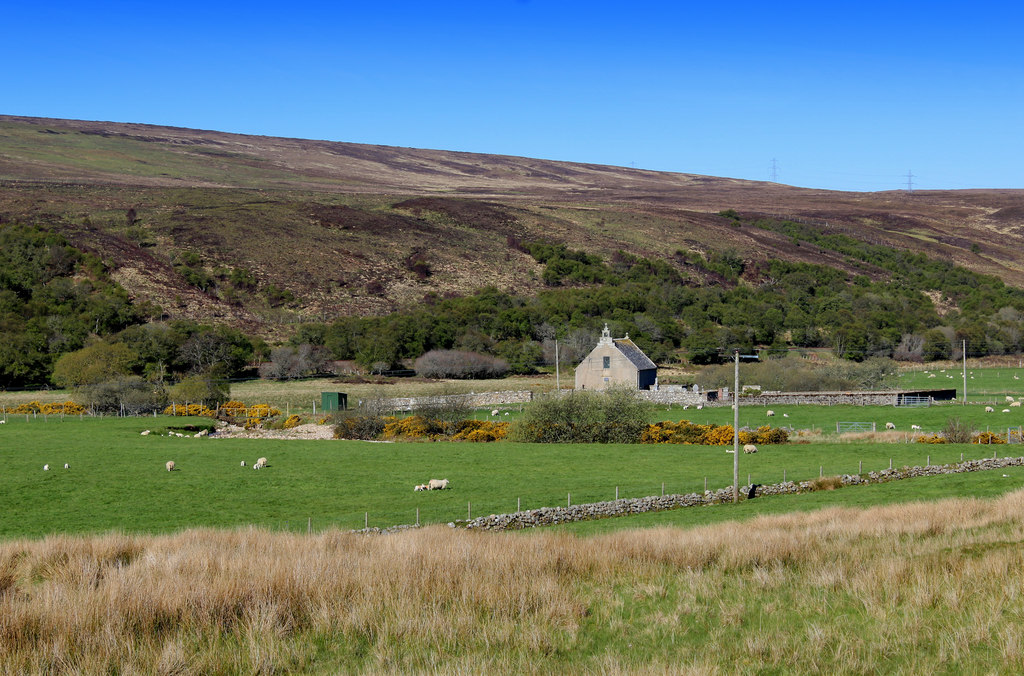
The scene above is from a view point on Campbell’s Hill, southeast of the village of Scotsburn.  It is a spring day in which the leaves are just beginning pop out. In the near distance is the tower on Bethel Presbyterian Church. A bit further in the view is a ridge adorned with farms in the community of Heathbell.  In the distance is the blue waters of the Northumberland Strait and, on the horizon, the eastern end of Prince Edward Island.  It is a peaceful spot that gladdens the soul.

It was not always that way.  In 1819, a few dozen feet from this viewpoint, the most horrendous murder in Pictou County, (at least up until 1877), was committed.

This farm was first settled by a Campbell family, probably around 18031.  They were from Rogart in Sutherland.  The next farm up the hill was also settled by a Campbell family2, most likely a sibling or near relation.  The names of the parents are presently unknown.  Their graves, whether in Scotsburn or Durham, are unmarked.  The mother died before 1819 after which the father took a second wife, also a Campbell, who was part of a Campbell clan on Scotch Hill.  Of the first marriage, we only know of one son – Donald – the principal character in this story. 

George Patterson in his 1877 publication The History of the County of Pictou, describes the events which I will paraphrase here.

Donald Campbell, then settled in the Earltown district, was returning from errands in Pictou and took the opportunity to stop at Campbell’s Hill to visit his father and stepmother. It is unknown whether something was said during the visit to upset Donald or if he was already angry when he stopped for a visit. It is believed that Donald resented the second wife of his father as he felt she was going to delay or diminish his eventual inheritance. The visit ended with Donald resuming his trip back to Earltown.  He stopped at various farms between Campbell’s Hill and West Branch, giving the impression that he was trying to get home to Earltown before it became late.

However, Donald retraced his steps back to Campbell’s Hill after dark.  He fastened the door of his father’s log cabin with withes attached to the latch handle to prevent the occupants’ escape and then set fire to the cabin while his father and stepmother were asleep.  Awakened by the fire, the father managed to force the door open and started to remove the contents.  Donald, lurking in the dark, struck the father with a stick and pushed him into the flaming house where the bones were found the next day.  While this was unfolding, the stepmother managed to get out.  She was a sturdy woman and would have won a fair fight, but was struck down by Donald’s weapon.  He only partially succeeded in putting her into the flames, as she was “quite a load” to borrow an old phrase.

Hearing shouts and seeing the fire on the crest of the hill, a MacIntosh neighbour arrived to see a man fleeing whom he then believed to be a ghost.  A small dog was also found at the scene which belonged to Donald and later aroused suspicion.

The remains were buried without an investigation.   At the funeral, Mrs. Campbell’s brother, Angus Campbell, expressed his belief that there had been foul play.  The authorities opened a case, exhumed the body of Mrs. Campbell, and determined she had been dealt a deadly blow.  The scene of the crime was examined where a missing button from Donald’s coat was found as well as a flint that matched a gun Donald owned.  It was suggested that Donald lost the flint, causing him to resort to using a bludgeon.   Upon arrest in Earltown, it was noted that Donald had scorch marks on himself.

The subsequent trial received considerable attention.   S.G.W. Archibald of Truro presented the case, which was adjudicated by a jury with Judges Haliburton and Wiswall presiding. Archibald presented a strong case after which the jury was quick to find Donald guilty.  He was immediately sentenced  “to be taken from where you now are to Prison whence you came and from thence to the place of execution and there hung up by the neck until your body is dead”.  A clerk later noted: “Exactly a week later on the 22nd September Campbell was executed at Rogers Hill within a few yards of the spot where the crime was committed, pursuant to a warrant from the Earl of Dalhousie, our Lieut. Governor”.

Executions were a spectator sport in those times, appealing to the darker side of the human spirit.  On the appointed day, Donald was loaded on a cart and transported to the Kirk then located beside St. John’s Cemetery.  This was the end of a proper road.  Access to points beyond was by way of paths.   Guarded by the militia and accompanied by a group of clergymen, the procession climbed the 3 km path to the remains of the incinerated cabin.  Once at the scene of his crime, Donald confessed to his crime but showed no interest in repentance despite the efforts of Rev. Dr. James MacGregor and other clergy. 

Acadian Recorder – October 9, 1819 – The paper didn’t report the proceedings but instead published a separate account. At least one copy survived into the 1960’s in Earltown.

The execution was supervised by the High Sheriff of Halifax County.  The ineptitude of the chosen executioner added to the drama.  Hanging, despite the image it conjures, was somewhat merciful.  The process involved releasing a trap door or a push off the gallows platform.  The sudden drop of the body would cause the noose to break the neck, thus bringing instant death.  In this case, the bolt on the trap door didn’t release fully thus causing the rope to slowly tighten instead of snapping the neck. The result was death by a slow strangulation 3. So disturbing was the spectacle that many in attendance vowed never to view another hanging.

Patterson was silent on the particulars of Donald’s own family and life back in Earltown.

Two and one half kilometers east of Earltown Village on the Berichon Road, an old road branches to the north.  This was once a listed shortcut between the Berichon and Clydesdale.  (It is now gated by the owner of the surrounding woodland).  About 250 meters in, a logging road branches northwest into a grown-over clearing.  A few meters off this road is the cellar of Senoid Sutherland.   Senoid is Gaelic for Janet and is pronounced Shawna, which morphs into Shawney, the equivalent of Jennie.  This farm was once known as the Shawney place4

The land grant map found online shows this to be the 150 acre grant to a Janet Campbell.  Another version of the land grant maps show it to be the grant of Donald Campbell.  Some deeds of surrounding properties reference the line of Janet Sutherland while others state Janet Campbell.   

This confusion of names confirms the oral tradition around Earltown that this property was that of Donald Campbell, convicted killer.  It also confirms another interesting story that Donald’s widow, in shame and horror, changed her surname and those of her children to Sutherland to distance themselves from the crime at Campbell’s Hill. 

Sutherland was Janet’s maiden name.  There is a tradition that she was connected to John Sutherland “Doula” who settled an adjoining farm but the connection has yet to be confirmed.  She was born in Sutherland and came to Nova Scotia prior to 1815.  She had at least one brother in the Scotsburn area who gave evidence at Donald Campbell’s trial.

Janet and Donald’s eldest son, John, was born at Rogers Hill in 1816 which would place their marriage around 1814-15.  Janet’s eventual land grant was among those petitioned by a group of second generation immigrants living at Rogers Hill.  These petitions were in 1817, suggesting that Donald and Janet may have begun clearing their farm that summer. The deeds would not be granted until later in the 1820’s hence Donald’s name is absent. A second son, George, was born in 1818  at Earltown.

It is hard to imagine the situation that Janet found herself in on that 22nd day of September, 1819.   Widowed, two children ages 3 and 1, a crude log cabin, a partially cleared farm, no immediate family in close proximity, and an epic scandal to overcome.  Donald Campbell was characterized as an ignorant and unsavory character with obvious violent tendencies.  The scandal may have been a blessing.  Domestic abuse is as old as matrimony. 

A return to the Rogers Hill area was not likely an option given the circumstances.  Earltown was still in infancy and new settlers were arriving with no ties to the victims or accused.  It would appear that Janet stayed on course and made the small farm work.  Undoubtedly, there would be some assistance from siblings in Roger’s Hill, possibly a kind father was still living.  The Highland culture ensured that widows had help.  Hard labour, such as the annual threshing and wood cutting, was often a collective labour in the neighbourhood.  It must be remembered that back in Scotland, the women were the gardeners and looked after the dairy livestock. 

The 1838 census confirms that “Widow Sutherland” with two males over 14 were still living on the Berichon Cross Road.  The next census in 1861 finds her son John as the head of household, which indicates that Janet had passed away in the intervening years.   No tombstone marking the grave of either Janet Sutherland or Janet Campbell exists but she most certainly rests in the village cemetery.

The eldest son John took over the homestead.  In 1857 he married Catherine, daughter of “Laughing” Sandy Sutherland and Christy Baillie of The Falls.  They had one daughter Betsy.  John’s brother George is absent from the  farm in 1871 but returned in 1881.  When John died in 1885, he left the farm to George with the stipulation that Catherine be provided a living for as long as she would live.  By 1911, both George and Catherine are absent from the census.   As for John and Catherine’s daughter Betsy, we have no further information.

The property was later purchased by George MacIntosh.  It is a short distance through the woods to the main MacIntosh farm on the Denmark Road.  The Shawney place continued to used for pasture and crops by the MacIntoshes and later the Van Veld family.

Sources:

Patterson, George “Old Court Records of Pictou County, Nova Scotia published by The Canadian Bar Review, Vol13 No 3 1935

Patterson, Rev. George  A History of the County of Pictou, Nova Scotia  Dawson Bros, Montreal 1877

Gladys Sutherland MacDonald – Interview – 1978

A. Howard Murray and Mary Douglas Murray – Interview – 1978

Layton Lynch – assistance in locating the Campbell – Sutherland homestead in the Berichon.

  1. The Dunwoodie family were the next to occupy this farm for a couple of generations. After the farm was vacated, James and Harold Forbes of Lyon’s Brook farmed it for many years. ↩︎
  2. The farm owned by Hugh and Stanley Campbell in the mid 20th century. ↩︎
  3. The executioner was brought by the Sheriff from Halifax. Pictou had its own executioner at the time who served the courts in Prince Edward Island as nobody on the Island would accept the responsibility. ↩︎
  4. The current owner has it gated to keep out traffic. His number is posted on a sign for people to call for permission to enter. ↩︎

The Kildonan Riots (The Earltown Connection)

Kildonan Parish is located in the north-east of Sutherland along the Caithness border.  It begins in the high country on the watershed between Strath Halladale and Strath Ullie and follows the latter southeasterly down the Helmsdale River towards the sea.  In the early 19th century, it was home to at least 1,500 souls, predominantly Gunn, MacKay, Polson, Sutherland, Matheson, and a handful of other Highland names.  The valley floor had abundant land suitable for grains and the surrounding hills afforded thousands of acres of grazing for cattle and sheep.

Helmsdale River near Kildonan Farm – Julian Paren Photo

In 1807-1808, the Sutherland Estate created a farm in Kildonan out of three townships and leased it to an outsider.  The collection of small tenants cleared out in making this farm, offered no resistance.  In all likelihood, they were not expecting such a move nor were they organized or prepared to mitigate the situation.

On January 5th, 1813, farmers “from away” were seen exploring and surveying other parts of the parish, which raised alarm among the traditional tenants.  In the lead was the proposed new tenant for another extensive farm which would precipitate another clearance.  Major William Clunes, who already had a farm on the coast, would have been recognized by former soldiers in the parish from their days in the Peninsular War.  That evening, it was learned that Clunes had settled for the night in the manse of Rev. Alexander Sage. 

A delegation was appointed by the local tenants to confront Clunes at the manse.  They summoned Clunes to the yard for a conversation and learned that Clunes was doing due diligence on a lease near Torrish.  The delegation appealed to Clunes to abandon the plan and let them continue to farm in peace. The conversation became heated and ended with threats.

Kildonan Church Chris Heaton Photo

This was reported back to the leaders of the protest, who were awaiting word at a nearby mill. The protests were being organized, allegedly, by the local schoolmaster, George MacLeod, and an influential catechist by the name of George MacKay.  While they all realized that their actions were against the law, the catechist was able to assure them they had the moral high ground.  Overnight, tempers flared, adrenaline flowed, and the protest took on a momentum that was hard to contain.

The following morning, as Clunes was saddling his horse, he was confronted with a mob of fifty men bearing sticks and cudgels.  He was warned to take leave of the strath before blood would be shed.  Realizing there would be nothing productive happening that day, Clunes saddled up and went home.

Meanwhile, other southerners in the same party were housed with a Turnbull family further up the Strath in Suisgill.  Another party of 50 concealed themselves in the thickets and gullies surrounding the Turnbull farm.  A couple of shepherds/farmers, managed to escape on horseback across the hills into Caithness, but others were trapped in the house.  The scene became quite ugly with threats of violence.  One of the tenants, a pragmatist by the name of Alex Fraser, entered the house and suggested that the party mount up and leave.  They were advised to tell the mob what they wanted to hear and not engage in any conversation that would make matters worse.  If they obeyed Fraser’s instructions, they would likely get away unscathed.  As predicted, the men safely departed, although they continued to be threatened with harm should they ever be found in the parish again.[1]

Suisgill,- Approximate locale of second mob Julian Paren Photo

This so unsettled the southern farmers that they avoided the parish in the weeks that followed.

Complaints were presented to Sheriff Substitute MacKid by the Estate.  Sheriff MacKid attempted to get peace bonds served but was unsuccessful.  The Estate then called a meeting whereby they promised crofts on the North Coast or smaller ones within Kildonan in exchange for their current leases.  These offers were rejected.  The tenants decided they needed to counteroffer to move things along and proposed to match whatever terms Clunes had negotiated for his lease.  The bearer of this counteroffer was arrested and jailed in Dornoch which only served to raise the temperature once again.

Over time, the Sheriff learned the names of some likely ringleaders.  Summons were issued to appear at court in Golspie to give evidence.  When one of the constables, Donald Bannerman, arrived in the Strath, he discovered those named were nowhere to be found and were believed to have been hiding in Caithness.  Bannerman, later to be labeled a brutal thug in later clearances, returned to Golspie empty-handed.  Nevertheless, he posted the names of the men expected to appear for discovery on February 10th at the Golspie Inn.[2]

Once bitten, twice shy.  There was no doubt in Kildonan that the discovery was an ambush to arrest the alleged ringleaders.  Once again, the men of the Strath congregated in the mill of John Gordon to develop a plan.  It was quickly decided that all that were able would accompany the named men to Golspie to ensure their protection.  Two men were dispatched to Caithness to hopefully raise upwards of a hundred men.  Another two men, George MacDonald and John MacKay were sent south to recruit in Strathbrora.

Strathbrora (home of many of the Earltown settlers) could be expected to be sympathetic with the Kildonan tenants.   Like Kildonan, much of Strathbrora was leased by the Sutherland Estate to small tenants. It was equally suitable for large scale sheep farming.  One of the gentleman farmers present at the Kildonan Riot was Gabriel Reid, the owner of Carrol on Loch Brora, who had ambitions to expand up Strathbrora.

The two emissaries, George MacDonald and John MacKay, crossed from Kildonan into the upper settlements of the Skinsdale and Blackwater valleys which they followed down into Strathbrora.  They had instructions to go west to Braegrudy at the entrance to Rogart where John Sutherland, Tacksman of Scibberscross, was known to be opposed to the “improvements”.   The two proceeded from township to township, tapping on windows and entering wherever they were welcome.  After explaining their mission, the Strathbrora men were asked to meet the Kildonan men at the bridge in Brora and proceed together to the outskirts of Golspie.  They would then be instructed to enter the village in small parties and pretend to be on business until proceedings started at the Inn.

Reports vary as to how many showed up.  There was likely a full contingent from Kildonan.  They may have been 50 to 100 from Caithness and a similar number from Strathbrora.   The appointed time the mob assembled in front of the Inn.  The Sheriff and Clerk came forward and read the names of those to appear.  Two started forward but the crowd became agitated and unruly.  The discovery was called off and the officers retired to Dunrobin Castle for safety. 

The next move was to employ the military. Infantry was dispatched from Fort George near Inverness to bring order to Kildonan.  This seemed to bring the temperature down while the Kildonan tenants sought out alternatives to the proposed small crofts offered by the Estate.  The only violence reported was the flogging of a soldier for unwanted advances on a local woman.

Hearings, known as precognitions, were held in Golspie in March.  These proceedings would be similar to what is known as a discovery in our current justice system.  This becomes interesting from an Earltown perspective as familiar names appear among the witnesses.

The first of interest is Alexander Sutherland of Balnakyle.  Unfortunately, Sheriff Depute Cranston and his interpreter, Alexander Anderson, didn’t use descriptor names which were then prevalent, so we have no idea if this Alex Sutherland was a future emigrant to Nova Scotia.  He describes visiting at the home of Widow MacPherson, Faissalach, along with his Uncle Donald MacLeod of Achrimisdale and John Bruce of Baddenbeg.  Also present were Robert Bruce of Ardachu, William Gilcrest of Wilkhouse, John MacLeod of Gartymore and Hugh Ferguson of Rhives.   He declared that George MacDonald and John MacKay of Kildonan came into the house and said that they had come down from Kildonan to go down Strathbrora and afterwards westward to Braegruidy to invite men in those parts to come to Glasslochan to meet the Kildonan people and fifty men from Caithness who were all going to Golspie to prevent the persons cited there by the Sheriff from being committed to jail

Mid Strathbrora Jonathan Billenger Photo

Alex further declared that “… the men about Clyne had been told by Major Houston to be quiet and that they might be needed to help peace officers.”  He also mentioned that “… the men of Kildonan and their assistants were determined to take John Bannerman … out of the Dornoch jail.”

The next witness of interest is Adam MacDonald.  Adam MacDonald of Aschoilmore was the father of Alexander MacDonald “Macadie”, and early settler at The Falls and ancestor of the MacDonalds who operated the Balmoral Grist Mill and a large branch who later settled in California[3]

Adam’s testimony was very similar to that of Alex Sutherland.  He declared that George Clyne, Tailor, of Gobernausgach and his apprentices were also in the house and would have understood more of what was said as he, Adam, was sick in bed at the time.  It was noted that he was still in a very infirm state.  His testimony was read back in Gaelic as he declared that he never learned to write.

Adam recovered from his malady and was still alive when the Estate turned their attention to the clearing of Strathbrora.  As reported elsewhere, he and his brother-in-law, Mad Donald MacKay, attempted to renegotiate their leases at terms matching those of Gabriel Reid.  They successfully orchestrated resistance to the clearance in 1820 but were finally removed in 1821 with the military present.

The next precognition was that of George Ferguson.  Many in Northern Nova Scotia, myself included, descend from this man.  He was the miller of Kilpheddermore in mid Strathbrora.  His testimony is a bit longer than those preceding him, as he admitted to being at the Golspie Inn disturbance.

George “declared that he remembered when the Kildonan men were to be examined at Golspy and thinks it was about the beginning of February last but he cannot specify the day of the month;  that William Sutherland “Merchant” in Ellan told the declarant upon the day before that intended examination that the Kildonan men were to go to Golspy the next day and the declarant thereafter being solemnly sworn and interrogated if William Sutherland wanted him to attend at Golspy.  Deponed that he did not but that William Sutherland informed him that the Strath Brora people had been invited to attend by two men from Kildonan but he did not mention their names and that the purpose of their attendance was to see what would become of the persons who were cited for examination; that Sutherland said nothing of preventing those men  from being apprehended or of rescuing any person from Dornoch jail  Depones that the deponent himself went to Golspy on the day of examination, and his purpose in doing so was to get payment of a debt which a man in Kildonan owed him;  That he was present when the Officer called over the names at the door of the Inn, but he was a good way down the road and only heard the last of them; That he does not recollect to have seen the Sheriff Substitute on that occasion but he saw Mr. Taylor, Sheriff Clerk, and Mr. Leslie the Procurator Fiscal.  Being interrogated how he could see these two Gentlemen at the door of the Inn when he was a good way down the road and the crowd between him and them, depones that there was a considerable interval between them and the crowd which enabled him to see them. Deponed that he saw some of the people whose names were called come in front of the crowd, but he did not see an Officer attempt to apprehend them or the crowd close in about them.  Deponed that the deponent expressed his sorrow for having gone to Golspy that day to Adam Sutherland in Kilfeddermore and Alexander McLeod in Torrisellar both in Strathbrora – Being interrogated what the cause of his sorrow since he only went to crave payment of a debt.  Depones that it was because he saw the people were likely to make a disturbance and he was afraid of being implicated. Deponed that he saw some Strath Brora men at Golspy on that occasion in particular Donald Sutherland in Kilfeddermore, Donald MacKay, Tailor in Strath Roy, John Sutherland, Pentioner, in Duchal, Alexander Sutherland in Achnamean, the said William Sutherland, Merchant, who informed him that the Strath Brora men had been invited to attend, Donald Grant, son to Donald Grant, Tenant in Ellan, Robert Sutherland, son of Donald Sutherland, Tenant, in Kilfedderbeg, Donald and William Grant, Tenants in Urachcall, William Sutherland, Stone Dyker in Scottary, Donald Murray, Alexander MacKay and Norman Douglas all in Ballenleden, Donald MacDonald, Donald Baillie and Robert MacKay, Tenant’s sons in Aschoilmore; Alexander Sutherland, James MacLeod and Robert Baillie in Oldtown of Carrol. Alexander Sutherland, Weaver, and John Sutherland, Tenant in Brachary, Robert Bruce and John Sutherland in Aultsmerrel; Deponed that he returned home that evening in company with some of the Strath Brora men who were saying in conversation that the Kildonan men who had been cited were prevented from being taken into custody, but he did not hear them say there were determined to prevent all arrests for the future.  Depones that he was informed the day before the said William Sutherland that Strath Brora men were meet the Kildonan men on the day of examination at the Bridge of Brora and to proceed together to Golspy, but the deponent did not fall in with the party till they reached Strath Stephen.  That William Sutherland informed him that they were to be joined by men from other parishes in Sutherland and also from the County of Caithness  – that William Sutherland did not mention the number of men expected but said they were to get as many men as they wanted – all which is Truth as he shall to God and depones he can not write – the foregoing Oath being administered and the Deponent interrogated through the medium of Alexander Anderson, Wright in Brora sworn Interpreter,   signed Geo. Cranstoun   Rob MacKid “

Aside from actual ringleaders from Kildonan, this discovery was unusually lengthy and detailed as to those present at the Inn. Reading between the lines, the interrogators seemed to be doubting George’s reason for being in Golspie on that particular day and this descendant is not entirely convinced, although the opportunity to collect a debt is plausible.

Towards the end he was quite forthcoming with a list of attendees, which likely didn’t please his neighbours back in Strathbrora if they learned the content of his testimony. 

Some of the names are of interest.   William Sutherland, Merchant, lived in Ellan, the township where the Sutherlands of MacLeod Road were born.   William Sutherland of Scottary was likely William Sutherland “Ruidh” of The Falls.  Alexander MacKay, Ballenledan, is undoubtedly Alex MacKay ‘Caribou’ who emigrated to Pictou in 1815 and later settled in the Berichon.

Donald MacDonald of Aschoilmore would be a brother to Alex MacDonald, The Falls.  Donald became an employee of the Hudson Bay Company at Fort Edmonton.   Norman Douglas settled in Loganville.

George Ferguson returned to his labours at his grist mill.  Having an inkling of what would likely happen in Stathbrora in the not-too-distant future, he began to mull over the merits of emigrating to Nova Scotia.  Before that dream became a reality, he developed cancer and died around 1817.  His widow, Catherine Graham, left with six young children.  She was among a group in Scottary[4] that petitioned the estate to let them occupy their leases until they departed for Pictou in May of 1820.  Patrick Sellar, the Estate factor and ruthless promoter of the clearances, was happy to see them go believing them to be better suited to the wilds of Nova Scotia.

As for the Kildonan people, Thomas Douglas, Earl of Selkirk, had plans for them.  He needed settlers for his proposed settlement on the Red River and the hardy people of Kildonan fit the bill. In June of 1813, 90 of them sailed from Stromness to Churchill on Hudson Bay, arriving in September and overwintering in that frozen land. The following spring they were confronted by an 800 km trek through the wilderness to their new home.  By 1820,  the Strath of Kildonan was empty but for a few farmers, shepherds and their families.

Sources:

Hunter, James  Set Adrift Upon the World, The Sutherland Clearances  Birlinn Ltd  2015

National Records of Scotland, High Courts AD14-13/9 Precognitions, Kildonan 1813

Credit to Joyce Ferguson, The Falls, for noticing George Ferguson’s name in the High Court Index.

For more information on George Ferguson’s mill site and the township of Kilfeddermore, see this video by Nick Lindsay of Brora


[1] There was only one Kildonan immigrant to Earltown, John MacLeod, who later removed to North River. He would be in his late teens during this period.  James Murray, North River, and a member of the Earltown congregation, was also from Kildonan.  The Polsons of North River also had roots there.  Alexander Murray “Corrigan” was operating a mill at Aultandon in a remote part of Kildonan at this time and was later cleared. Thomas MacKay, grantee of the eastern end of the Berichon Road in West Branch was also from Kildonan.

[2] The Kildonan Riots is a complicated story that is well presented in James Hunter’s “Set Adrift Upon the World, The Sutherland Clearances”.  The story has been heavily condensed to give context to the Strathbrora portion of events.

 [3] The writer’s Great, Great, Great, Great Grandfather. 

[4] The mill lease was likely given up when George took ill, necessitating the move to a holding in Scottary down stream.