This article is being presented for two reasons. First, it is a good example of how families, once established in North America for a generation, quickly spread across the continent. Second, it is my direct paternal line. I also descend from another Matheson settler in Earltown which have been styled the “weavers”. If the family in this post had a descriptor, I have never heard it.
When traveling from Kemptown to Earltown one crosses a hilltop upon which sits the Urquhart Cemetery across a field to the left. The road then dips down a long hill to a hollow where a small brook crosses the road. This brook appears on maps as Matheson Brook and marks the beginning of the Gilbert Matheson land grant. The grant stretches along both sides of the Earltown Road through a recent housing development for about a half-mile.
On a relatively level area on the right near the brook, Gilbert Matheson, his wife Catherine Watson and infant son Gilbert Watson Matheson, started a new life in Nova Scotia.
Gilbert was born in the hamlet of Balblair, on the shores of Loch Fleet in the Parish of Golspie, on September 19th, 1798. His father, also Gilbert, was a corporal in the Sutherland Fencibles stationed at Fort George at the time of his discharge in 1799. Gilbert Sr’s discharge papers indicate that he was to return to his native parish of Rogart although this young family was clearly settled at Balblair both before and after 1799. His wife was Christy MacPherson, a native of Balblair and daughter of John MacPherson and Isabel Murray. In addition to Gilbert of Upper Kempton, the couple had children George, John and Ann.

In the Sutherland Land Papers1, Gilbert Sr appears as a small tenant at Balblair along with Christy’s parents. In 1809, both the Mathesons and MacPhersons appear on a list to be evicted. For reasons unknown, this didn’t happen, as they appear on a subsequent list in 1818 as still living at Balblair. This second eviction was put into force, at which time they were instructed to remove their roof timbers2 and leave. They moved to a small holding at Morness in the Parish of Rogart. Morness is a community in the hills north of Strath Fleet where some earlier families had vacated and moved to the Scotsburn area of Nova Scotia. It was also the community where one of the “Weaver” Mathesons settled after being cleared from Leatty, Parish of Rogart. Most of the “Weaver” family emigrated to Earltown in 18203.
We lose track of Gilbert Sr, Christy and the children except for Gilbert Jr. One family tradition claims the family moved on to work in the woolen mills in Roxbury-shire. Another tradition claims that a brother or half brother of Gilbert Jr. settled in Ontario.
We next find a trace of Gilbert Jr. on January 7, 1831, when the Rogart Parish Register lists a child, Gilbert Watson, born to Gilbert Matheson and Catherine Watson, Morness. Catherine has been difficult to find in the records. Some claim she was from Galashields where the Mathesons seemed to have lived at one point. It is plausible as Watsons were a name associated with that area. Others suggest she was the daughter of southern shepherd who had come north to work the large sheep farms that gave rise to the clearances. This too is plausible as the Watson name starts appearing in Sutherland around that time.

Gilbert and Catherine, with their infant son, joined a sizable group that emigrated to Nova Scotia in 1832. Upon arrival in Earltown, a logical destination given the sizable Rogart community already established there, they discovered that land available from the crown had been parceled out. Fellow passengers with financial resources purchased grants from absentee grantees. Those without resources, or a willingness to part with them, accepted grants at Upper Kemptown.

Gilbert received a 100 acre grant at the location described above. Two other members of the party settled nearby, Strachan Gordon and George Bannerman. Both had ties to Balblair in Golspie.
Gilbert constructed a crude cabin beside the brook that would later take his name. There were no further recorded children to Catherine Watson. Life in the forests of Nova Scotia was not kind to Catherine. She died December 28th, 1836 and was laid to rest in the Earltown Village Cemetery.
During this rough period, neighbours Elizabeth and Strachan Gordon came to the rescue and took over the upbringing of young Gilbert Watson Matheson. The oral tradition in Earltown was that Elizabeth Gordon was a near relative of Gilbert, (by now known as “Old Gibbie”), The name Strachan Gordon entered into the naming patterns of these Mathesons for the next four or five generations.
In 1842 Gibbie married for the second time. His bride was a young woman 22 years his junior. She was Nancy MacLean, eldest daughter of Alexander MacLean and Eiric MacLennan, Riversdale, whose parents had settled in that area a year before she was born. It was a productive union with the couple bringing 11 children into the world, all of whom survived childhood. It was a busy homestead and quite a feat to feed that many mouths on a hundred-acre upland farm. By the time the youngest two children came along, the older ones were leaving home.
Education was near at hand with the schoolhouse being the crest of the hill to the south. In religion, they adhered to the Free Church congregation in Earltown where services were available in Gaelic.
Gilbert died on December 18th, 1883, survived by his second wife, 12 children and 16 grandchildren.
Shortly thereafter, the old farm was vacated and Nancy went to live with her daughter on the farm immediately to the north on the Earltown Road. She lived to 1897. She was survived by 10 of her 11 children and 35 grandchildren.
Gilbert Watson Matheson (1831-1906)
By all accounts, Gilbert Watson remained with Elizabeth and Strachan Gordon after his father remarried. His relationship with his half-brothers and his half-sisters was agnostic at best, tense at worst. The Gordons, who had no natural children of their own, are remembered as exacting in moral standards and the way things were done. This appears to have rubbed off on Gilbert Watson. The Gordon farm was immediately behind the Urquhart Cemetery. Today it is a large blueberry plantation. When the Gordons passed on, it was left to Gilbert Watson.
Gilbert W. married Catherine Ross of whom nothing is known at the present. They had no natural children but were foster parents to Theresa Baker and Thomas Myers.
Gilbert was a staunch member of the Earltown Congregation and observed the strict Calvinist rules of the old Free Church. One story handed down through the Mathesons tells that Gilbert W. was so strict in the observance of the Sabbath that he harnessed the horse on Saturday afternoon in preparation for the trip to Earltown the following day. On Sunday, the poor beast would have to stand in the traces of the buggy or sleigh until the Sabbath was over on Sunday evening. Another story comes from Gertrude MacLean Wright. She and her father were crossing the mountain from Riversdale to Earltown one day and met Gilbert W. heading home. He was “fit to be tied” over the condition of the Earltown church on the previous Sunday. A group had decorated the church for Thanksgiving with sheaves of oats and garden produce. This was not okay with Gilbert W. who believed the sanctuary must be stark and unadorned in respect. She vividly remembered him striking the wagon repeatedly with his horsewhip to make his point.
Gilbert and Catherine are buried in Earltown.
Catherine Matheson Jollimore (1843-1920)
Catherine is listed as living with her parents at Upper Kemptown in 1871 but is also listed as living in Halifax at the same time. With so many mouths to feed at Upper Kemptown, she likely had to leave the family in her mid to late teens to enter domestic service. In 1871 she appears as a domestic servant in the household of Archibald Patterson on Victoria Road in South End Halifax. Her fellow servant, Mary MacKay, was likely from Kemptown as well. Patterson was an Inspector of Inland Revenue.
In 1874 Catherine, aka Kate, married James (Jimmie) Jollimore of Jollimore Village on the Northwest Arm near Halifax. Jimmie’s father and uncles settled next to what is now the Dingle Park. They were originally from Terrance Bay and moved to the “Arm” to be nearer the markets in Halifax. Jimmie was a successful farmer and gardener.
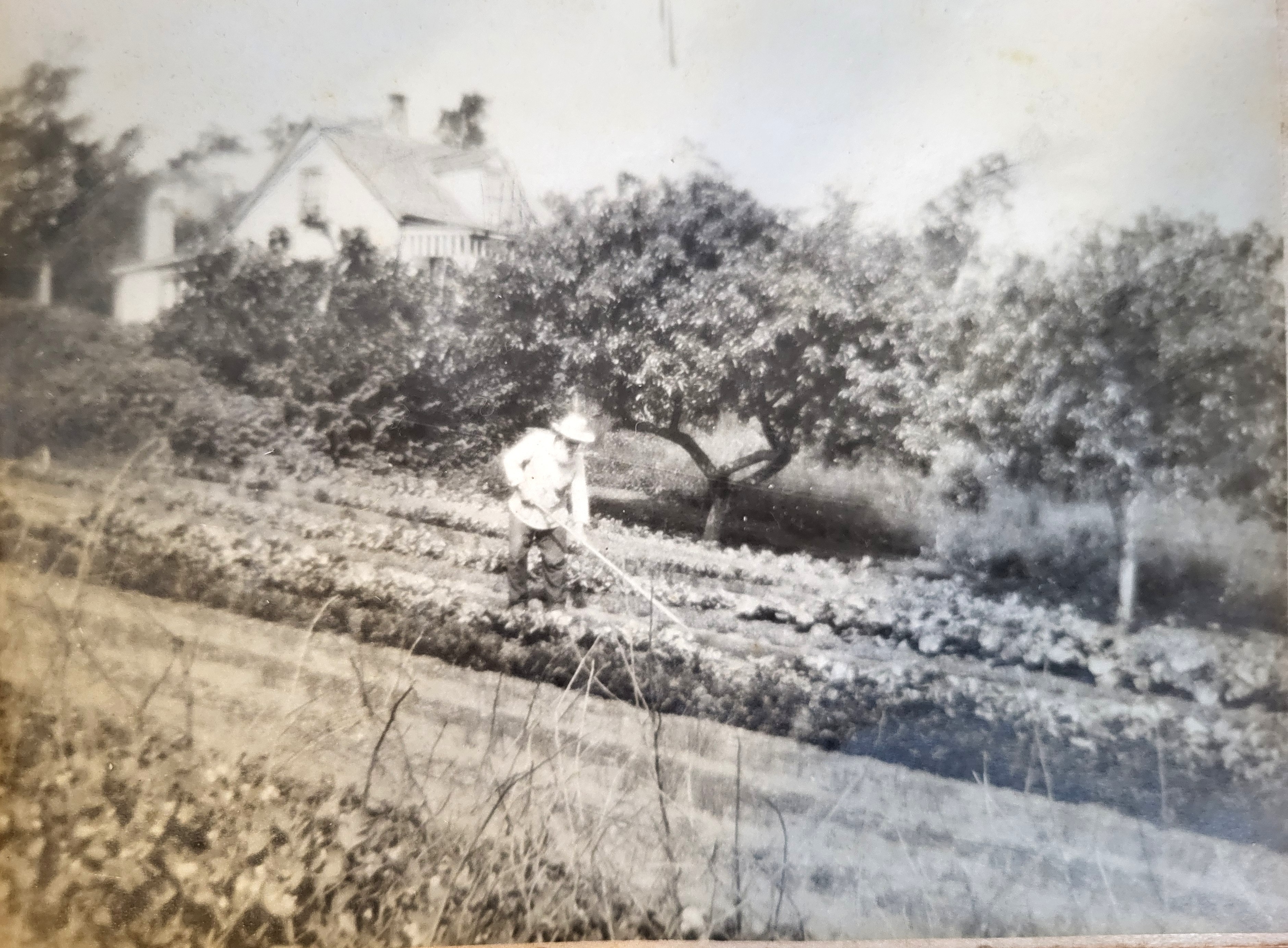
They had three children. (1) Gilbert Watson Jollimore left home young after a dispute and settled in New Waterford, Cape Breton. He dropped the Jollimore name and was known the rest of his life as Gilbert Watson. His descendants still live in the Sydney – New Waterford area. (2) Gordon Jollimore took over the family farm and married Isabella MacDonald of Scotland.
(3) Lucy Jollimore married Joe Boutilier. Joe and Lucy operated a ferry service between Jollimore and peninsular Halifax. The business was acquired from one of Lucy’s cousins. They lived in a large house on the shore. In addition to the ferry, they rented rowboats and canoes and later provided service to motor boats when they came into fashion4.

Alexander MacLean Matheson
Alex is also listed in the 1871 census at Upper Kemptown with his parents. Again, this is false as Alex left for the west in 18665 and never returned to Nova Scotia. At an early age he was trained as a blacksmith, perhaps in Truro, before heading to Maine where he worked on the railroad for a short time. This was followed by a year in Illinois on a farm followed by a stint in Wells, Minnesota where he assisted in the building of a roundhouse for the Minnesota Southern Railroad. He had entered Freemasonry while in Nova Scotia which enabled him to help organize the first Masonic Lodge in that town. From there he moved to St. Paul where he furthered his knowledge in metal work in the railroad shops of that city.

His next move was to Georgetown in Colorado, a mining town on the rise, where he presumably continued with blacksmithing. While in Georgetown, he met and married Rachel Jeanetta Shawl of Philadelphia.
The stay in Georgetown was short and the couple proceeded to Butte, Montana, another mining town where he continued in the blacksmithing business. Further opportunities beckoned on the West Coast. Alex and Rachel acquired a team of horses and a wagon to cross the mountains on a route leading to Spokane, Washington. Now a substantial city, then it consisted of a general store, saloon and butcher shop. This adventurous journey landed them near the village of Baker City in Oregon where he settled on the Owyhee River and engaged in farming. Farming never seemed to satisfy Alex and he became involved in the promotion and construction of the Owyhee Ditch, an early and substantial irrigation project in Eastern Oregon.
By 1892, opportunities further north in Washington captured his interest. He obtained employment with a shingle mill as an engineer and millwright in Ballard to the north of Seattle. After a few years in this capacity, he struck out on his own and built a shingle mill with two partners of which he was the promoter and lead manager. Once well established, he sold his share to his partners and moved to Hoquiam on Gray’s Harbour.
Two first cousins, originally from North River, Nova Scotia, were in the midst of creating what would become a major logging empire on the Pacific Coast. Together with Robert Polson, Alex organized and built the Polson Shingle Company to add value to the timber being extracted from the surrounding area. The mill produced 300,000 shingles a day. The other Polson brother, Alex, entered the picture and the mill was discontinued and a modern sawmill was built under Alex Matheson’s supervision. The new mill, Eureka Cedar Lumber and Shingle opened in 1914 with Alex Matheson as managing director. It was capable of 125,000 board feet per day.
Alex’s name was associated with several companies in Hoquiam. He and others acquired a sash and door company of which he was president.
Alex and Rachel had a son Gilbert who was a foreman in the sawmill and continued in the employ of the Polsons after Alex’s death in 1917.
On the personal side, A. L. Matheson6 was an unapologetic Republican and an unwavering promoter of the Masonic movement.
George Gordon Matheson (1847-1928)
Unlike all of his full brothers, George remained in Nova Scotia and stuck with farming. He is listed with his family at Upper Kemptown in 1871 as a farmer. With so many younger siblings, George likely spent considerable time working in lumber camps to take the strain off the family food supply. He also spent time helping his maternal uncle, “Ally Og” MacLean at Nuttby, with his farm as that uncle had no sons to help with the crops. Ally Og’s daughter, Harriet, was married to Alex MacDonald, MacAdie, of The Falls and through them, George met his future wife Christena MacDonald.
The couple married at the Earltown Manse in 1875 and acquired the Dan Baillie farm at Balfron. Although it was fully cleared and set up for immediate farming, it was an expensive property. Unable to keep up with the mortgage held by the previous owner, it was returned to Mr. Baillie and two remained friends for many years thereafter.
Ally Og came to the rescue and helped George purchase an undeveloped property at the end of a branch of the MacLeod Road near The Falls. George constructed a small house and sizable barn and began clearing the timber off what would eventually become a 75-acre farm. The property was conveniently located a short distance through the woods from Christena’s mother’s farm on the New Annan Road.
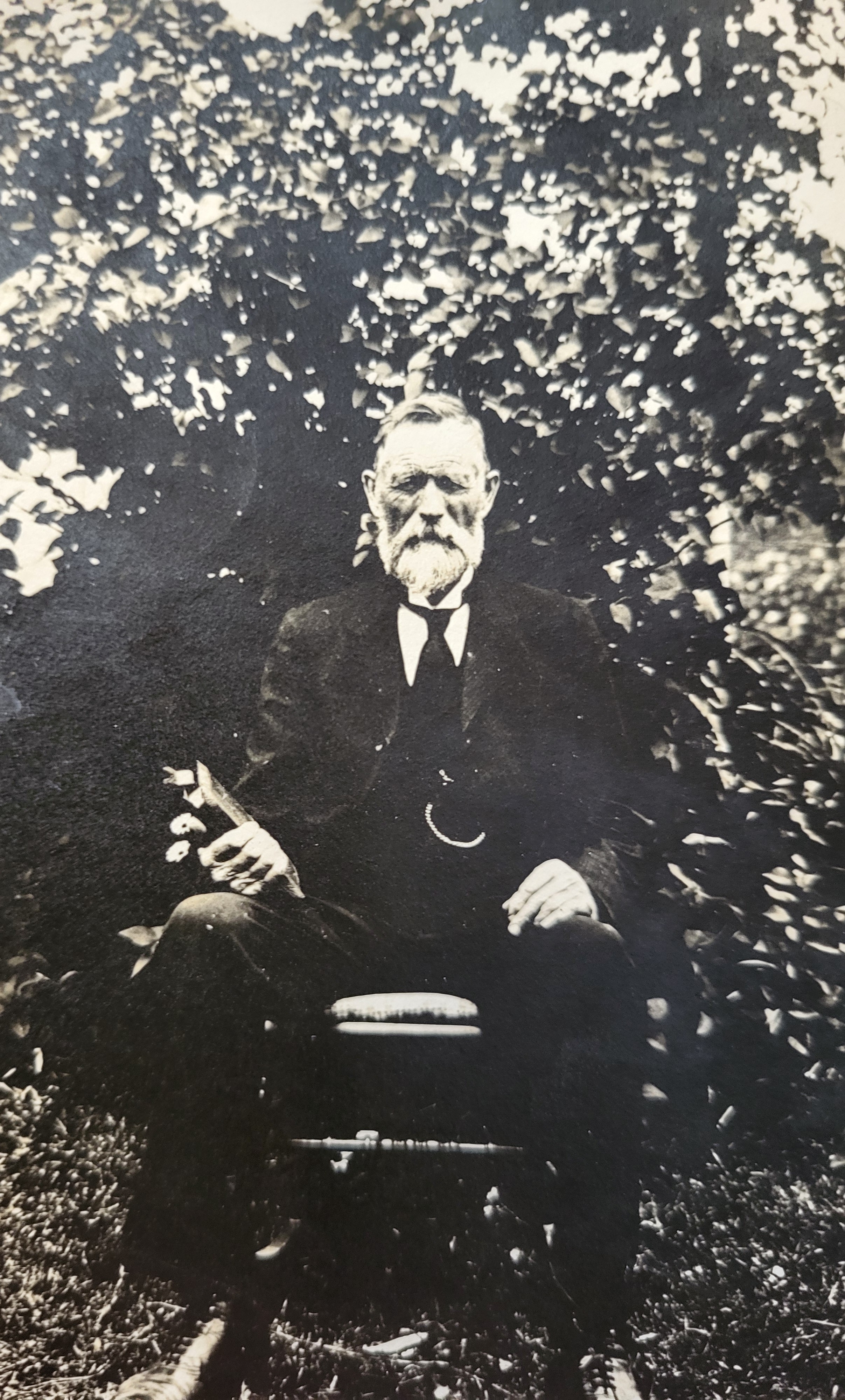
George and Christena had four sons and four daughters. 1) Adam married Jane Lynch and farmed at Nuttby before moving to Montesano, Washington where he had a ranch, 2) Gilbert married a) Maude Hiscox and 2) Ellen Campbell. He learned the carpentry trade in Boston, had a contracting business at Balfron for a few years before settling in Trenton. He built coffins for 50 years in New Glasgow; 3) Donald William (Bill) was also a carpenter in Boston before heading to Hoquiam where he became a saw filer. He married Mary Welsh and settled outside of Olympia before his untimely death at age 32; 4) Gordon working in local logging camps before heading to Gray’s Harbour to work with cousins. He acquired land near Lethbridge but was called back to take over the home farm before the dream became a reality. He married Grace Murray, a teacher from College Grant. 5) Margaret married William Polson. They took over his parent’s farm on Polson Mountain, Upper North River. In 1912 they moved to Montesano, Washington, and lived on the 500 acre Polson ranch which supplied food for the Polson logging camps. 6) Cassie died young of TB: 7) Tena married Percy MacIntosh of Oliver. She also died young of TB; 8) Bessie married Ira Nelson, a farmer at New Truro Road. They moved to Nappan near Amherst.

George died on May 1st, 1928. It was a late spring and the road to the farm was still blocked with snow although the roads coming from Tatamagouche were bare. In order for the undertaker to reach the farm, the men of the community formed a work party to shovel a kilometer long road.
Strachan Gordon Matheson (1850-1914)
Strachan became a carpenter at an early age and was first employed in Halifax where we find him rooming downtown in 1871. In 1874 he married Isabella MacDonald of East Earltown, daughter of Donald MacDonald and Betsy Matheson. She was working in Halifax at the time. This was not a chance encounter in the city. Isabel’s mother, Betsy, was born in Rogart, Sutherland, and came with her mother and stepfather to Upper Kemptown in the 1840’s.
In 1880 Strachan, Isabell, sons Gilbert and Gordon were living Ivanhoe Street in Halifax where Strachan was listed as a builder. Living with them at the time were Isabel’s brother Dan Matheson MacDonald and John Sutherland “Johnny Lake”. Both men were carpenters. Strachan’s younger sister Elizabeth was living with them as a domestic.
In 1882 the family moved to Winnipeg and first lived at 540 Main where Strachan had a shop producing picture frames. By 1890 he was back in the contracting business. His brother in law, Dan MacDonald also settled in Winnipeg and continued to work with him.
In a surprising turn of events, Strachan, Isabel and the younger children were back living in Upper Kemptown in 1911. Strachan was heir to the estate of his half-brother Gilbert W. who had died in 1907. The sojourn may have been brief as his grandchildren had no recollection of this move.
Strachan died in Winnipeg in 1914.
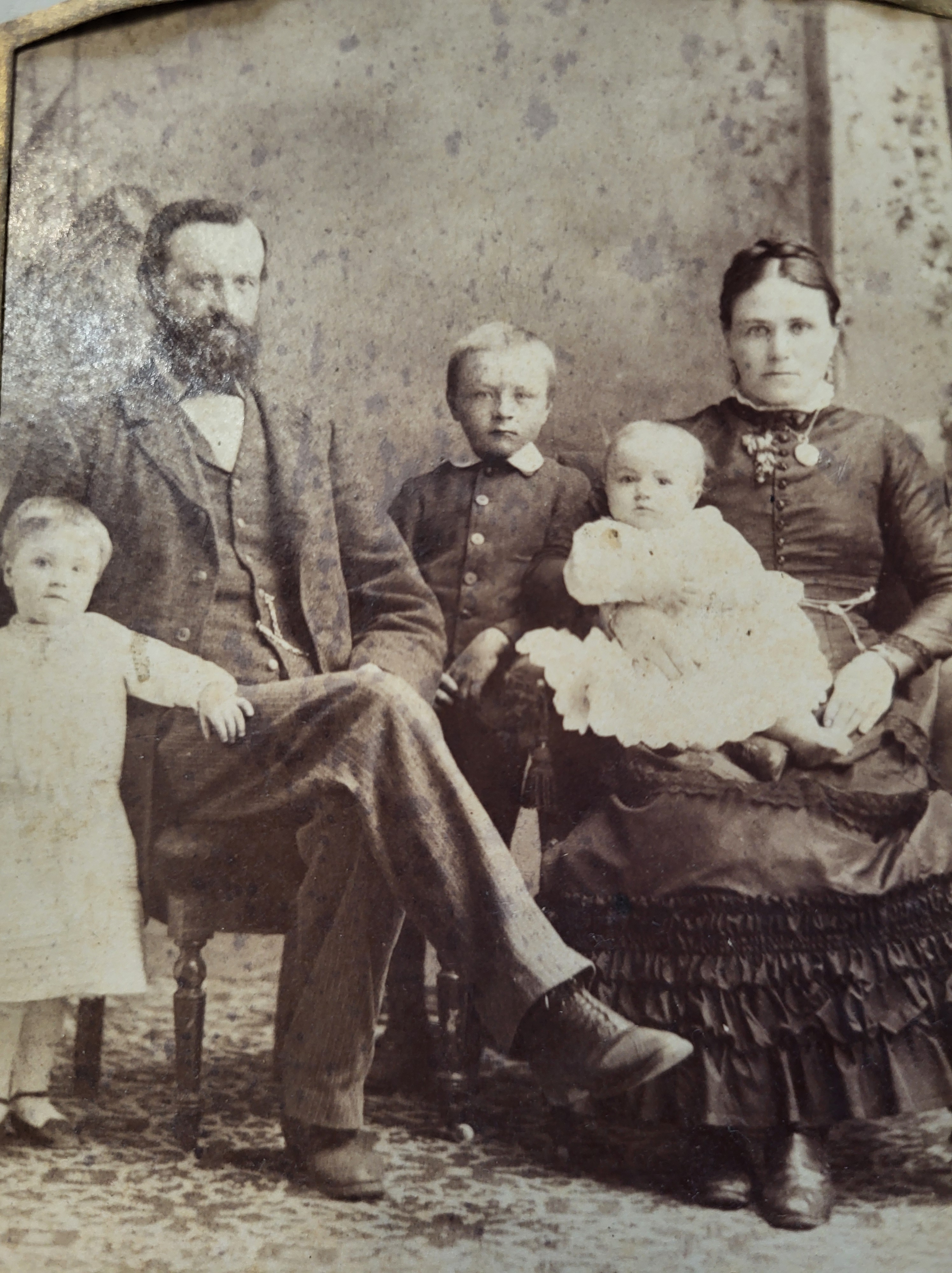
His sons were Gilbert, Gordon and John. The daughters were Elizabeth Loos, Caroline Skidmore, Bell MacCallum and Sophie. John was a grain inspector and later a grocer. Bell MacCallum’s husband John was a Nova Scotian from Greenfield, Salmon River. Sophie came back to Earltown in the early 1920’s and eventually became engage to William “Billy Pentioner” MacKay at East Earltown. Tragically Sophie died in 1923 before they were married.
Eiric (Henrietta) Matheson 1851-1887
Eiric was an old Gaelic name often entered in church records as Erc. Henrietta and Harriet are both translations. Henrietta never marred nor did she ever leave the homestead at Upper Kemptown. She is buried in Earltown.
John Matheson 1853-1932
John also started his working career as a blacksmith and most likely apprenticed in Truro. Like his brother Alex, he migrated west to Colorado and settled in Silver Plume to ply his trade. In 1879 he met a young lady from Blue Mountain, Pictou County, by the name of Catherine Stewart Austin. The following year their daughter Una Jeanetta was born in Silver Plume.
Their only other child, George Stewart Matheson, was born in San Francisco in 1885 where they were still living in 1892 on Treat Street. In 1886, John acquired vacant land in Langley Prairie, British Columbia. For six years, John spent the winters clearing land and building a road to his property. His family remained in San Francisco until 1894 when the whole family became full residents of the area. In 1898, they constructed a farm house which today is a protected heritage site in Langley Prairie and the only 19th century farmhouse still extant in the immediate area.


John and Cassie were successful dairy farmers and passed the farm along to their son George. The writer’s father arranged a visit to the farm while on furlough from his Vernon posting during the second war. Although the area is now a city, it was a sparsely populated farming community at the time. He was instructed to inform the bus driver to watch for swinging buggy lantern when passing through area at night. As expected George Matheson was waiting at the end of a rural road with a lantern late at night. It was a bittersweet visit as the Mathesons were just getting over the loss of a son in a military air crash.
Elizabeth Matheson 1855-1901
Elizabeth (Bessie) followed her sisters to Halifax and made her home with her brother Strachan. When Strachan relocated his family to Winnipeg, she followed. In 1893 she married Albert G. Perry, a native of Pimlico, England, in Winnipeg. A few years later they moved to Vancouver where Albert worked on the trolley system. The couple had a child in 1895 who didn’t survive. Elizabeth died “before her time” in 1901 and is buried in Vancouver. Albert remarried and died at age 95 in 1960.

Christena Matheson 1857-1934
Christena followed her sisters to Halifax and in 1881 married Alexander Jollimore, first cousin of Jimmie Jollimore, her brother-in-law. He also farmed on a hill in Jollimore Village and worked locally as a labourer.
Four of their children died within days in November of 1891. Annie, Bessie, John W. and Violet are buried in the Old Anglican Cemetery on Purcell’s Cove Road. Henrietta, (Etta), lived unmarried on her home place. Alexander, (aka Bert), lived nearby and was a bridge builder with the Province. Strachan Gordon Jollimore was a painting contractor in the city.

Bert’s son Jack, who died in 2024, was the last of this pioneer family living in Jollimore.
William Lane Matheson 1859-1920
William, at age 20, set out from Upper Kemptown for the United States and eventually settled in the mining town of Butte, Montana. In 1888 he married Annie Hier, a Welsh girl from Maestege, Wales. Around 1905 the family moved to Hoquiam, Washington where his cousins, Alex and Robert Polson along with his older brother Alex, were developing a shingle mill and later a full lumber mill. William worked in the mills.

William (Bill) and Annie had nine children: Margaret Olson; Gilbert W, a sawyer; Glen J. a merchant; Dr. George, a dentist; Ruth Day; Elmer died in Butte; Ethel Sparling; Dr. John, a dentist; and Robert, a lumberman.
Many of his descendants remain in the Gray’s Harbour area.
Marion Matheson 1862-1909
While her brothers and sisters scattered to Washington Territory, Colorado, British Columbia, Winnipeg, Halifax and The Falls, Marion moved a half mile down the road. In 1881 she was living with her half-brother Gilbert W. and her sister Henrietta as a servant. In an interview with her son Richard a century later, he related that it was not a good experience as Gibbie W. was a “difficult old bugger”.
On February 11, 1885 in Truro, Marion became the wife of George Richard Munro, son of Donald Munro and Janet Urquhart. He was only a year old when his father died and two when his mother died. He was brought up his Urquhart relatives on the farm opposite the cemetery.
George and Marion continued on the Urquhart property. They had five children: Dan Gilbert, Annie and Jessie, all of whom died young of TB. John Alexander “Sandy” worked for the railroad in Truro before an injury after which he retired to The Falls; Richard continued as a farmer on the home place.

George died in 1902, leaving Marion with the five children to raise. Sometime before 1905, Sandy and Richard were dispatched west to live with George Munro’s sister in San Francisco. No doubt this move was to alleviate the strain at home and also shield the two boys from TB which often lurked in an infected household. The boys experienced the San Francisco earthquake of 1905. While in his late teens, Richard went to Hoquiam to work for the Polsons. After a year, he left Hoquiam to stay with his Uncle John Matheson in Langley. While there, an aunt persuaded him to enroll in a college at New Westminster. In his first year, a virus broke out necessitating a quarantine. After being released from quarantine, he returned to the farm at Upper Kemptown.
Marion died in 1909. She and her husband are buried in Earltown.
Robert Matheson (1866-1954)
Robert went to New England as a young man where he apprenticed to be a stone mason. While in New England, he met up with a girl who was born in Kemptown, Delia Florence Fenton. They married in 1887 in Laconia, New Hampshire. Together they returned to Kemptown for a few years where their eldest daughter, Florence, was born in 1891. Shortly thereafter they moved to Winnipeg where Robert, no doubt, worked with his brother Strachan in the building trade. In 1895 they were living in Michigan when daughter Mabel was born and by 1900 they were permanently settled in Goffstown, New Hampshire, where Robert continued to work as a mason.

They had four children: Florence married Paul Marshall, Goffstown; Annie married 1. Melvin Radford and 2. Raymond Brown in Massachusetts; Mabel married Forest Johnson and lived in Enosburg, Vt. and William Robert married Josephine Leland and lived on the home place in Goffstown.
Sources:
Canadian Census – Kemptown – 1838, 1861, 1871,1881,1891,1901,1911
Canadian Census – New Westminster, BC 1901
US Census 1910 – Salem, Oregon
US Census 1910 – Hoquaim, Gray’s Harbour, Washington
US Census 1900 – Hoquaim, Gray’s Harbour, Washington
US Census 1900 – Butte, Montana
US Census 1880 – Silver Plume, Colorado
Montana Marriages 1865-1987
Colorado Marriage Records 1879
Hunt, Herbert Washington, West of the Cascades, SJ Clarke Publishing 1917
Van Sycle, Edward They Tried to Cut It All, Pacific Search 1981
Shea, Iris Ferries on the Northwest Arm – A Fond Memory Mainland South Heritage Society
Newspapers.com Various articles pertaining to the Polson Logging Company, A.L. Matheson and William Matheson.
Free Church Records, Earltown Congregation
Jollimore Cemetery
Deeds – Nova Scotia Property Online
Interview – Richard Munro – circa 1978
Interview – Margaret Munro circa 1977
Correspondence – Ruth Matheson Renner, Ariel, Washington
Correspondence – Shirley Jollimore Fraser, St. Margaret’s Bay, NS
Correspondence – Myrtle Boutilier Burton, Jollimore Village
Interview and correspondence – J. Stuart Matheson, Winnipeg
Interview and correspondence – Ronald MacCallum, Calgary, Ab.
Correspondence – Caroline Matheson, Langley, BC
- Adams, R.J. Papers on Sutherland Estate Management 1802-1816 ↩︎
- While the estate owned the stone buildings, the roof timbers belonged to the tenant and thus could be removed. ↩︎
- There is an oral tradition that the two Matheson families had some connection back in Scotland. George MacKenzie of Earltown, a weaver descendant, claimed relationship to Richard Munro, son of Marion Matheson. The connection could also be through the MacPhersons as George Matheson “Weaver” was married to an Elspeth MacPherson while Gilbert Matheson’s mother was also a MacPherson. ↩︎
- The operation of the ferry had its challenges. In addition to weather conditions, calls for service from the Halifax side would come at all hours. Lucy was very much “hands on” in the operation. The Boutiliers son continued the service until the mid 1960’s when Halifax Transit began bus service to the Northwest Arm. ↩︎
- Per the 1900 Census. His biography in Washington, West of the Cascades claims he left home in 1867. ↩︎
- Alex, like some of his MacLean cousins, changed MacLean to Lane after settling in the United States. There was considerable bigotry towards the Irish in the later half of the 19th century therefore those with a “Mac” surname or middle name often dropped the Mac. ↩︎
 earltown
Thank you very much.