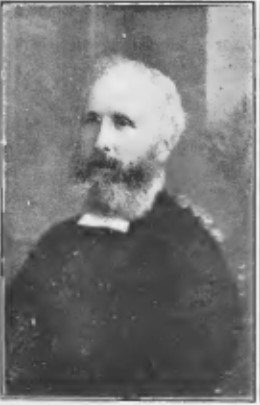
It was often said that Earltown contributed, proportional to its population, more than its share to the ranks of Presbyterian clergy in Atlantic Canada. Some were influential clerics in the church’s courts, some were prominent in the cities of North America, some selflessly went to foreign lands as missionaries, and a few quietly went about their duties in the rural countryside.
The subject of this post, a son of Earltown, is seldom, if ever, remembered in his home community and perhaps in the communities he served. However, his story is worth telling in terms of the hardships endured by clergy who brought the message of hope and encouragement to isolated settlements.
Donald Sutherland was born on Christmas Day in 1835 at Central Earltown. His parents were Nicholas Sutherland and Christiana MacKay. With the uncommon forename of Nicholas, it is not surprising that their progeny had the descriptor “Nicky” attached to their names. Nicholas was born in 1798 in Golspie, Sutherland. In 1824 he married Christiana MacKay, daughter of James MacKay, miller of Rossal in the Parish of Rogart. The couple settled at Little Torboll in the Parish of Dornoch near the mouth of Strath Fleet where their eldest four children were born. In 1831/32, they were part of a substantial migration from Eastern Sutherland to Pictou.
Christiana’s two brothers were already established in Earltown – John MacKay the miller and Neil MacKay the tailor. Nicholas and Christiana acquired the farm west of Neil about one kilometre from the village. In total, the Sutherlands had eight children 1.
The MacKay side of the house greatly emphasized education with offspring entering medicine, ministry and politics. In the Sutherland household, young Donald Nicky showed promise as a serious scholar and was sent to the Pictou Academy. Upon graduation from the Academy, he entered the Truro Seminary and finished his theological instruction at the Free Church College in Halifax.
It would appear that he was first dispatched to Cape Breton Island as a student minister by the Home Mission, assisting settled ministers in covering their extensive pastorates. While in Cape Breton, he qualified and was ordained in June of 1860 at Baddeck. He was immediately sent to Aspy Bay to become their first settled minister.

The Aspy Bay pastoral charge was headquartered in what is now the community of Cape North. For the first thirty or so years of its existence, the Presbyterians were occasionally visited by a minister from other parts of Cape Breton. In 1860, Rev. Donald was responsible for the Presbyterian population extending from the top of Cape Smokey, around the tip of Cape Breton Island and down the western shore to Fishing Cove. This area included the settlements of Ingonish, Neil’s Harbour, New Haven, White Point, Dingwall, Cape North, Sugarloaf, Bay St.Lawrence, Pleasant Bay and Fishing Cove to the north of Cheticamp.
Around Aspy Bay, the settlements and farms could be reached by boat or canoe in the summer months. In some cases, the minister might catch a ride on a schooner heading to the next village. To reach his flock in Pleasant Bay, Rev. Donald had to traverse a ten mile obstacle called North Mountain. Today, a two lane highway clings to the side of the mountain making it a tense driving experience. One can only imagine carefully guiding a horse along a narrow path above a sheer drop. In winter the trip had to be undertaken on snowshoes over snow several feet deep in the uplands. If a ten-mile hike in snowshoes weren’t a challenge, the unpredictable weather at higher elevations would be.
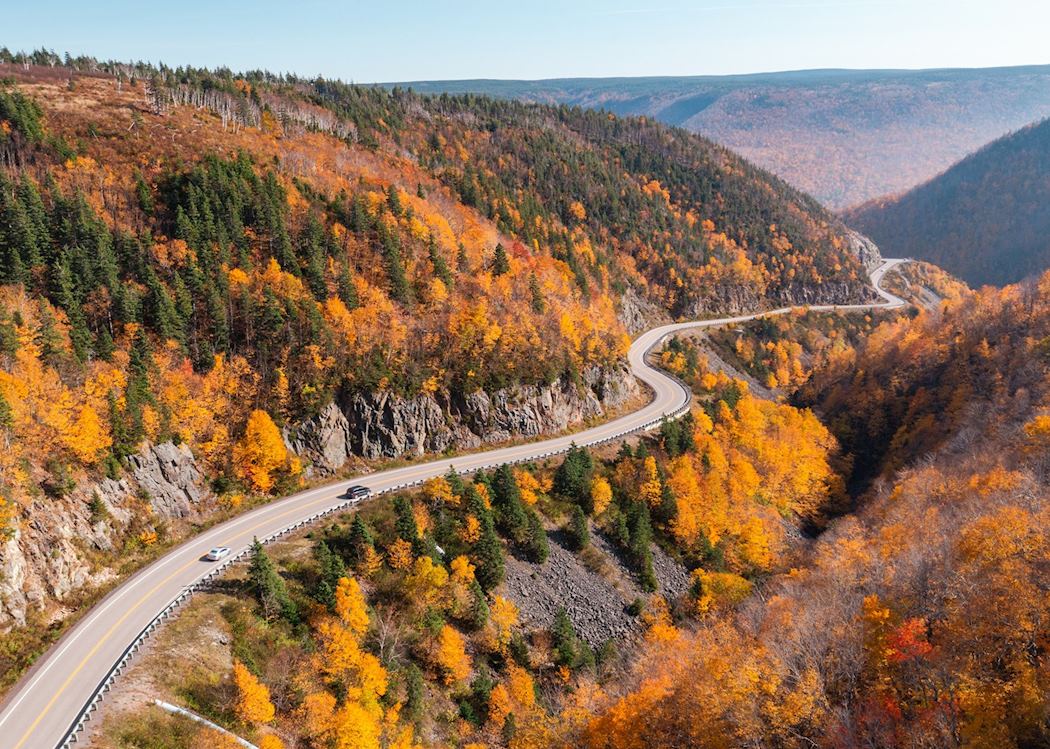
While attending to the spiritual needs of Pleasant Bay, the minister would be expected to make a pastoral visit to a small outport called Fishing Cove. This would require a climb up MacKenzie Mountain, crossing the bogs and barrens at the top and descending through a deep gorge to the fishing hamlet.

Rev. John Murray, in his The History of the Presbyterian Church in Cape Breton, describes Donald as having an uncommonly fine physique. He was tall, stout and handsome. He was considered “eccentric at times but had a tender and sympathetic heart”. In addition to being a theologian and preacher, he was a linguist and mineralogist.
In 1863 Rev Donald resigned his position after which he was sent by the Free Church Presbytery of Halifax as a missionary to the Labrador Coast. This, by necessity, was a summer posting involving visits to many seasonal fishing ports along the Gulf of St. Lawrence and the Labrador Sea. These ports, and the mission, were serviced out of Harbour Grace where there was an established Free Church congregation. Whether by coincidence or design, Donald would have reported to Rev. Alexander Ross, a native of Earltown and long time minister at Harbour Grace.
Donald Sutherland reported to Presbytery that future work should center around the Bay of Islands on Newfoundland’s west coast where he found a robust population of Highlanders, many of whom migrated from Cape Breton. The following summer he was posted to that region.
In 1867, Donald moved on to Ontario where Gaelic ministers were in great demand. His tenure there was short and he moved on to Kansas and Nebraska2 for a couple of years. By 1870 he was back in Aspy Bay tending to a portion of his former flock at Pleasant Bay. Rev. John Murray of Scotsburn was serving the Cape North area at that time3. In addition to his preaching duties, Rev. Donald was also teaching some of the older students. He devoted some time to transcribing various Gaelic poems and songs unique to the area.
Rev. Donald’s return to Pleasant Bay may have been a calling other than theological. On July 27th of 1870 he married Christena MacLean, daughter of one of the original permanent settlers of the community.
Probably one of Rev. Donald’s most enduring contributions to the community was its current name. Prior to the 1870’s, Pleasant Bay was known as Grand Anse. There was also a community of the same name in Richmond County which was resulting in mail being sent to the wrong community. To rectify the situation, Rev. Donald put forth the name Pleasant Bay which has survived to the present day.
In 1875 Rev. Donald was called to the Charge of Gabarus which comprised the communities of Gabarus, Kennington Cove and Forchu in Cape Breton County. It would be a successful and uneventful pastorate of 28 years.

The Sutherlands had three daughters. Sarah died at the age of 4, Christena died unmarried in Gabarus in 1904 and Jessie married Donald MacLean of Gabarus Lake4.
On July 29, 1903 Rev. Donald Sutherland “Nicky” died sitting on the veranda of his manse.
Sources:
Murray, Rev. John History of the Presbyterian Church in Cape Breton, 1921 New Publishing Co., Truro
MacDougall, John L History of Inverness County Nova Scotia 1922
Moncrieff, Wilfred M. A History of the Presbyterian Church in Newfoundland 1842-1967 MS
1871 Census of Canada, Inverness County
Murray, Rev. John, The Story of My Life, with Several Reminiscences Edited version by Eric Wilson and William Collett
- Other children of Nicholas and Christy Sutherland were: James, a merchant in Halifax; Catherine at home; Janet (David) Murray of Clydesdale; John, a merchant in River John; Annie (Dan) Baillie of Balfron; Marion (Kenneth) MacLean of West Branch and Hugh, mail carrier between Truro and Earltown. ↩︎
- Several families migrated from West Pictou to Kansas and Nebraska. Rev. Alexander Sutherland of Earltown briefly served them before returning to Canada. Rev. Donald was undoubtedly familiar with their settlements and may have been invited to serve. ↩︎
- This is the same John Murray who wrote the History of the Presbyterian Church in Cape Breton. Murray was from Scotsburn and he was related to many of the families in Earltown. In addition to their overlapping service to Pleasant Bay, they were co-presbyters in Cape Breton County for the whole of Rev. Donald’s tenure in Gabarus. ↩︎
- Mr. MacLean died young. Jessie lived much of her remaining life in Sydney and died at the age of 90. ↩︎
 earltown
Thanks for your thorough research on the life of this man and his colleagues. Most likely they can be found somewhere on the same trees as my family. I enjoy these history lessons. Thanks again!
Lynn Gray