2015 Cemetery Tour – Murray’s Cemetery, The Falls

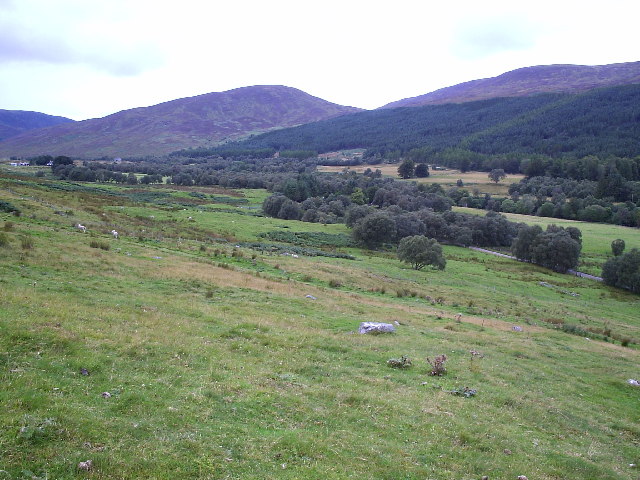
In a forgotten corner of West Earltown and The Falls, in the shadow of Spiddle Hill, lies Murray’s Cemetery. It is not visible to the travelling public nor are there any signs to lead one up a single track road along the Waugh River to this very tranquil and very historic spot.
This was the cemetery that served the above two communities from the 1830’s through to 1900. It is the resting place of a couple of generations that were, for the most part, evicted under duress from their ancestors’ homeland in Strath Brora, Sutherlandshire. They chose to emigrate to Pictou and reassembled as a Strath Brora community in exile, clearing the heavily forested slopes in the northwest corner of Earltown.
On Sunday, August 2nd, we will be conducting a guided walk among the monuments of these exiles, remembering their past, their struggles and their contribution to their new community. We will see the stone of Rev. William Sutherland, a settler and farmer, who was never called but served the area nonetheless. Nearby is the memorial to Catechist Baillie, one of the “Men of Sutherland” who was revered and feared in the days before the ministers. Then there are the two Eliza’s, one the legendary “Scotch Lady” who was lured from Glasgow to marry a cousin, (spoiler alert – she died single!), and the other Eliza who was “done wrong” in every sense. These are just some of the colourful characters that will be featured.
This event is part of the annual Earltown Gathering centered at Sugar Moon Farm. People may assemble at Sugar Moon prior to 10 AM at which time they will be guided to the cemetery. For those who know the way and wish to go there directly, access is currently off the Gil Sutherland Road and through the Edwin Cameron farm. It is highly recommended that you park at the far end of the farmstead, (near the old bridge), and we will provide transportation for the remainder of the way. The road is single lane and there is only parking for three vehicles at the site.
There is no admission fee for this event but donations will be accepted, if you are so inclined, towards the maintenance of the cemetery.

UPDATE: The Cameron family has indicated that people may park in a pasture immediately past the cemetery.  The road is in good shape but one should proceed with caution.  For those with low vehicles, we will still arrange for lift from the farmyard.  It is also a pleasant 10 minute stroll.

It’s Complicated …The Relationship of William Murray and Girzel Grant

Readers of this blog may also be interested in following the posts on historylinksdornoch.   The blog explores the history and archaeology of Dornoch and surrounding areas in Sutherland, Scotland.   It is a collaboration between Historylinks museum in Dornoch and the Centre for History at the University of the Highlands and Islands, and moderated by Dr. Elizabeth Ritchie.  Dr. Ritchie is an enthusiastic scholar of the history of Sutherland, particularly in the areas of religion, education, emigration and women’s issues.

You will find a post entitled  It’s Complicated …The Relationship of William Murray and Girzel Grant: Part 1.     This couple, who embodied the notion that opposites attract,  were parents to three emigrant families to West Pictou and Earltown.   Janet Murray MacIntosh settled near Elmfield in 1812, Robert Murray “Valley” settled near East Earltown in 1819 and Donald Murray “Craig” settled several years later atop the Craig in Loganville.   Part II will appear in the near future after which this blog will flesh out the continuing story of the family in Nova Scotia.

Enjoy !!

Achany Letters # 2


This letter was written by Alex Murray, brother of William’s wife Sybella Murray MacKay.  Alex was also a brother of Robert Murray, “Stager” of Earltown and he makes mention of his brother in the greetings.  Alex is living in the Parish of Creich on the opposite side of the Kyle of Sutherland from William’s home parish of Kincardine, Ross.   Consequently he is well acquainted with William’s family and friends.

Of particular historical interest is the mention of clearances taking place nearby.  It would appear to be the Glen Calvie clearance after which the people took refuge in the churchyard of Croick.


To William M’Kay,   Newfield

Earltown Settlement

By Pictou Nova Scotia

North America


Clashnashinag, May 30, 1845


Dear Brother by receiving this short epistle you will understand that I received your most welcome letter on the 15th of April last, and I am overjoyed to hear that you and your wife and family and the rest of my relations there were in the land of the living and in the place of hope at the date of your letter.   As this leaves me at present, my wife and family, my Brothers and Sisters, and all our relations as far as I know, except Alexr M’Kay’s wife, my uncle’s daughter – she is always sickly. Hugh my uncle is poorly in health. He got a fall about six or seven years ago and he is going on crutches since.   Appy my Aunt died last year

I think you forgot writing to Mr. Alex Ross and sister – they are always inquiring about you when they happen to see me. Please to give my best respects to Christian and her husband – I forgot his name, to Kenneth and his wife, to George and his wife to John and William, not forgetting Robert, my brother, and his wife and family. And tell him that I did not forget him yet but he thinks I did. I would to like to hear from him now and then; But for myself I would sooner travel a days journey than to begin to write, for my hand shakes and my sight fails me.

I am told that a number of the tenants in Gleann Palawarg** in Ross Shire were summoned out of their farms and has no place to go to…and I a m told that that a civil officer or a lawyer came dwon from Edinburgh for to see them and that he desired them to put tents up in the churchyard for such a time and then to take rooms in Tain and to be good to themselves.   I suppose that the Man that put them out must provide for them while they live, or give back their farms to them again. There is some of the great men that would not allow the lower people to live at all if they could. They are worse since this separation took place than before.

I have nothing particular to acquaint you of at present. Provisions are cheap and plentiful, oatmeal 16 s per bole, potatoes __ per bole, very little demand for cattle.

Remember me to David Grant and wife and tell him John his brother is well and that his wife died. Remember me to Strachan Gordon. Adam and his wife wishes to be remembered to you all – there is none of his children living but Barbara and Anne.   My wife and sisters joins me in sending our best respects to you and your wife,

I remain your loving Brother Ales’er Murray


** Very hard to transcribe. It could be Balawairg, Balawaing, Calawairg.

The Achany Letters #1


The following letter was written by Nellie (MacKay) Munro of Langwell, Strathcarron, Ross, to her brother William in Earltown.   She was the wife of John Munro.

To Wm MacKay

new settler,  Earltown

Nova Scotia by Pictou

North America

Langwell Strathcarron 4th June 1832

Dear Brother

I embrace this opportunity to address you these few lines to let you know that I and my  husband and the family are in good health at present. I thank God and earnestly wishing that these lines my find you and concerns in good health.  We are happy to hear your arrival well in that quarter of the world.  You will learn by this letter that Mary & Bell is very desirous of going to America if they could induce us their parents to go with them, and they are pointing out that part where you are for their destination and therefour I earnestly wish you t forward a letter to us as soon as possible and let us know particularily how does the country agree with you and how are you and yours coming on since you have arrived in that country.  We wish you to give us all possible information concerning the country and its climate, And if so be that we shall be encouraged by your letter we may have a good chance of going over the Atlantic all next year – as we have every chance of being all removed next Whitsunday because they are to make five lots of all Langwell and there is few or none of the present tenants that can take a lot.

Strathcarron near Langwell   (c) Donald Bain

Strathcarron near Langwell (c) Donald Bain

This country is still getting worse every year.  I suppose there is a great number of the people of this country that shall go to America next year

We are happy to learn that you have 100 acres of land in your possession – let us know then if your sons are employed at cutting the wood and clearing the ground or have they in service some other where.

I was told by John Urquhart, (who read your letter), that Christy your daughter were in service in Pictou.  There is a dreadful plague raging in this Kingdom in England and Scotland called the Cholera Morbus – it carried away thousands in the south.  We have every reason to be thankful that it did not come north yet, we hope that it will not as it is dying away by grees in the south.

The Rev. Dr. M___  of Tain died lately.

Your brother and family are in good health, the boy _____ trouble with weakness is better these days and able to walk about.  I suppose you will receive a letter from him by this  –(ship?) that is about to sail from Cromarty.  Please let us know in your letter what (type?) of a house you have built and if other neighbours are close to your plantation.  Glad to hear that you have a cow.  How does she please you in that country.  Your mother in law is still living and they are all well –

I conclude now with own blessing to you and your family – let us know how your wife coming on and in hope that this will come to your hand and that you will write us without delay as we shall be anxiously expecting your answer,  I remain  Dear Brother your affectionate sister Nelly Munro

NB. Donald Ross MDonell and his family are well and send their best respects to you.  Mary is still in Tain with Dr. Munro and my husband is serving at Balnagown –   fare well N Munro


Editor’s notes

The letter clearly places William “Achany” and Sibella among the influx of settlers that arrived in Earltown in the 1830/31 era.

Nellie and John Munro never emigrated as planned.  Subsequent correspondence indicates that they relocated to Strath Oykel, a few miles to the north.

It is implied that there was still an active shipping lane between Cromarty and Pictou in 1832 thus making correspondence convenient for those literate enough to write.

The Achany Letters

Introduction

Highland emigration to Nova Scotia is often portrayed as a traumatic event after which the emigrants permanently left their homeland thus concluding all contact with those left behind.   In many cases that would be true.  Those with the literacy skills to conduct correspondence  were in the minority, both in Nova Scotia and Scotland.  Some, like those from Clyne,  left communities that became totally vacant.  Others came as part of an extended family with little need to keep in touch with people back home.   Consequently there are very few surviving documents of communication between the old and new settlements.

Earltown did have at least one settler who not only kept in touch with family and friends in Scotland but actually kept the letters.   William MacKay “Achany”  corresponded for a number of years with siblings, nieces, nephews and old acquaintances in his home Parish of Kincardine as well as his wife’s family in Rogart and Dornoch.   We don’t have any of the letters written by William but a portfolio exists of original letters addressed to  “William MacKay, settler, Newfield, Earltown by Pictou, America”.

The letters give insight into the continuing struggles of the crofting class back in Scotland.   Some make reference to the unpopular moderation of the Kirk,  a precursor to the formation of the Free Church of Scotland in the 1840’s.   Certain writers inquire about the possibility of getting free land in Nova Scotia should they decide to emigrate.  A few letters give insight in the customs of the times such as providing mourners with a wee dram at a graveyard burial.

Many of the letters are difficult to follow.  The education of the writers may have been limited but the main contributing factor is that the writers were trying to convey their Gaelic thoughts in written English, their second language.   As one Mr. Murray writes  “I don’t know how to put the English to it”.

William MacKay “Achany” was born in the Parish of Kincardine, Ross, in 1783.  In adult life he lived at Invercarron at the confluence of the Carron and the Kyle of Sutherland.  This area was part of the Achany Estate, a one time Munro holding that straddled the boundary of Ross and Sutherland.  When William arrived in Earltown, he was nicknamed “Achany” to distinguish him from a number of other William MacKays. He married Sybella Murray of Rogart in Scotland.   Sybella’s brother and mother emigrated to Earltown in 1819, (the Stager Murrays), which may account for William and Sybella arriving in Earltown a few  years later.

William and Sybella’s homestead was located on the Campbell Road at Central Earltown.  Their sons William and John lived on this road as well.   A son, Kenneth, lived at West Branch while another son George settled on the Peter MacDonald Road at The Falls.  Their only daughter Christy married George Henderson of Kildonan and West Earltown.

Robert (Bob) Forbes, late of Denmark, NS, and a great, great grandson of William “Achany”, generously shared the letters several years ago.   Over the next few weeks, examples of the letters will be posted along with some background comments.

The Shoshone Sheriffs

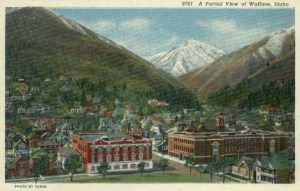
Shoshone is a county in the Idaho panhandle, a sliver of the state that is wedged between Montana and Washington extending towards British Columbia. It is near the city of Coeur d’Alene and 80 miles east of Spokane, Washington. It comprises a series of river valleys west of the Rockies, rich in minerals, particularly silver. It was silver that put this area on the map after 1884.Wallace_2
And what has this to do with Earltown?

Two prominent law enforcement officers in this wild, frontier settlement were born in Earltown.

The first and most famous is Angus Sutherland.   He was born on a farm overlooking the Balmoral valley in 1851. He was a son of John Sutherland and Christy Sutherland.   Tradition claims that his father John was a son of William Sutherland “Ruidh” and Mary MacKay, first settlers at The Falls. His mother Christy was a daughter of William Sutherland “Ban” and Marion MacLeod, also early settlers.   John and Christy settled to the back of the Sutherland “Ruidh” farm on what is now known as the Peter MacDonald Road. In the 1860’s they sold this property[1] to Donald MacDonald of West Earltown and ventured westward. They were among the first to start the exodus from Earltown to new frontiers.

The family appears to have first sojourned in Ontario and around Port Arthur, (Thunder Bay), for a few years. It appears that their son Angus was the first to explore possibilities in the American West. He arrived in Pierce City, Washington Territory, (now Idaho), in 1878 where he worked at mining for two years. He was able to purchase a mail contract between Lewiston and Pierce in 1880. By 1884 he was operating a saw mill and grist mill in Lapwai, Idaho. In 1886 he permanently settled in the infant mining district east of Coeur d’Alene which became the town of Wallace. Along the way he married Elizabeth Mallory.

At some point his parents, John and Christy, settled in the area as well as his brother Dan. Brother Will stayed in Port Arthur where he worked for CP Rail.   Others in the family are believed to have settled in Idaho.

Like many mining towns, life was crude. There were over two dozen saloons and bordellos flourishing where the male to female ration was around 200 to 1. It was pretty close to the images of the wild west portrayed in movies many years later.

Angus and Dan Sutherland removed themselves from the mines and operated a successful livery stable business called Sutherland Barns. This business later evolved into a garage when automobiles became common.   Dan appears to have been content to mind the shop while Angus was much more civic minded.   It is likely that he volunteered as a Deputy Sheriff in in the 1890’s to assist in maintaining law and order.   In 1898 he put his name on the ballot to run for Sheriff of Shoshone County. He lost by 144 votes.

At this point in time, the labour movement was finding its way into the mining camps of Idaho and Colorado.   Things quickly became nasty with many acts of violence being perpetrated in the name of the union or the employer companies.   Certain mines were bombed, violence escalated and the Sheriff of the day chose to stand aside. The higher levels of government declared a state of emergency, fired the Sheriff and installed Angus as Acting Sheriff in 1899. This was followed by a two year permanent appointment. Over 700 miners were arrested and confined in a stockade for a period of time but later released. In the midst of this turmoil, Angus attempted to maintain a degree of law and order. The result was that he was an enemy to both camps.

Around the time of his appointment, the miner’s association issued a statement saying this about Angus Sutherland:

His record is one that will compare with any criminal on earth. He was organizer of a group of highwaymen that lynched a man for his money some years ago between Lewiston, Idaho, and Walla Walla, Washington. These worthies are the men selected by the democratic government of Idaho under the supervision of Gov. Steunenberg to execute the plans of the Standard Oil company and the mine owners.

The editors of the local paper went on to refute the above claiming; “Mr. Sutherland is one who has manly stood out against the rule of anarchy in the Coeur d’ Alenes and is naturally hated by such men as …. But let us see what is thought by those who have long known him. He stands high in the estimation of the better element of Coeur d’Alenes where he has made his home for some years. Formerly he lived in the southern part of the state and is widely known among the Lewiston people.” “…… Mr. Sutherland’s connections by birth and marriage, his friendships and business associations are those that can only belong to a man or excellence and repute. In politics he is an unswerving Republican but is now acting under a Democratic appointment because there is work to do that requires work of the highest citizenship in which party ties are lost in larger call to patriotic duty. “

Around the same time, Angus sued a Mrs. Hutton who published a book with the subtitle “ A Tale of the Modern Inquisition in Idaho”.   Angus took exception to a passage where Mrs. Hutton claims that a brother of Angus, living in the south of the state, was murdered by an employee over unpaid wages. She accused Angus , “the great law and order demagogue” of leading a mob and lynching his brother’s murderer who merely shot his brother for refusing to pay honestly earned wages.   Angus denied the truth of the statement in total.

Subsequent writers have described the 1898 to 1905 period as a state of war in the mountains of Shoshone.

During these troubled times, Angus became famous throughout the north west. Newspapers from Kansas, Colorado, San Francisco, Spokane, and even as far east as Chicago were following his exploits. The Idaho Statesman made note of Mr. Sutherland’s first visit to Boise, Idaho. “He is a quiet, unassuming gentleman but he has demonstrated in every sense that he is in every sense a noble officer.

By 1905 things became very complicated with the assignation of ex Governor Steunenberg. It was alleged that the assassin was connected with the miner’s union. It was Angus Sutherland who played a major role in the identification of the assassin, further earning the wrath of less than savory elements. Another key witness was an accomplice who was wanted in Shoshone for another murder. The papers of the day give a very detailed account of Sutherland’s conveyance of the accomplice through various jurisdictions that also wanted the criminal on other grounds. He succeeded in bringing the criminal to court in Wallace, Idaho.

In 1907 the Topeka Daily of Kansas described Angus as “the little Scotsman of Shoshone, himself a famous gunfighter”.  

Sutherland also had some close calls. It was reported that he was the target of assignation attempts on three occasions.   On one occasion he was lured to Washington State only to find a trap had been laid. On another occasion he was shot in the neck – a setback but not fatal.  The miner’s association denied complicity.

His term as sheriff was up during the prosecution of the ex-Governor’s assassin. He was asked to step aside as he was accused by his captive as being biased towards the miner’s association. His deputy became the Sheriff and Angus was officially made Deputy although it was known that Angus was still in control. The deputy was William J. Baillie (Bailey), native of the Berrichon.   More about Sheriff Bailey in a moment.

With his brother Dan managing the family business, Angus maintained his interest in law enforcement. In 1931 President Hoover recommended to the Senate the appointment of Angus Sutherland as the Federal Marshall for the state of Idaho. It was a fitting climax to an exciting career.

In his later years, a former private detective published his memoirs including an interview with Angus about the early years of crime in Wallace, Idaho.   The former gunfighter described “enough gore to float a small steamship”.

Angus died March 6, 1937 in Wallace.   Various reports claim him to have been a native of Scotland while some pointed to Ontario origins. The actual government documents clearly place him as a native of Earltown.

William Baillie, (spelled Bailey by this branch of the family when they went to the States), arrived in Idaho in 1897 at the age of 24. Whether he had connections to Angus Sutherland previously or simply wandered into Wallace looking for work in the expanding mines, we can only guess.   He hadn’t been long in the town before being recruited into the Sheriff’s department. One can imagine that Angus Sutherland felt more secure with a fellow Earltowner watching his back.

William had a front row seat in the “war” between the miners and the mining companies. He appears in various articles as the arresting officer in gruesome cases. When Sutherland’s term was up and he didn’t reoffer due to accusations of bias, his protégé William stepped into the Sheriff’s position. In the following years the labour disputes settled down and William’s duties were more domestic in nature but likely just as gruesome.   The lack of major crime stories attests that William was successful in bringing law and order to the region.

During William’s tenure there were 26 saloons operating in the small town of Wallace. It was also well known as a Red Light district.   This distinction continued into the 1980’s when the last bordello was forced to close.   William and his successors turned a blind eye to the activity.   It was also reported that William failed to enforce the Sunday closing of saloons and businesses.   One likes to think that he had a premonition that such laws would be repealed in the future.

When his term as Sheriff was up, Bailey became the police chief of the expanding City of Wallace.

William was a son of Donald Baillie “Buidhe” and Euphemia Baillie of the Berrichan.   In Idaho he met up with and married Christy Jane Salisbury of River John in 1904.   She died in 1907 after which William married Mrs. Lydia (May) Furey of Montana.  The Bailey’s had no children. He died in 1943 and Lydia in 1964.

So the next time you watch an old western with gunfighters, saloons, dancing girls and the bombing of railroads, think of Angus Sutherland and William Baillie.

[1] Currently the Pope property