MacLeod Road Farms

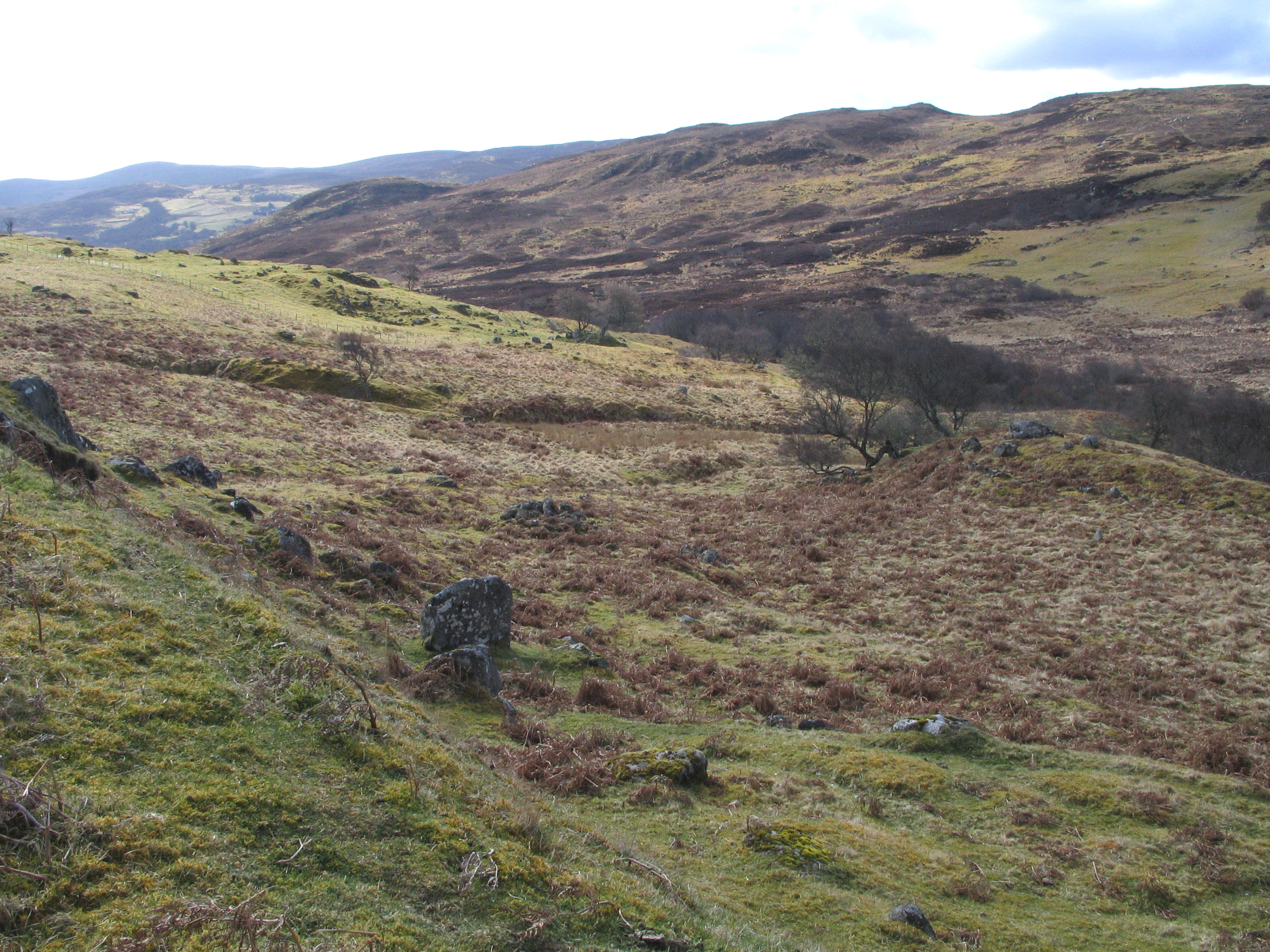
The MacLeod Road is accessed about 1/2 kilometre south of The Falls Cemetery on Highway 311.   Today it leads up the hill and terminates on a vacant farm.  Few people realize that it was once a through road to the community of Kavanagh’s Mills.

The first farm, as one starts up the hill, was originally the homestead of Donald MacLeod, (1803-1876).  Donald was born in Kilbraialhaid, Clyne, a crofting community in Strath Brora.  At the age of 18, he emigrated with his widowed father Hugh, sisters Marion and Margaret and brother John.   They were passengers on the Ossian of Cromarty and arrived in the port of Pictou in 1821.

The family were first allotted land at West Earltown on the farm last inhabited by Joe MacKay.  It was a low lying acreage on the Waugh River in the shadow of Spiddle Hill.  Hugh complained to the authorities that it was unsuitable due to late frosts.  The family then acquired land at The Falls,  Donald on the subject property and John directly across the river.  Their sister Marion married William Sutherland “Ban” who had settled immediately to the south of Donald.

Donald married Barbara Gunn, (1816-1879), a daughter of William Gunn of Strath Halladale, Parish of Raey.  The Gunns didn’t come to Nova Scotia until the 1830’s, settling briefly at Middle River and then eventually settling on the Charles McGill farm at West Earltown.  Barbara’s brother Hugh settled near East Earltown while another brother, Alex, lived for a time near Earltown Lake before settled at Brule.

This couple had a family of ten including a son William who settled the  southern half of the property which runs along the MacLeod Road at the crest of the hill.  He was the father of Geordie MacLeod who took over that property and the grandfather of Don MacLeod who retired to the farm around 1970.  The property is now the summer home of Joyce Ferguson.

Donald Sr.’s younger son John, (1858-1933),  took over the main homestead.  He married Elizabeth (Bess) MacKay, daughter of John MacKay “Black” and Janet MacDonald “Salt” of Balfron.  They had a family of eight including Barbara Murray of Rossville, Catherine Murray of Waugh River, Jessie Gunn of Brule,  Dan Robert and Alex in British Columbia, John and Marion died young and John Will MacLeod, the hier to the property.

John Will was a confirmed bachelor and farmed the homestead well into his seventies.  He sported a Model A Ford from 1930 until shortly before his death in 1971.  He was an elder in the United Church.

The farm was then owned by an Anderson family during the 1970’s. It is now the home of Jack Ferguson.

On the crest of the hill are a couple of homes of more recent vintage.

At the edge of the forest, a branch of the road veers to right and enters another early homestead of The Falls.  This place was originally granted to a Francis Henry but there is no evidence of this man ever improving the property.  The earliest settlers appear to be Widow Catherine Sutherland and her two unmarried sons,  George and Angus.  Catherine was the widow of a George Sutherland in the hamlet of Eilanan, Strath Brora.  George seems to have died in the old country before Catherine and her five sons emigrated in 1821.  It would appear that they first lived on the property now owned by Reg Terry, (Caribou Sutherland homestead), but gave it up for a series of properties along the MacLeod Road. Land documents show that the family was a given a survey ticket to occupy this lot. After clearing a field and planting their potatoes, it was discovered that Francis Henry still had a claim.  The matter was eventually resolved. The last of this family to live on the property was George Jr. who died around 1880.

The next permanent resident was Donald (Dan) MacLeod, (1857-1922).  He was a son of Donald MacLeod and Barbara Gunn.  He married Margaret Baillie of West Earltown.  They lived in an old style house on the bank of a small brook.  They had three children, Danny, twins Barbara and Willie John.   Barbara died unmarried in Boston.  Danny, unmarried, lived with his Baillie aunts and uncles at Kavanagh’s Mills.  Willie John took over the farm and built the present house.  He was married to Sadie Hayman of Balmoral.  This couple had four children.  After Willie John died in 1959, Sadie moved to the Dan Baillie house at The Falls.  Dan MacRae lived there briefly before the place was acquired by Tommie Pugh.  The Pugh’s moved to Bass River around 1980.  It is currently owned by Geoff Crinean.

Continuing along, the branch road crests a second hill before forking.  The right fork leads through the woods to the bank of the Baillie Brook where we find the remains of a small farm.  This was the home of Paul MacDonald and his sister Christy.  They were two of several unmarried children of William MacDonald “Paul” and Jane Matheson of Earltown.  Christy died in 1911 and Paul shortly thereafter.  The farm was added to the Dan MacLeod farm.  It is now part of the Dorje Denma Ling Centre to the north.

The left fork of the branch road used to lead along the MacLeod clearing to the Matheson farm.  Today the property is accessed by a new road further up the main MacLeod Road.  This property was originally part of the James Foreman grant which extended across the Baillie Brook to Tatamagouche Mountain.  It was first settled on the Tatamagouche Mountain side by Hiram Downing.  The east side of the brook, (150 acres), was subdivided and sold to Dan MacKay, Achany, in the 1870’s. Local lore tells that a hermit lived on a small clearing on this property for several years.  Dan MacKay doesn’t appear to have lived on the lot.  He eventually took over his father’s farm on the Peter MacDonald road.

George Matheson, (1847-1928),  was the first permanent settler.  He was a son of Gilbert Matheson and Annie MacLean of Upper Kemptown.  He was married to Christy MacDonald (MacAddie), of The Falls.  They lived on the Carl Beck farm at Balfron when they were first married but returned it to its former owner and settled on this property.  They built a small house and cleared fifty acres for cultivation.  It was the last farm to be cleared at The Falls.  George and Christy had eight children:  Adam lived on Nuttby before moving to Montesano, Washington,  Gilbert of Trenton,  Bill of Olympia, Washington, Gordon, Margaret Polson of Montesano, Cassie died young, Tena MacIntosh of Oliver and Bessie Nelson of Nappan.

Gilbert and his first wife, Maud Hiscox, enlarged the house with intentions of taking over the homestead.  Maud died young and Gilbert went to Boston to work as a carpenter.  He returned with a second wife, Ellen Campbell,  and took up residence at Balfron before settling in Trenton.

After Gilbert’s departure, the youngest son, Gordon, came home from the west and took over the farm. He married a schoolteacher from College Grant,  Grace Murray.  They had four children,  George, Neta, Murray and Robert.   After Murray returned from service overseas, the family decided to vacate and take up farming in a less remote location at Balfron.  The MacLeod Road farm is still in the family.

Returning to the main MacLeod Road, we continue up the hill and past the new road to Mathesons.  At the top of the hill is the remains of the next farm.  In better days, it had a commanding view over the lowlands of North Colchester and the Northumberland Strait.  This was originally the farm of Robert Sutherland, son of Widow Catherine Sutherland.  He was born in Eilanan, Strath Brora in 1799.  He married Janet Sutherland, likely of Pictou County.  Their descendants were known as the MacRobbies.

This couple only had one known child,  George Robbie Sutherland.  George Robbie continued on the farm and married his first cousin, Betsy Sutherland “MacIan”   They had four children,  James and John who both died as young men, Christy, (Mrs. Johnny Munro of Willow Church Road), and Jennie Bell.

Jennie Bell took over the farm.  She was married to Jim MacDonald of Upper Kemptown.  Jim was known as “Corbett”, a reference to a well known boxer at the turn of the century.  Jennie Bell and Jim had two daughters, Christy who died young, and Elsie who married Lewis Cook.  Elsie and Lewis lived for a few years in a small cabin on the lower part of the property.

Jim and Jennie Bell retired to Kemptown to live with Elsie and Lewis.  The place has been vacant since and under the ownership of Donald Sutherland and his son Douglas.

The road continues a short distance over the crest of the hill and presently terminates in another old ruin.  This was the homestead of Alexander Sutherland better known in the district as Laughing Sandy Sutherland.  Laughing Sandy was a brother to Robert “MacRobbie” , George and Angus who lived on the preceding farms.  He came to Nova Scotia with his widowed mother and four brothers.  His wife, Christy Baillie, was also a native of  Clyne and the eldest daughter of George Baillie, Catechist, of Spiddle Hill.  They had seven children.  Only two married, Margaret to John MacDonald of Shinimicas, and Catherine to John Sutherland, Shawnee, of the Berrichan.   The last two children to live on the farm were Elspy and Robert.  The farm was later associated with the Sterling Matheson property at The Falls as a woodlot.

At this point, the road can no longer be navigated by motor vehicles.  A hiker can follow the old road down the grade and eventually come out on a vacant farm above the Kavanagh’s Mills Road.  This small farm was originally granted to Edward Studivan.   Studivan, so the story goes, was actually Edward Denoon, the son of a Scottish land agent, Hugh Denoon.   Denoon Sr. recruited settlers for the Pictou District in the Highlands and brought them over in over crowded boats in the 1801-1803 time frame.  Edward chose his wife’s maiden name for his surname.   They had at least three sons,  William, Murdoch and John.   William was the ancestor of the present day family on Studivan Mountain.  Murdoch and John settled in Cumberland County.

After Edward Studivan moved on, the farm was acquired by Geordie Sutherland “MacIan”.  He was a son of John Sutherland and Christy Ferguson.  His father John lived across the brook on the Kavanagh’s Mills Road and was the original MacIan or Macin as it was pronounced. John was a brother to Laughing Sandy,  Robert, George and Angus.  Thus the whole family of Widow Catherine were settled on the entire length of the MacLeod Road.

Geordie “MacIan”, (1841-1914), was married to Margaret Baillie, a daughter of Robert Baillie and Isabel MacKay of West Earltown.  They had eight children.  Son Robert lived at Durham, John in New Westminister, Dan died in WWI,  Hugh died young,  Jim and Geordie Macin Jr. lived on the home place unmarried.  A daughter Bella never married and another daughter,  Christy, married Paul MacDonald at Central Earltown.

The MacLeod Road crosses the Baillie Brook below the former farm house and joins the Kavanagh’s Mill Road.  This is the boundary between Earltown and New Annan.

Map with code: https://www.google.com/maps/d/edit?hl=en&authuser=0&mid=zWuNe7Aar9m4.kTJ1hRJWA7vA
Graveyard Tour : Earltown Village Cemetery on Sunday, August 3rd

In 1824,  John Sutherland, (alias Ian M’Ian M’Rob), surveyed his recently settled homestead for a suitable site to bury the remains of his young son.  He chose a hilltop overlooking the river valley, the surrounding hills and the future site of Earltown Village.  It became the main resting place for the early settlers of the surrounding communities, their descendants and continues to be an active burial ground 190 years later.

Join us on a tour of the Earltown Village Cemetery on Berrichan Road.  Learn about the local cousin of our first Prime Minister;  an accomplished family of bonesetters; a tombstone imported from Sutherlandshire; the family of 22 Baillies; unbending Calvinists; a family of West Coast lumber barrons, and much more.

This is one of several offerings of “The Gathering in Earltown: A Celebration of Celtic Culture and Heritage”.   There is no fee however a modest donation for cemetery upkeep is always welcome.  Participants may gather at the Sugar Moon Farm at 10 AM and car pool to the cemetery for a 10:30 start.  Glen Matheson, (this blogger), will be providing the commentary which will last approximately one hour.

Afterwards we can retire to the Sugar Moon for an afternoon of piping and Celtic music.


The Burial of Big Donald

Big Donald MacDonald was born at East Earltown in 1859 on the farm which was settled by his grandparents in 1818.  His grandparents were Donald MacDonald and Esther Sinclair, natives of Caithness.  There is a strong tradition that Esther was the daughter of Sir James Sinclair, Earl of Caithness,  who disapproved of Esther’s marriage to someone beneath her station.   That is a story for another post.

Donald’s parents were Donald MacDonald and Betsy Matheson who also lived on the farm which straddled the county line on the road to West Branch.  The rest of the family married and moved away leaving Donald to take over the homestead.   By all accounts he was a big man which earned him another title – The Bear.   Later in his relatively short life, he married Eliza MacKay of West Earltown.  They had no family although Eliza had a child to a previous relationship.

Donald died in the heat of the summer in 1903.  It was suspected that he died of a virus which caused some concern among the neighbours.  The men of the area decided to bury him in the family plot at Gunn’s Cemetery in the dark of night.   It was hoped the cool night air might prevent the spread of germs,  not to mention the convenience of not having to interrupt their busy harvest season.   Apparently the men smoked their pipes as an added precaution.

Finley Ross,  the local blacksmith and a renowned wit,  was present at the burial and penned the following poem, a parody of a well known poem  “The Burial of Sir John Moore”.    True to the Gaelic tradition,  references were made to various nicknames, family feuds, and partisan politics.   Offense was taken by some of the families mentioned so the poem went “underground” for many years. While interviewing some elderly people in the 1970’s,  this writer was told on several occasions that we mustn’t talk of such things!!

Despite the morbid circumstances,  the verses are a delightful reflection of the comical culture of the time.


The Burial of Big Donald

Not a note of solemn music was heard,

As his corpse to Clydesdale we hurried.

Not a Ross discharged a farewell shot

O’er the grave where our hero was buried.


We buried him darkly in the dead of night,

The sods with our hay forks turning.

By the struggling moonbeam’s misty light,

And Hughie Clinkie’s lantern dimly burning.


No beautiful coffin enclosed his breast.

In sheet and in shroud we wound him.

He lay like a warrior taking his rest

With Big Christy’s Cloak wrapped around him.


Few and short were the prayers Big Jim said.

The MacLeans spoke not a word of sorrow.

But we steadily gazed on the road ahead

And thought how we would sleep tomorrow.


We thought as we hollowed his narrow bed,

And smoothed down his lonely pillow,

That the foe and the stranger would walk on his bed

And the Spar far away on the billow.


The Grits will talk lightly of the spirit that’s gone

And o’er their black rum they’ll upbraid him.

But little they’ll reck if they let him sleep on

In the grave where the Bishop had laid him.


But half of our heavy task was done,

When Geoff Gunn gave the word for retiring.

We heard the distant and random lie

That Supp was solemnly telling.


Slowly and sadly we laid him down

Far from his fields of willow and carroway.

We carved not a line and we raised not a stone,

But left Big Donald alone in his glory.

Attributed to Finley G. Ross, (1872-1954)

Notes:

1.   Big Christy :   Christy MacKay,  daughter of Big Jim and wife of Peter Gratto

2.   The Spar :    John Bain,  West Branch

3.    The Bishop:   Peter Gratto,  native of River John and later resident of East Earltown

4.    Geoff Gunn:   Dan Gunn who lived next to the cemetery

5.    Supp :   Big Jim Graham,  another local story teller

6.    The MacLeans:   An extended family that lived on neighbouring farms across the line in Pictou County.

A Spiddle Hill Tragedy

The onset of active winter weather in 2013 brings to mind the harsh winter of 1900-1901.   The first few years of the 20th century were remembered as having particularly harsh winters.   The most notable year was 1905 better known as “The Winter of the Deep Snow”.  The winter of 1901 was also noted for its heavy snowfall.

The John Murray and Christy Sutherland family lived on the northeast slope of Spiddle Hill.   Both were born in Sutherland, likely in Clyne.   John emigrated in 1815 to Pictou County.   A few years later John and Christy settled on their remote homestead.  They had at least six children of which only one daughter married.   Three daughters and a son continued to operate the small farm after the parents died.

By 1901 only two elderly daughters were left,  Eliza and Kate.  One of them was completely blind and confined to the house while the other managed what was left of their farm.   During a particularly bad blizzard,  the able sister was stricken with either a stroke or heart attack and died.

The farm was off the nearest road which was not regularly travelled in the best of times.  It was several days before people were able to shovel themselves out.  A neighbour,  realizing that nobody had been past the Murray home since the blizzard,  ventured back through the woods and discovered both sisters were dead.   One story claims the blind sister was found frozen outside the house while another version claims she was found by the stove.  Her fingers had been burned trying to manage the fires.

The sisters are buried in the MacKenzie Cemetery.

Sons of the Bear on Matheson Brook

Letty

(The upland remains of Lettaidh with Ardachu in the distance)

An old Irish tribe named the MhicMathain, (Sons of the Bear),  arrived in Scotland in the 9th century and made their base at Loch Alsh.  There are fantastic legends of how a branch of the clan became established in Sutherland however the most plausible theory posits that they were planted in most of the parishes of the See by their kin,  Bishop Alexander MacMhathan, around 1400.   The main branch evolved along the shores of Loch Shin in the Parish of Lairg.

Another branch made their home between Lairg and Rogart on a remote upland above the River Leatty.  The earliest recorded generation were three brothers who were born in the 1760’s,  George, Angus and David.   George, the eventual immigrant, served in the British army in the 1780’s and later.  His notebook, still in existence,  mentions sailing on the Clyde in 1785 and being in Appleby, England prior to that.

Recently an article has surfaced in Calgary written by John K. Sutherland of Hanna, Alberta, and originally of North Earltown.  The article is written from the perspective of George’s military issue musket which was gifted to John K. when he left Earltown for the west.  The story tells that George was also in the Napoleonic Wars along with a brother Alex, who was a piper, and a Matheson cousin.  Their adventures took them to Portugal and then on to Spain where they were involved in several battles.  They were then sent to Belgium and saw action in the Battle of Waterloo.

After his discharge,  he returned to Rogart and rented a small farm on the Bratton of Leatty.  His brother Angus lived nearby and David lived a couple of miles east in Morness.

George married Elspeth MacPherson.  Between 1789 and 1808 they had eight children born on the Bratton.   Family tradition always claimed that they emigrated 1814. However correspondence in the Sutherland Estate papers indicate that George accepted an offer from the estate in late 1819 permitting him to remain on his lease until the following year provided he then leave without causing trouble.  George is the first tenant listed indicating he was singled out to lead the opinion of others.  Not all the neighbours accepted these terms.  It now appears that George arrived in Earltown in 1820 along with various tenants from Strathbrora who had negotiated similar terms of removal with the estate.

Years later we would learn why 1814 was burned in our tribal memory.    David Craig, in his book,  “On the Crofters’ Trail“,  shares a memoir of a lady who was living as a child in Inchcape, near Lettaidh, in 1814:

She remembered being woken by her mother and taken  to the window, and she looked out into the darkness and saw a red glow in the hills opposite.  She asked what it was, and her mother said in a grim voice, “They are putting fire to Lettaidh.  The people have been put out.”   The child was frightened, naturally enough, since they had relatives in Lettaidh themselves, but she was reassured when told it would not happen to her house, since all the men were still there.  All the men from Lettaidh had been recruited, by the Sutherland Estate factors, to go to fight in the Napoleonic wars, and then the factors seized the chance to evict the women and children without fear of resistance.

As the widespread clearance did not happen until the 1819-1820 period, it is hard to say what this lady witnessed.  There were undoubtedly men away in the Napoleonic wars in 1814.  It may have been an isolated situation in which a family or families were removed for other reasons.

One tradition claims that when George and his family came to Pictou, they sought out former neighbours and relatives in West Pictou.   They located Donald MacIntosh,  a former resident of Leattaidh, who by this time was established as one of the first settlers at Clydesdale.   George “squatted” on land close to MacIntosh.   George never received a ticket for the lot but was directed to the bowl at the headwaters of the Matheson Brook.   George settled a short distance east of Matheson Corner while his son Alexander settled meadowland west of the Church Road and son Donald settled at the corner itself.

They were joined by eldest daughter Annie who had been married in Scotland to Robert Munro, also of Lettaidh.  The Munro’s settled an unforgiving patch of land on Back Mountain but later moved to East Earltown.

Another daughter,  Jane,  married William MacDonald,  native of Rovie, Rogart and an early childhood settler of Earltown Village.   This couple settled a farm at the end of the Alex MacDonald Road.    The youngest daughter,  Margaret,  married Donald MacIntosh who arrived a few years later from Rogart.  They were the progenitors of the MacIntosh family near Earltown Village.

Meanwhile all three sons married Sutherland women and continued a tradition of weaving, a skill learned in the old country.

There are no Mathesons today on the Matheson Brook but there are several of that tribe still living in the surrounding area. Research has located descendants, at various times,  in New Brunswick, Ontario, Manitoba, Saskatchewan, Alberta,  British Columbia,  Washington, Oregon, California, Montana,  Illinois,  the New England states and likely the other states as well.

George and Espeth rest in the old section of the Earltown Village Cemetery.  They died in the 1840’s of “old age”.

The original homestead and the first generation homes are on this map: https://www.google.com/maps/d/edit?hl=en&authuser=0&mid=zWuNe7Aar9m4.k8l_jnZwwot4

Donald MacIntosh – Co-Founder of the Earltown District

Donald MacIntosh, 1763-1831,  along with Angus Sutherland “Prince”,  was a founder of the District of Earltown in 1813.  In fact he predated the naming of the community by several years and may not have been aware that he was creating a new district.

Donald, his wife Nancy Murray,  and four young children had lived in the Parish of Rogart, Sutherlandshire.   They farmed a croft in an upland township called Leatty which was located high above Strath Fleet.   People from Rogart had been migrating to Nova Scotia since 1773 so it was a logical destination for Donald when circumstances dictated that emigration was necessary.  By 1813 the Napoleonic Wars were over and sea travel was once again safe.  He arrived in Pictou and went to the Roger’s Hill area where others from his neighbourhood had settled.   At this point the closest ungranted land was located along the present day Pictou-Colchester county line.   His grant was located near what is now the junction of the Stewart and Clydesdale Roads and extended up the hill towards Gunn Cemetery.

Unlike his next door neighbour,  Mr. Sutherland,  Donald did not have the advantage of previous land clearing experience.  It is doubtful whether he had ever used an axe before coming to Nova Scotia.   There were other hardships such as starvation.  One historical account tells that during a particularly harsh winter, food ran scarce.  His neighbours were almost in the same circumstances.   Donald was ill at the time so it fell upon Nancy to walk to Dalhousie Mountain and get a bag of potatoes from relatives.  As it was late winter,  the crust on the snow was breaking.  It was reported that Nancy could be tracked for miles as her ankles bled from being chaffed by the broken crust.

Donald died at age 68 in 1831 leaving a widow and five surviving children.  In his will, he divided his farm with his eldest son Hugh getting the west portion and his widow and son John getting the east.   Hugh did not marry and appears absent for many years, likely working in the lumber camps.  John married Marion MacKay of Diamond whose people,  the Bratten MacKays, had come from Leatty as well.  Of Donald’s daughters,  Nancy married Donald MacDonald “Doolie”,  and Margaret married Kenneth MacKay Ächany of Central Earltown.

John’s son  Robert obtained the Hugh MacIntosh lot and another son,  Dan, retained the homestead.   Robert’s son Charles was the last to live on the MacIntosh grant.  It was vacated in the 1950’s.

These MacIntoshes were related to William MacIntosh who settled the Earltown end of the Clydesdale Road and to Donald MacIntosh who lived near Earltown Village.

Gunn Cemetery Tour Follow Up

The weather cooperated and approximately twenty five people showed up for a tour of Gunn Cemetery near East Earltown.

Among those attending were descendants or relatives of the MacDonalds, Gunns, MacKays and Baillies.

Thank you to Layton Lynch for sprucing up the grounds and providing transportation.   And a special thank you to those attending for their generous donations.

As the presenter for the event, I was overwhelmed by the interest in this nearly forgotten corner of Gaeldom.   There were some requests for transcripts.   Sorry,  it was ad hoc for the most part.  However I will try to post some of the material in the weeks to come.

To quote one of the inscriptions,  “Far from the haunts of the busy world,  may their ashes rest in this serene and quiet place”.

Graveyard Tour – Gunn’s Cemetery – Sunday, August 4th

“Far from the haunts of the busy world” lie the remains of some very interesting people.

Join us on a tour of Gunn’s Cemetery, a small graveyard in the back country near East Earltown.  Hear the stories of the daughter of the Earl of Caithness,  a one armed settler who fought in New Orleans, the midnight burial of Big Donald,  a hobo, a birth on the high seas and more.  Who knows, some participants might have their own stories to share.  It is a small cemetery which has some large characters.

Unless you live nearby, accessing this unmarked cemetery at the end of Squire MacKay Road can be an adventure.  We suggest you register at the Sugar Moon Farm, (Alex MacDonald Road),  before 9:30 at which time we will car pool or go as a procession to Squire MacKay Road.  The first 1 1/2 kilometers of that road are in excellent shape.  The last 1/2 kilometer is moderately rough but can be carefully navigated to a wood yard near the cemetery.   From there it is a 5 minute walk.  However we can provide motorized transport to the cemetery gate with an SUV for those with mobility challenges.   Glen Matheson, (this blogger), will be providing the commentary. The tour will be about 50 minutes after which we can retire to the Gathering at Sugar Moon Farm for various Scottish events.

If you can’t make it, maybe we will do a repeat visit some evening in early October,  “darkly in the dead of night with lanterns dimly burning….”

The Gathering in Earltown

Mark Sunday August 4th on your calendar for the The Gathering in Earltown.   Sugar Moon Farm will once more host a day of Scottish themed activities to celebrate Earltown’s celtic heritage and to raise funds for the upkeep of the local cemeteries.

At 9:30 you can join a group for a tour of a local cemetery –  more on this in a subsequent post.   From 11 to 3,  you can be entertained by pipers, fiddlers, a sword fighting demonstration and much more.  Na Gaisich Pipes and Drums from Pictou County will be featured.

At 3 PM,  you can take part in a Pig Roast.   Go to http://www.sugarmoon.ca for information on how to get tickets.

Hope to see you there.

Where did everyone go????

In its prime, Earltown District took in a trading area of over 2000 people who mostly belonged to a distinct ethnic subgroup from Sutherland, Scotland.   It was a patchwork of farms separated by an equal proportion of woodlands.  Today it is mainly settled with scattered homes along a couple of  main roads.  Much of the area is a network of old roads joining long since vacated farms that have returned to forest.   Where did everyone go?

Like many of the upland communities in Northern Nova Scotia,  Earltown was phase one of  a migratory process.  It was a destination in the early 1800’s for Highlanders who were either cleared from their ancestral homeland or who chose to seek a more stable existence in North America.  At that point in history,  they still had strong tribal instincts which led to them locating and settling near their kinfolk when they arrived on these shores.  They also were Gaelic speaking which led to further isolation for a couple of generations.

In their new environment they had better access to food, a healthier lifestyle, no military service obligations as well as less exposure to disease.  This resulted in larger families,  a reduced infant mortality rate and longer life expectancy.   The one and two hundred acre grants were not sufficiently large enough to subdivide among sons.    The soil was initially quite fertile due to hundreds of years of organic build up and was further enhanced with ash created during land clearing.   The soil lost many of its nutrients after a generation and agricultural practices had not evolved to the point of  replenishing the land.   Therefore yields dropped and, with it, the ability to support large multi-generation families.

Another factor was the hunger for education and advancement.   Writing in the Statistical Account of Scotland in the late 1700’s,  a minister in Sutherland noted that his flock possessed a thirst for knowledge and were capable of scholarly pursuits if not for their crushing poverty and lack of affordable education.  With immigration to Nova Scotia came access to the crude rural schools which provided the basic building building blocks for academic advancement.  The growth in population created an urgent need for more schoolmasters and clergymen.  Older siblings with a cash income were then able to lend money to younger siblings  for education.   Thus the community of Earltown provided clergy, teachers, doctors and lawyers at a disproportionate rate to its population.

Armed either with a marketable education or experience in breaking new farmland,  young individuals and families looked to other parts of North America to better their circumstances.  As Nova Scotian towns were already at a mature state before the Scots arrived in Earltown,  they had to look much further afield for opportunity.

The earliest migrations appear to have been to the “Boston States””.    Boston was easily accessible by boat from Halifax.  It had an appetite in the 1850’s and later for carpenters, teamsters and other labourers.  From that port,  the Earltown boys ventured into other areas of New England.

By the 1870’s,  it was well known that there were opportunities west of the Great Lakes.  The earliest complete families to migrate sailed west across the Great Lakes and appear to have disembarked at Chicago.  Some put down roots north of Saint Louis, Minnesota.  Families from the Corktown region chose to settle in Wisconsin while the Hendersons, MacKays and Munro’s claimed homesteads in Manitoba.   The Morrison clan from West Earltown were among the first settlers of Ardoch, North Dakota.   The Donald Murray family of The Falls first settled in Illinois but later made Iowa their permanent home.

The more adventurous went west to look for gold in Colorado.   One such person was Alex Polson of Upper North River,  a member of the Earltown Congregation,  who was advised in Colorado that the real gold was the tall timber of  the Pacific Coast.  He heeded the advice and eventually founded a logging and milling empire near Hoquiam, Washington.  Many of his workers over the next few decades were young single men from Earltown and Kemptown.   Most chose to settle in that country.

By 1900,  Alberta was a favored destination and it was not long before several found their way into the mining settlements of  Cranbrook and Trail.   Others found their way to the lower mainland of British Columbia by way of California.

In the meantime,  single women left the community to teach school in other parts of the province.  Few returned.  Women, who were not suited to teaching, went in great numbers to Boston between 1850 and 1920 where they found work as domestics or in clothing factories.   Again, few returned.

The end result of all this movement was an abundance of bachelors left behind to look after the old folks.   Some died alone on the family homestead.   Others deeded their farms to local merchants in exchange for food and necessities.   Some ended up at the Poor Farm with their farms auctioned off at a tax sale.

Every province in Canada as well as the Yukon have welcomed Earltowners.   South of the border,  we have found our people in the six New England states,   New York, Connecticut,  Illinois, Indiana, Iowa, Wisconsin, Minnesota,  North Dakota, South Dakota, Montana, Idaho, Utah, Wyoming, Colorado, Nebraska, Oklahoma, Texas,  Nevada, Washington, Oregon, California,  Arkansas, Florida and Alaska.
One, a Joseph Murray,  found his way to South Africa and to Central America.    Rev.  John MacKay,  a missionary,  was labouring in British Guinea when he met an untimely death.