The Long Goodbye -Earltown’s Celebrity Ruin

Christmas in Rossville (Lori MacKenzie Collection)

For the past several years an anonymous person has set up a lighted Christmas tree in the entrance of the iconic vacant house at Rossville.  There have also been lights at Halloween.  Here is a link to some media reports in the past.

During its one and a quarter century of occupation, it was an impressive house compared to other farm houses in the area.  It was a full two story dwelling without the second floor rooms being compromised by dormer ceilings.  It was neatly painted white with green trim and stood in a commanding manner above the road.   It would have been quite the novelty when it was built around 1860.   
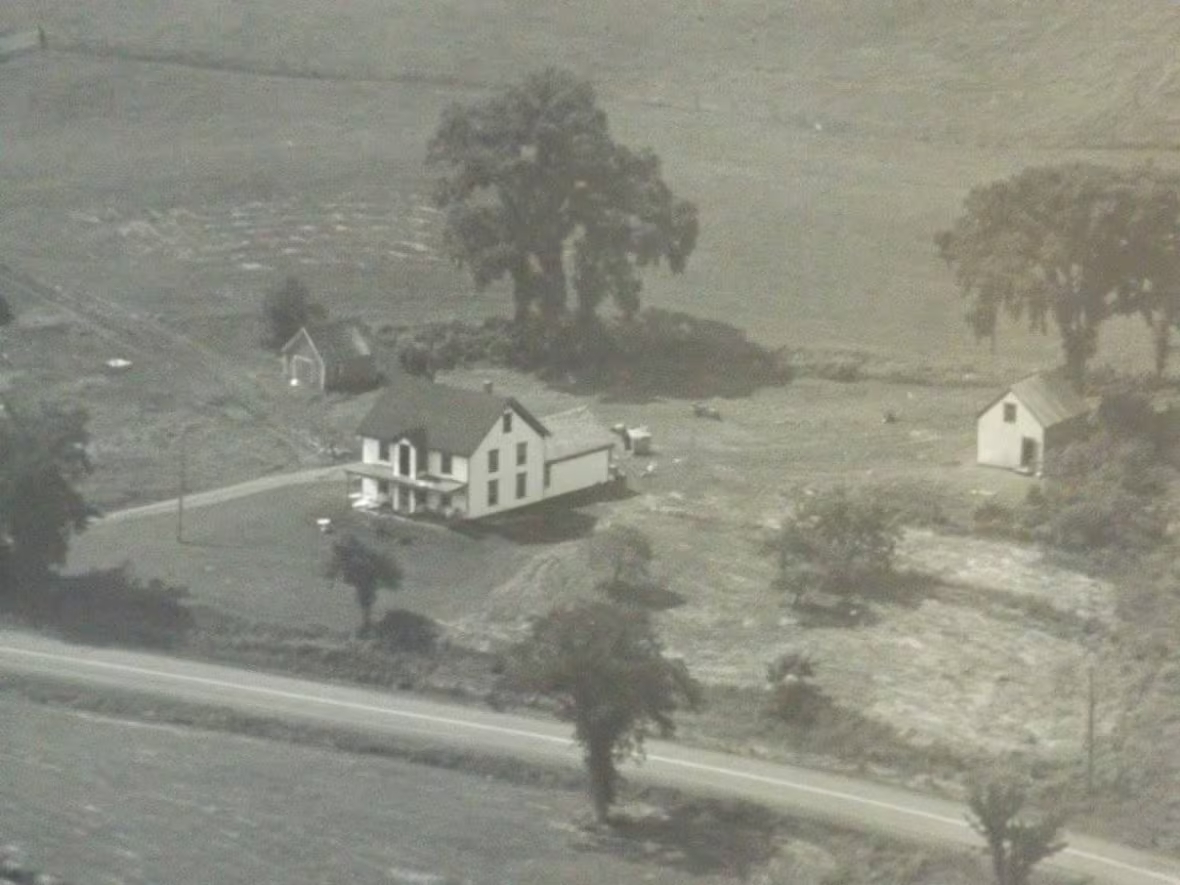
The property circa 1970. The barns were across the highway from the house. (Lori MacKenzie Collection)

This post will summarize the families that inhabited this house and those before it.

This 100 acre property was first settled by Donald MacKay better known as “Donald Ross”.  There were at least four settlers named Donald MacKay so for clarity this Donald was tagged after his home in Rossville1.  He was the son of Sandy MacKay and Janet MacLeod, Rogart.   There is no record of the parents coming to Nova Scotia.  Like many of the settlers, Donald entered the military in 1809 at the age of 16 and served in the West Indies with the 55th Foot between December 19, 1809 and January 4th, 1814.  Having already experienced a Transatlantic crossing, the decision to emigrate to Nova Scotia would not be daunting.

 Donald was single when he arrived in Earltown as evidenced by the standard 100 acre grant he received.  His old friend from Rogart, Donald Ross, was in charge of guiding the settlers in from Pictou and likely helped him pick out the location near the Ross brothers.  Behind him was Rogart’s John Sutherland “Ballem” and to the Northeast was Alex MacKay “Judge”, another Rogart settler. Considering the topography of the area, Donald didn’t do too badly. There was a good acreage of level and fertile ground along the Nabiscamp Brook in addition to a slope behind the house suitable for pastures but could also be cultivated.

Donald “Ross” MacKay rectified his marital status by marrying  Marion MacKay around 1819. She  was born in Rogart in 1793 to Alex and Christy MacKay.  There is a faint thread of oral history that suggests that her parents came to Nova Scotia and settled, if not in Earltown, somewhere close by in Pictou County.  Her sister Christy married another Donald MacKay at MacBain’s Corner.

Marion and Donald “Ross” had three children that we know about:   Janet, (1820-1857), Marion (1825- ), and John (1830-1910).   Janet never married and is buried beside her parents in Knox Cemetery.  Marion married Joseph MacCulloch and they settled in Diamond.  John alias “John MacKay Ross” inherited the homeplace.

It was John MacKay Ross’s marriage in 1860 that gave rise to the need for an upgraded dwelling to accommodate both his parents and what he hoped would be a growing young family.  His bride was Janet Murray “Og” from Back Mountain.  The 1860’s were prosperous years when Earltown was at the height of its population with its lumber and farm produce being in demand.  The exodus to the West was yet to begin.

John and Janet or Jennie had six children.  Christy married Donald MacKay “Achany” at The Falls; Janet never married; Marion died at the age of 19; Maggie married Manning Lake of Hants County and lived in Cohasset, Ma.;  Donald and finally Mima who married Jerimiah Murphy of Ireland in Boston.

Life in this house was not always happy.  Daughter Janet had died before 1881.  In 1887 Marion died at the age of 19.  It was somewhere in this time frame that Jennie, the mother, passed away.  The eldest daughter Christy died in 1892 at The Falls leaving two young boys.

On Sept 21, 1893  John married Henrietta Isabel Morrison.   John was 63 at the time and his bride was 25 per the marriage certificate but later records show that she was probably 23.  Bella Etta is on the 1901 census so the marriage survived presumably until John’s death in 1910.   Where Bella went after this is currently unknown.  Her father was a Morrison from Nuttby and her mother was a Stewart from an old farm near Gunn’s Cemetery.  

Son Donald Alexander was heir apparent to the farm.  In the late 1890’s he married Jennie Belle Sutherland of Earltown Lake.   Sadly this marriage was short lived.  Jennie Belle died on July 15th, 1898 and was buried in the Earltown Village Cemetery with an infant daughter.   Donald, often called Dan, remained with his father and stepmother for a few years and then went west to work in the smelters of Trail, British Columbia.   While there he married Florence Twells in 1908.  They returned to Nova Scotia where they raised their 5 children on a showcase farm at Lower Onslow.

Meanwhile in Earltown, John died in 1910 and by 1911 the farm had been taken over by John Murray “Og” . John Og was the brother Jennie, first wife of John MacKay “Ross”.  This move was likely precipitated by the marriage of his son Rod who may have wanted a more accessible farm than the old place on Back Mountain.

John had been married to Alexandrina “Lexy” MacDonald (1846-1903) of North River and they had five children all born on Back Mountain.   Christena, a teacher, was the second wife of Robert MacIntosh, Clydesdale; Jessie, unmarried, lived her adult life in Medford, Ma.; Sibbie Bell died at the age of 28; William Roderick, known as Rod, married Barbara MacLeod of the The Falls; and Neil Dan, a blacksmith, moved to Cape Cod where he worked for Berichon native Hugh Baillie manufacturing cranberry harvesters.

John Og died in 1919 and the farm was fully in the hands of Rod and Barbara.  They are remembered to this day as a warm and hospitable couple, very neat about their property but also very thrifty in the Scottish sense.  They had four children born in the old house : Allister, Sybel, Ken and Marion.

Ken married and lived in Truro until his death in 2019.   Marion  was married and lived in Brentwood.  Allister and Sybell, both unmarried, remained at home to run the farm.  Allister was the clerk of the Presbyterian Church.   After Allister’s death in 1974, Sybell moved to Truro and the farm was sold to the MacKenzie family.

The MacKenzies lived here for several years and then abandoned the dwelling.  Lori MacKenzie tells of a wonderful childhood in this CBC interview and as she explains, life took the family in other directions.
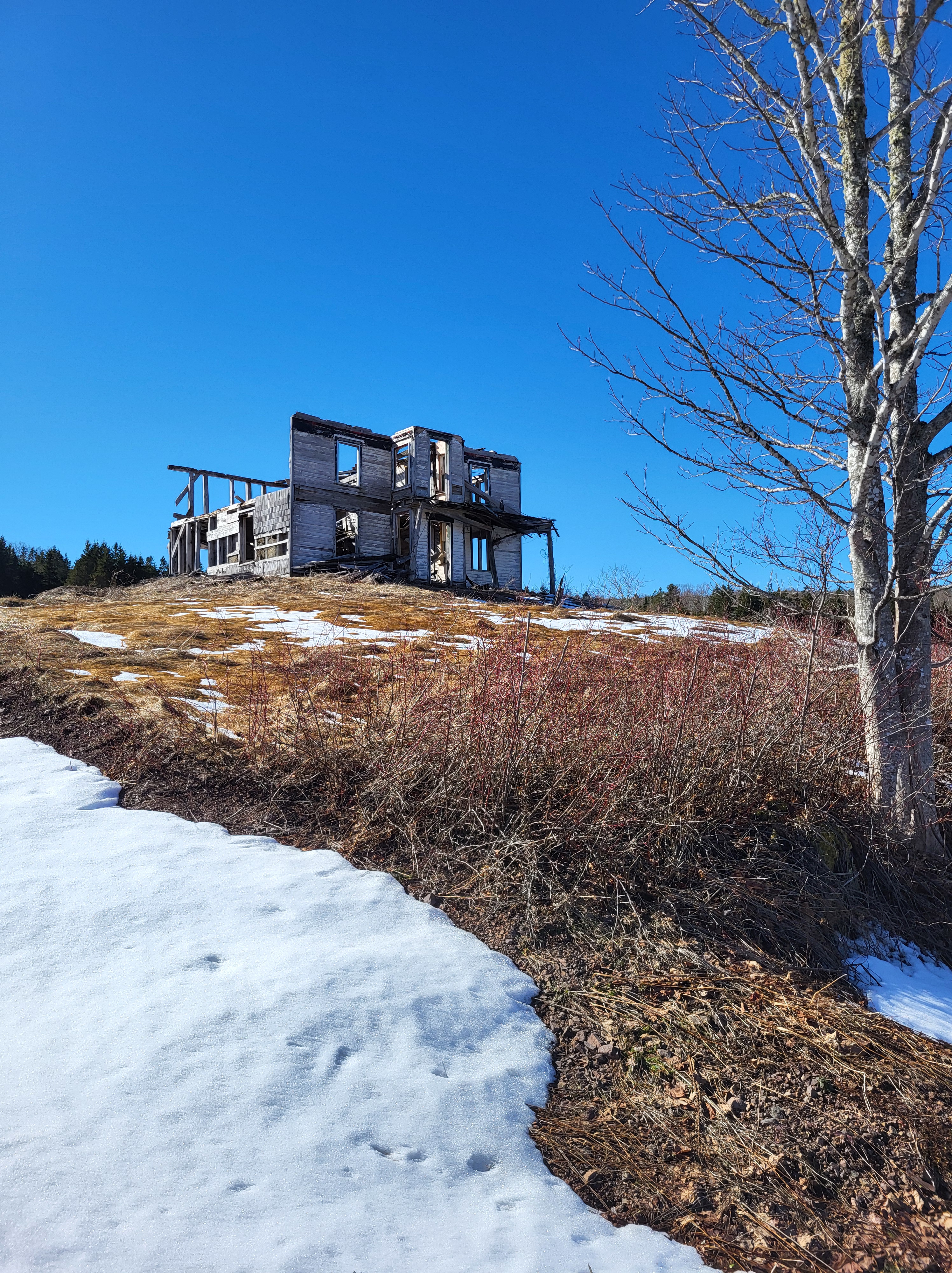
March 2024 – Will it be here next year? (Matheson)

Like all those dwellings that have disappeared over the past century, it saw the birth of new generations, hosted wakes for the dead, entertained guests at weddings, welcomed neighbours for a visit and was the administrative centre for the family farm. The old landmark is gasping its last breath this winter, (2024), and will soon join the hundreds of empty cellars scattered throughout the surrounding hills.

  1. During this Donald MacKay’s lifetime, there was Donald “Pentioner”, Donald “Deacon”, Donald “Miller”, Donald “Magomish”, Donald “Uhr”, Donald “Gouda”, Red Donald, Black Donald, Donald “Judge” also known as Danny Baptist, Big Hector’s Donald, Donald “Achlean” and likely others. ↩︎

CONCEALMENT SHOES AND WITCHES’ BOTTLES

by Joyce Ferguson

In 1980, my father Jack Ferguson moved to the John Will MacLeod farm on the McLeod Road. The large white house is perched on the rise of a steep hill and the barn (built in the early 1900s) is still in use. In 2011, my husband (Rémi Lemoine) and I purchased the Don & Joyce MacLeod house in The Falls, located on Highway 311 just south of the McLeod Road and in 2017, we took possession of my father’s  property.  John Will and Don both descended from Donald MacLeod & Barbara Gunn: John Will would have been a grandson and Don a great-grandson.  (See a detailed history of the land ownership in posts on the MacLeod Road Farms (September 2014) and the MacLeod Family series in the past few weeks).

John Will MacLeod Property, MacLeod Road

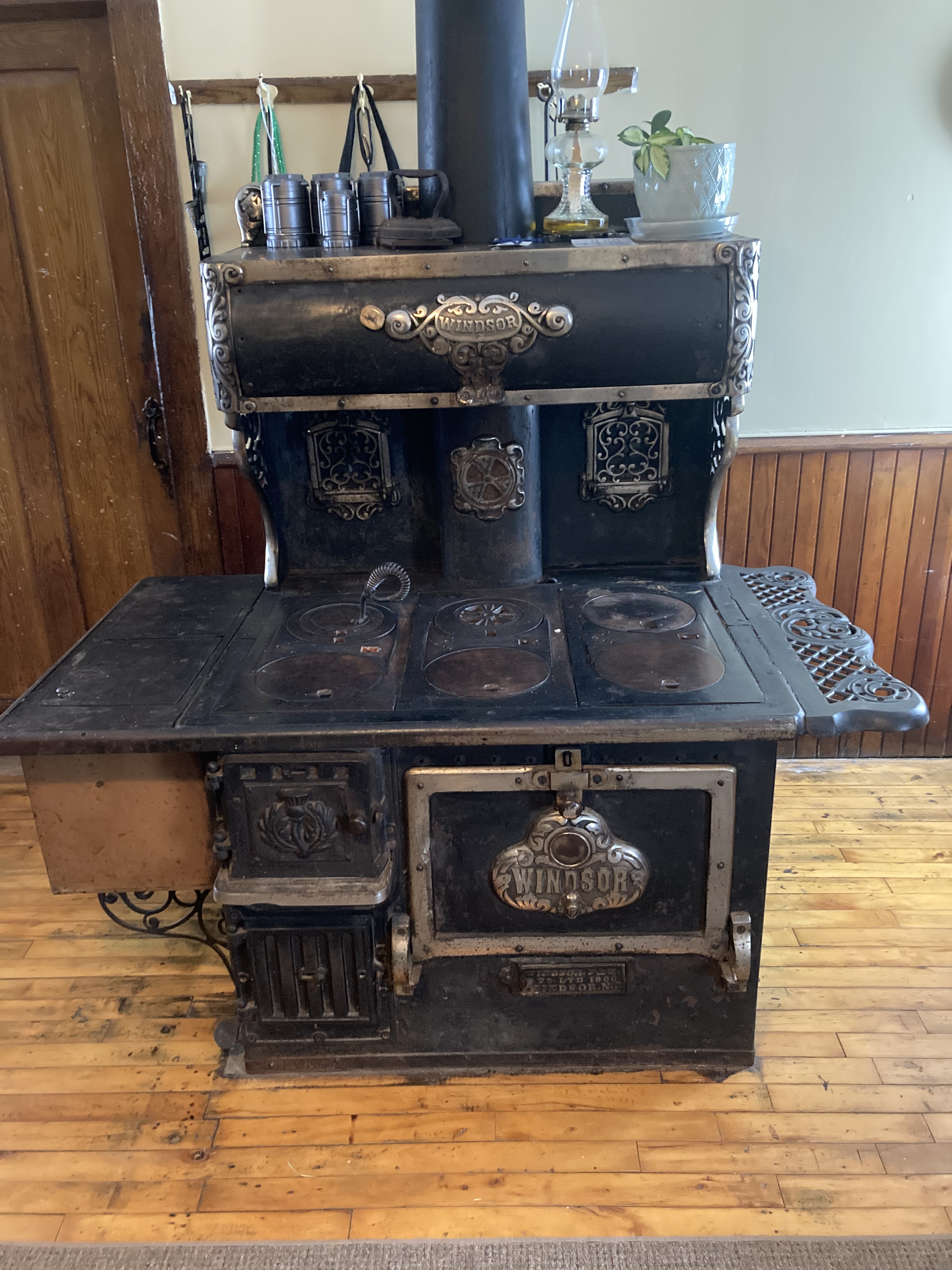
My father came to the John Will farm in 1980 with a “rent to buy” agreement and the formal sale was finalized within a few years. My siblings and I were always sure that Dad would eventually purchase the farm as the “out kitchen” contained a huge wood stove with a raised thistle design on the firebox door. Dad was very proud of the Ferguson crest with its thistle and a bee on the blossom. Alice Sutherland MacKay (the daughter of John Sutherland & Mary Henderson and was the mother of Dan MacKay) remembers that when she was a small child all the neighbours came to see the MacLeod’s wondrous new stove.  Alice would have been a very young child. The stove was built in Windsor, Nova Scotia in 1906. It had a metal receptacle attached to the left of the firebox to create and hold heated water for washing. Imagine the magic of having warm water at the ready without the hassle of large pots on the stove!

As previously posted, a portion of the farm to the south was given to Donald & Barbara’s son William and his wife Georgena (gravestone spelling) Sutherland and then passed to their son George (Geordie) and his wife Anna Ferguson.  Anna was a daughter from the Big Sandy Ferguson & Elizabeth MacKay family of the Ferguson Brook Road.  Elisabeth MacKay’s mother was Janet Ferguson, a sister to my great-great-great-grandfather Alexander Ferguson (wife Mary Gordon) of Spiddle Hill who also had immigrated to Nova Scotia from the Parish of Clyne in Sutherlandshire around 1821. This means I have a “cousin connection” to the property.

Not only the MacLeods, but the women they married (Gunns, MacKays, Sutherlands and Fergusons) were from Sutherlandshire and were Highland Scots.  These people were not very far removed from the ways and traditions of the old country as they established themselves on their land.  Highland Scots of this time period were known to be strict church adherents but there was also a strong streak of the old superstitions, a love of ghost stories and tales of those who possessed the second sight (such as my great- grandmother, Christena Gunn Ferguson).  The renovation of the two houses revealed a piece of this tradition.

 The first house I will talk about is the one we currently live in. We believe this house may be the second home built on the property by William & Georgena. Most couples starting out built a small house and as fortunes improved would build a larger structure for their growing family. In the 1871 census, they are living in a separate dwelling from William’s parents and have two children plus a Margaret MacLeod living with them.  I am making a guess that this was William’s unmarried Aunt Margaret (the 1871 census has her age at 69 and born in Scotland).  The early residents of The Falls were no strangers to tragedy. Sadly, Georgena died less than three weeks after giving birth to Geordie in 1886. It is probable that Geordie was born in this house

During renovations of the house we found two newspaper sheets in the walls that dated from 1885. It is possible that the newspaper could have been added at a later date to the house but how it was placed in the wall would make this seem unlikely. There were also some pieces of newsprint recording the prime ministers of England ending with Mr. Gladstone who served until June 1885.  On the back of this paper are some written notes listing the duties of a school trustee and a partial sentence about the “…attempt to establish a school”.  I wonder if this was the foundation for establishing the school at The Falls. An inquiry to Glen revealed that a school was in two former nearby locations before the present site. The final location also resulted in a new building constructed around 1896.  There were also some math calculations on a ragged piece of paper with Jessie Hayman written on the back.   

We were gutting the house to install new wiring and insulation when my husband, Rémi, called for my help. He was tearing out the inside wall boards of the house (neither of the MacLeod houses had lathe and plaster but instead had wide horizontal planks for walls).  He had found a small bottle, similar to a vanilla bottle in size, in the wall above the window.  The bottle was very dirty and had some dried “gunk” coating the inside.  I took the bottle and rinsed it out.  The drained water was stained a reddish yellow colour.  I put more water in the bottle and gave it another swish and out came more discoloured water and a feather.  I surmised that this must have a meaning.  I walked up the hill to get some service for my cell phone and Googled “bottle with a feather in it found inside an old house”.  Straight away up popped “witches’ bottle”.

In Scotland, Ireland and the rest of the British Isles, there is a tradition of putting witches’ bottles in a hidden spot in the house to, of course, keep witches away.  A bottle would usually be filled with personal items such as hair, nail clippings, thread, buttons, iron nails, or as in our case, a feather.  The vessel would then be topped up with either urine or blood and closed up inside the house.

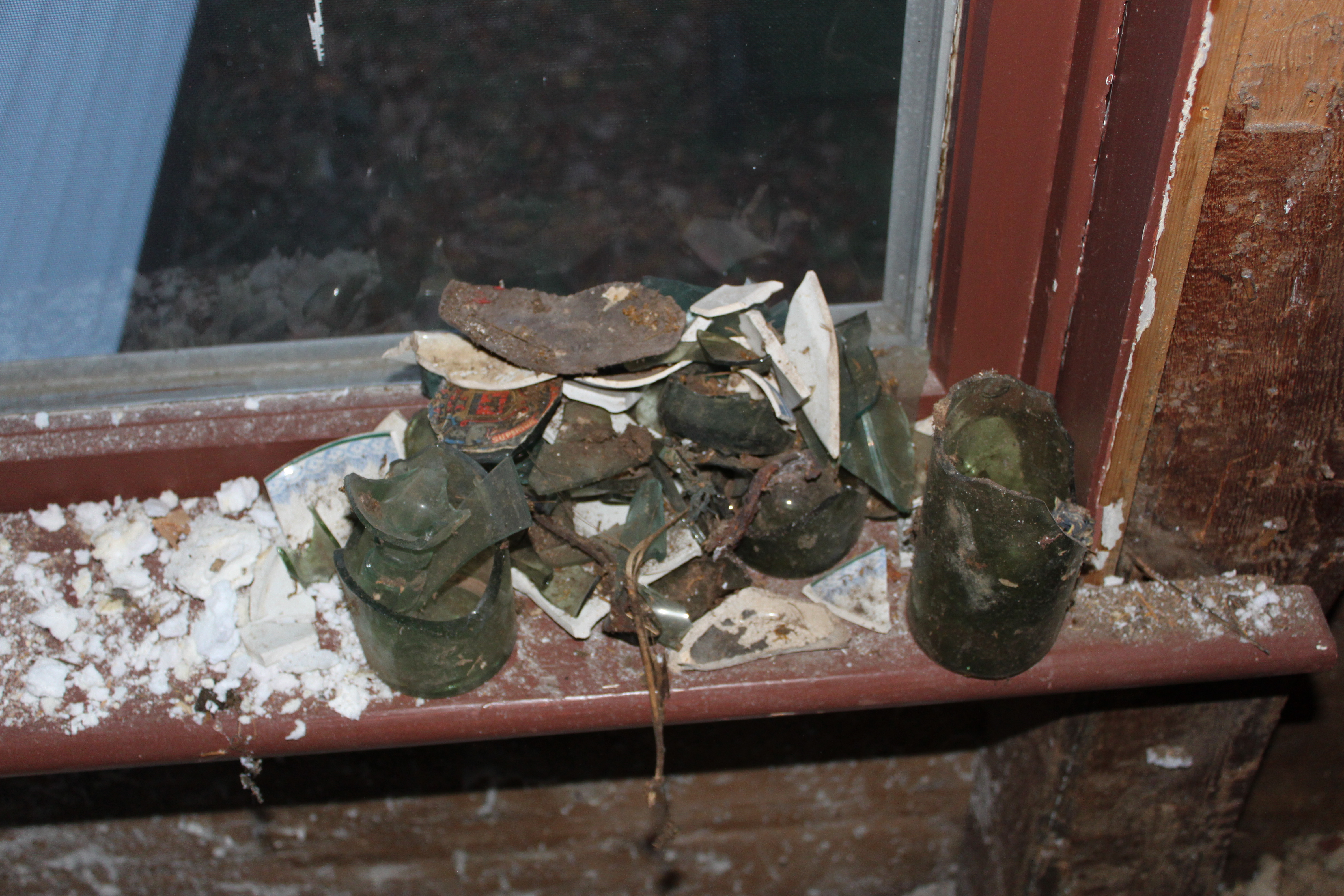
My next call from Rémi was to come and help him remove a vast quantity of broken glass and chards of crockery above two other windows.  There were two intact glass bottles but the rest was just a mess of broken bits.  Pieces of the crockery showed that someone liked pretty dishes with lots of blue and white and some of the red and white transferware that I am partial to.  The glass and pottery were certainly deliberately placed above the windows top sill. Mixed in with the glass were items of clothing and some papers.  The clothing seemed to be small such as children’s clothing would be.  The cloth was in complete tatters as mice and squirrels had used them for nesting materials so we burned them.

Next came the footwear.  There were three complete pairs of shoes and parts of one or two others.  The three pairs we could identify were of a man’s, a lady’s, and one small child’s copper- toed shoes. These are called concealment shoes. The shoes are supposed to protect you.  Sometimes it might only be one shoe that you find.  One theory is that the sole of a shoe is basically the symbol of your soul.  The imprint your foot makes in a well-worn pair of shoes is very personal and considered powerful.  No other piece of clothing moulds to your body the way footwear does.  Concealment shoes are usually found near openings to the house such as windows, doors, and fireplaces.  They can be found under the hearth or in old wall bread-ovens. Ours, as I said, were all found above windows. 

The shoes can also be a fertility charm.  Remember the very old tradition of throwing slippers at newlyweds? That tradition morphed into stringing shoes to the bumper of the honeymoon car in later generations.  In Lancashire County, England, there is a tradition that women who want to get pregnant try on the shoe of someone who has just given birth.  However, it seems most historians adhere to the theory that the main reason for concealment shoes was for protection.  In Scotland and England, brownies and hobs were domestic fairies and could be gotten rid of by the gift of clothing.  Perhaps that is why there was clothing in the wall.

The earliest known concealment shoe comes from 1308, and was found in Winchester Cathedral behind choir stalls that records show were installed during that year.  The shoes have been found in many types of buildings-from humble homes to grand country houses, inns, factories and two Oxford colleges.  The tradition is mostly British but the shoes can be found in Australia, the New England States, Germany, and, of course, here in Canada.  There is a museum in Northampton, England, that maintains an index of concealment shoes which stands at over 2,000 reports.  The practice of concealment shoes seems to have died out around the late 1800s and early 1900s.

We also found a metal button, a metal fork with a wooden handle, a small iron shoe-last (the form used to make shoes), and a piece of ornate iron that looks like it came off an old woodstove.  Iron is thought to ward off or provide protection from devils, fairies, spirits and witches.  I remember this from Helen Creighton’s book Bluenose Ghosts and other publications on folklore that I have read. Iron horseshoes were particularly powerful and still today are hung over the entry way to a house or barn (always hung like a U to keep your luck from running out!). Folklore suggests witches and spirits do not like to pass through iron.  That is why iron fences were put around graveyards to (hopefully!) keep spirits in.

There were also some wooden items: a stave from a wooden bucket, a piece of moulding like that of a chair rail, a wooden spoon, a piece of tree root (that might have been used as a binding for a bucket or small cask), a long twig (which my Uncle Ralph wonders might have been used for water divining), and a small wooden child’s shoe last. We found pieces of harness, leather and nails. 

The oddest item we found was a wooden bedpost placed upright between the studs in the wall near a window.  The carving of the bedpost had not been completed. The question is why wasn’t it finished? There seems to be something about unfinished items put in the walls although I could not find anything in a Google search about this practice. We have friends in New Brunswick who found a concealment shoe and with it was a piece of unfinished embroidery sampler with the needle and thread still in place waiting for the woman to come back to complete it.

In all, we had one heaping laundry hamper plus the bed post found in the walls.

Our story continues.  A few years later, I was cleaning up the shards of glass and bottles for a presentation and I came across one of the intact bottles.  It was dirty but I could tell no strange liquid had been left in it although there was some dust and debris in the bottom. When I washed out the bottle out dropped a lump.  It seemed to have a backbone.  On closer inspection it was a small bat. I believe this was also a witches’ bottle as there was no evidence of bats having ever been in the house.

We started the renovation of my father’s house (the house of Donald MacLeod & Barbara Gunn) in 2017.  We believe this house was built around the mid-1800s.  The windows were made with wooden pegs and the window glass was very wavy.  The boards used for the walls were much wider than those in our house of circa 1885.   The timber beams in the basement are hand hewn.

Above a bookshelf on an outside wall beside a window we found some more items: a horseshoe, wooden lady’s shoe last, broken glass and crockery, part of a horse bit, wooden thread spools (which were invented in Paisley, Scotland, in 1820), pieces of wood, bones, wooden tool bits, a hammer, a clasp for suspenders, and metal hooks.  We have not torn out the walls over the windows so who knows what else lies hidden behind the walls!

I have talked to some other people in the area who have also found items in the walls.  I knew someone who owns the Gavin Bell farm in West New Annan who was going to do some renovations to the house. I suggested he keep a lookout for items hidden in the walls.  Over one of the doors to the outside he found a large iron key.  Again the key was completely sealed into the cavity so it was not likely it was a key someone was expecting to use. This would indicate that those who settled from the Dumfriesshire area of southern Scotland also partook in these traditions.

To finish off our story, in William & Georgena’s house put some items back into the walls.  They will stay on the property and I have some objects displayed in a cabinet such as the witches’ bottle and some crockery.  When we built the addition on our house we placed a pair of our daughter’s ballet slippers and sneakers belonging to our boys underneath the west windows.  We did this to honour the tradition of the house and, since to date we haven’t seen any witches or nasty spirits “out and about” in The Falls, it must work!

Witches, Goblins and the Grim Reaper

(In a forthcoming post, a subscriber will be sharing her discovery of various artifacts during a renovation of her properties at The Falls.  Before posting her very interesting research, it might be useful to review the topic in general as it relates to the district).

In 1727 in the shire town of Dornoch in Sutherland, Janet Horne made history as the last witch to be executed in Scotland.  To put into local perspective, the spectacle of this execution was likely witnessed by some grandparents of the early settlers to Earltown.

Janet Horne was likely not her real name.  It was a title of derision applied to presumed witches and others living outside the norms of the times.  She was a one time maid originally from Loth to the north of Clyne.   Her neighbours, for motivations unknown, accused her of turning her daughter into a pony and having Satan shoe her.

In real terms, Janet was likely suffering from what is now known to be dementia and thus living in an alternate reality.   The daughter was said to suffer from physical deformities of the hands which may have had a likeness to hooves.   Both were arrested on suspicion of witchcraft and tried at Dornoch. Unfortunately the magistrates, who were no more enlightened than the general population,  found both women guilty and ordered that they be burned to death the following day.

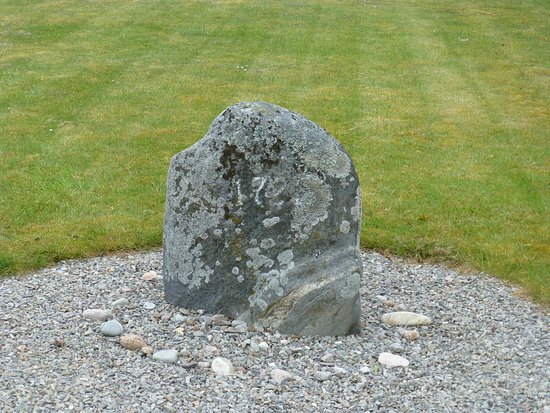
The stone marks the spot in Dornoch where Janet Horne was executed on charges of witchcraft. It is inscribed 1722 but correct year was 1727

The daughter mercifully escaped but Janet, as a result of her natural confusion, made no effort to follow.  On the appointed day she was stripped naked, covered in tar and paraded through the town on a barrel.  Before a large assembly, she was set on fire at which time she smiled and said that was “bonny warm”.   Whatever the theatrics of the event, it was a gruesome event.   Nine years later it became unlawful to execute anyone for alleged witchcraft.

Because it was unlawful to prosecute supposed witches, it didn’t mean such accusations didn’t persist for many years and the concept migrated with the Scots to Nova Scotia.

Patterson’s History of Tatamagouche makes mention of the persistence of witchcraft beliefs during the 19th century in North Colchester.  He recounts the cherished story of  Mrs. Mac, a old lady generally believed to have been a witch.   Mrs. Mac went to her neighbour Mrs. M to procure pigs and was annoyed that the pigs on offer had already been sold.   Likely there was a regrettable exchange before Mrs. Mac went home.   That evening  Mrs. M’s milk cow went inexplicably dry leading to the conclusion that Mrs. Mac was extracting revenge through the cow.   Mrs. M was not to be put off by this devilment and conjured a remedy whereby she boiled a sod of grass that the unfortunate cow had grazed.  The sod was tortured with pins.   The cow miraculously returned to production.   Later neighbours visiting Mrs. Mac reported that the old lady was nursing sore feet that were inexplicably scalded.   And from there the tale continued with its embellishments.   Patterson in 1917 wisely spared the surviving children embarrassment by not publishing the name but descendants assured me the alleged witch was Margaret MacKay “Black”, wife of Jim “Tailor” of Balfron.   [1]

On a related note, the late Dick Gordon of Golspie, Sutherland, told me several stories of underperforming milk cows being bedeviled by witches who often took the form of hares.

Another story told around The Falls pertained to Laughing Christy.  The daughter of an overzealous catechist, Christy was a bit of a rebel and never shy with opinions.   On one occasion she and her husband Sandy were visited by the local tax collector, Strachan Mackay.   Like present times, nobody enjoyed their interaction with the tax man.   After a tense visit, MacKay prepared to leave with his horse and wagon when Christy inquired about how many horses he owned.  MacKay replied that he had three of the finest horses in the district.   Christy replied that one or more would be dead before long.   A few days later one of the horses died or, as some versions proclaim, all three died.   Perhaps she knew her horses but the local consensus was that it was witchcraft.

Another story tells of Christy asking a neighbour for a ride home from The Falls church in his horse drawn carriage.  The request was denied because, to be polite, she didn’t meet certain standards of hygiene.   In retort, Christy hoped they would have to walk just like her.   As one would expect, the horse died in the shafts a short distance up the road.

Every culture has ghosts and the Gaidhealtachd of Earltown was no exception.  There are scattered stories of the sightings of  deceased relatives or strange sounds in certain buildings were death occurred.   (That was every house as there were no hospitals or nursing homes in those days).  Vacant houses, which abounded in the early 29th century, were venues for the imagination to run wild.   Strange lights have appeared in the area cemeteries at night.   Murray’s Cemetery, remote and spooky at the best of times, is said to be the scene of floating objects.   That can probably be explained as fog rising from the nearby river and swamps. 

Bluenose Ghosts by Helen Creighton recounts a dramatic scene on the night that Dump MacDonald took leave of this world.  He had been ailing of influenza and was nearing his end. A group of neighbours assembled to assist Mrs. MacDonald as Dump was a big man and difficult to manage.  While eating some pablum, Dump took to staring at the wall before suddenly rising from his bed, yelled and fell back dead.   At same time the upstairs of the house shook violently followed by a gust of wind that  blew off the henhouse door with the result being a hail of chickens hitting the house windows.  Various phenomena was experienced in the house and a man believed to be Lucifer was spotted in a window.  This story was given to Miss Creighton by John George Ferguson of Bayhead whose parents were living at Central Earltown when these events occurred.

John Dan Ferguson of Balmoral and Bayhead  shared the story of a recurring ball of fire that used to rise over Spiddle Hill at Ross’s Rock.   It was called Ross’s Torch but didn’t seem to be an omen of anything in particular.   When the Ross family moved to Wallace, the Torch was no longer seen.  It should come as no surprise that  Mrs. Ross was a sister of Laughing Christy.[2]

Complementary to the belief in such things, there were measures taken to protect a household from witches and unsavoury supernatural experiences.   Stay tuned for a future post by Joyce Ferguson on Concealment Shoes and Witches Bottles………….


[1] Patterson, Frank H.,  History of Tatamagouche, Royal Print and Litho, 1917

[2] Creighton, Helen Bluenose Ghosts,  McGraw-Hill Ryerson, 1957